
Eurozone disunion — a perspective view
K B Ahmed | Wednesday, 11 February 2015
The recession of the late 2000s has spurred a sovereign-debt crisis that infected several countries exposing weaknesses in parts of the eurozone, a region once lauded as an example of effective currency integration. Greece, Ireland and Portugal have all found themselves unable to pay their debts and have sought external assistance. Disquieting political, regulatory, and economic differences between the eurozone's member states explain how some nations can remain fiscally sound while others teeter on the edge of default. Greece's appalling financial data has cast doubt over the standardisation of finance-related laws in the eurozone; weakness in Italy, the zone's third largest economy, mirrors productivity issues in the rest of southern Europe; and Ireland's inability to pay back its debt raises concerns about the stability of EU members hitherto considered secure.
The sovereign-debt crisis has resulted in bailouts amounting to €750 billion to date that have saved all of the affected nations from default. While thus far only the three aforementioned nations have received funds, many are concerned that the same fate may soon befall the larger economies like Spain and Italy. Germany has emerged as a bastion of sound economic policy during the crisis and as a result, the eurozone's largest economy is now also its largest donor. Jan Fleischhauer, a popular German journalist, claimed in Der Spiegel that Germans have become the "America of Europe," referencing the United States' role in post World War II reconstruction.
As a result of the recent financial crisis, Greece and Ireland are facing difficulties with the terms of European economic and monetary union. Since these smaller economies are unable to devalue the currency in order to regain economic competitiveness as members of the single currency, they are recognising that the eurozone's economic structure may not adequately address their national economic vulnerabilities during times of crisis. Because of this and the worsening economic conditions in both Greece and Ireland in 2011, it can be hypothesised that these states are "fraying" the edges of the eurozone, or increasingly degrading the eurozone's specific economic relationships, and are demonstrating this through a growing scepticism of economic benefits to smaller, weaker economies as members of the zone.
"The European Union is possibly the most ambitious attempt at supranational organisation in history. The original idea was "that rival nation states can do better by pooling some sovereignty instead of going to war" (The Economist, 2010c, p. 1). As the idea developed, it became clear to those states participating in the original integration project that political union should be the ultimate goal in the search for both political and economic stability.
Of course, no sovereign state was willing to irrevocably cede power from its own government. Union became an ever-evolving process that began with economic union. Because of the 2008-2011 financial and economic crises, the current economic and monetary union has come into question given the difficult economic conditions faced by the eurozone's smaller economies", wrote Sara F. Taylor, Virginia Polytechnic Institute and State University.
A significant part of Germany's growth has been driven by the eurozone. Favourable conversion exchange rates upon introduction of the Euro artificially increased the purchasing power of countries like Italy, Spain, Portugal and Greece. The common currency led to a dramatic fall in interest rates in weaker eurozone members as well as over time a compression of credit spreads. No longer exposed to the risk of devaluations, a persistent feature of the post war economic history of Southern Europe, lenders lent generously to these countries. Debt fuelled consumption and investment drove growth.
German exporters were major beneficiaries of this growth. German banks and financial institutions helped finance the growth. It was the European version of Chimerica, where China financed American buyers of its products by lending back its trade surpluses.
German exporters also benefited from a cheap euro, receiving a significant subsidy because of the inclusion of weaker economies such as Italy, Spain, Portugal and Greece in the common currency. This cost advantage assisted German export performance, especially in emerging markets in Eastern Europe and Asia.
Greece was not the right candidate and not prepared enough to join the eurozone for many reasons. One was that over about four hundred years of Ottoman occupation, Greece was left with no institutional self-governance and during the Nazi period whatever infrastructure it had was destroyed by both the Nazis and by the advancing allied forces. Greece, as such, had no tradition of manufacturing and no investments were made in revenue generation from the meagre support it had received from the Marshall Plan unlike Germany or Holland. Following the World War-ll, when a democratic governance was initiated, the left leaning (neo-Communists) came to rule which was opposed by the US, and CIA engineered a coup d'état to bring the Army to rule the country. During the Army rule, the economy was dependent on foreign aid, mainly from the US, and no investment was made in industry or for income generation. When Greece joined the eurozone, the only thing going for them was tourism which had to compete with Spain, France, Portugal and Italy. Greek wine which was once a pride to the ancient Athens, lost ground to other producers due to lack of investment and modernisation. When eurozone opened up the opportunity to borrow money in a big way, Athens had no idea what to do with it and did not realise that come Monday it had to be repaid. They made no investments in industry, importing technology or in skill development; instead they built roads by the cronies who were close to the rulers. This caused the ramshackle of the country's economic state. Now, Greece wants forgiveness of their debt and with it new money to keep the nation afloat.
Like most of the Latin nations in Europe, Greeks think repayment of debt and paying taxes to the government is an Anglo-Saxon idea and therefore not relevant in their personal and national life. The idea of a chaotic Greek departure from the euro at a time of Franco-German disunion should terrify everyone it touches; the damage it would do to the world economy could well be the biggest risk to Obama's of re-election. With so much at stake, the rest of the eurozone urgently needed to lower the risk that contagion from a Greek exit would infect Portugal, Ireland and even Spain and Italy. The worry was that, just at the moment when hard-headed real-politick was needed, politics had fallen prey to self-delusion, with leaders in all the main countries peddling seductive half-truths that promised Europe's citizens an easier way out.
It was worst of all in Greece. The half-truth in Athens was that bigoted northern Europeans give Greeks no credit for the hardship they have borne. Greece really had suffered: between 2007 and 2012 its economy is expected to have shrunk by almost a fifth. The economy is being strangled by a severe credit and liquidity crunch, with more budget cuts and tax rises to come.
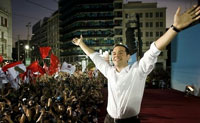
The Greek people have spoken and delivered a resounding no to Germany, Tsipras argues. He is quietly supported by France's François Hollande and Italy's Matteo Renzi, both of whom argued for "a Europe moving in a different direction" but who were reluctant to pick a fight with Merkel openly and hoped Tsipras could tilt the balance of power in their favour. Tsipras might help in the short-term to challenge Merkel. But the Germans are far from alone in stressing the primacy of cuts, sound budgets, lower borrowing and structural reforms as the solution.
"The rest of Europe cannot finance Tsipras's election pledges," reported, Martin Schulz, the president of the European Parliament, after being the first senior EU figure to see the new Greek prime minister in Athens last week. Almost everywhere the positions are national. These unresolved differences between countries are poisoning the politics of Europe. They can easily and quickly shift into nationalism.
This narrows room for manoeuvres on what to do about Greece and will trigger caution about making too many concessions because the Greek dilemma might escalate into something much bigger. If German public opinion joins much of the rest of Europe in turning against the EU, Merkel's leadership will be questioned and tested as seldom before.
Does that mean Greece is still better off in the eurozone? Probably, though the judgment gets ever finer. An exit, and the ensuing default, would lighten its debt, re-establish competitiveness and challenge its politicians to grasp their own destiny. Yet leaving the euro would also create chaos and destroy savings and, as often in the past, its advantages might rapidly inflate. The rest of the eurozone is also better off with Greece "in", if only because of the risk of contagion; and the inadequate preparations for that. After five years of austerity, the European Union is today inflicted by cultural, political and, increasingly, nationalistic divisions.
The writer is an economist, business consultant, President of Bangladesh-Myanmar Chamber of Commerce & Industry (BMCCI). kbahmed1@gmail.com