
Exiled Tibet PM accuses China of blanket repression
Friday, 6 June 2014
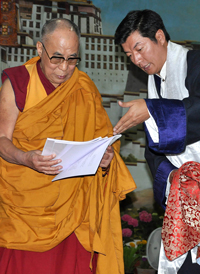
DHARAMSALA, June 5, (agencies): The prime minister of Tibet's government-in-exile accused Chinese authorities Thursday of blanket repression in the Himalayan region as he launched a new campaign for autonomy in his homeland.
"There is total repression and total discrimination" in Tibet, Lobsang Sangay told reporters at his government's headquarters in northern India.
"All this repression is making Tibetans more resentful of the Chinese government's policies and towards the Chinese government and various forms of protests are taking place."
The leader of Tibet's exiled government accused China Thursday of blanket repression in his homeland and warned that resentment over its rule was growing as he launched a new campaign for autonomy.
Speaking as he and other senior exiles, including the Dalai Lama, renewed their push for a "Middle Way" of peaceful autonomy within China, Lobsang Sangay called for more international help for the Tibetan cause.
The Dalai Lama, who is the spiritual leader of the Tibetans, said there was no shortage of commitment from the exiled leadership but added that patience was needed to produce results.
"There is total repression and total discrimination" in Tibet, Sangay, who is the Tibetan government-in-exile's prime minister, told reporters.
"All this repression is making Tibetans more resentful of the Chinese government's policies and towards the Chinese government and various forms of protests are taking place," he added at his government's headquarters at a hill station in northern India.
Sangay took over as the political leader of the Tibetan cause in 2011 when the Dalai Lama-a Nobel prize-winner who has long been accused by China of being a dangerous separatist-pared back his roles.
But Beijing has continued to resist calls by US President Barack Obama and other Western leaders to resume talks with Tibetan officials on autonomy that broke down four years ago.
"We advise these people to give up their attempts to separate Tibet from China," foreign ministry spokesman Hong Lei told a regular press briefing on Wednesday.
China has governed Tibet since 1951, a year after invading, and considers the Himalayan region an integral part of its territory which has prospered under its rule.
The Communist Party government held nine rounds of dialogue with the Dalai Lama's envoys from 2002 to 2010 but the process produced no visible results.