
Expansionary amid austerity, inflationary pressure
Govt borrowing from BB to stoke inflation, from banks, to worsen liquidity crunch, economists foresee such double bind
JASIM UDDIN HAROON | Friday, 2 June 2023
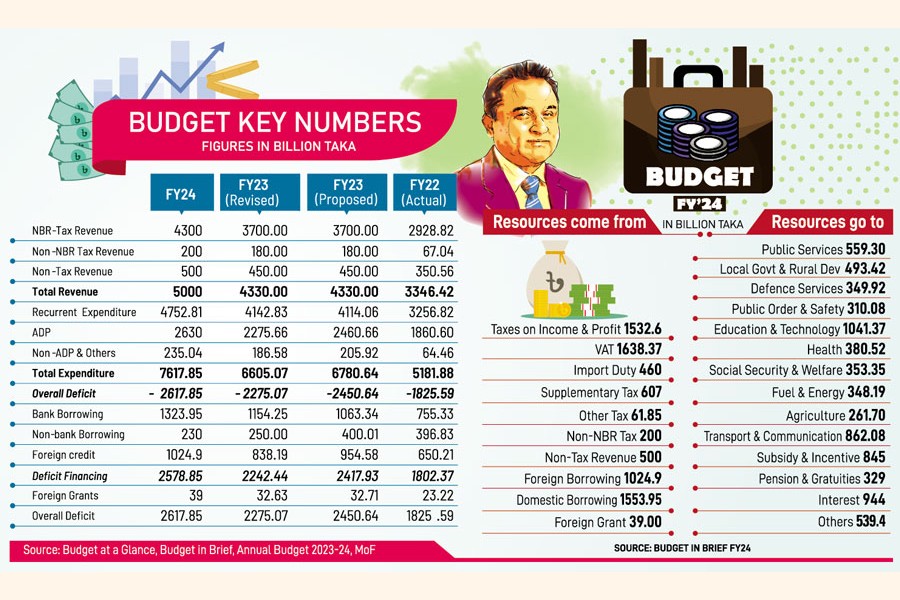
 An annual budget of Tk 7.62 trillion for Bangladesh is not that big given the size if its economy, but managing the money by taxing and borrowing will hurt commoners harder amid pinching inflation.
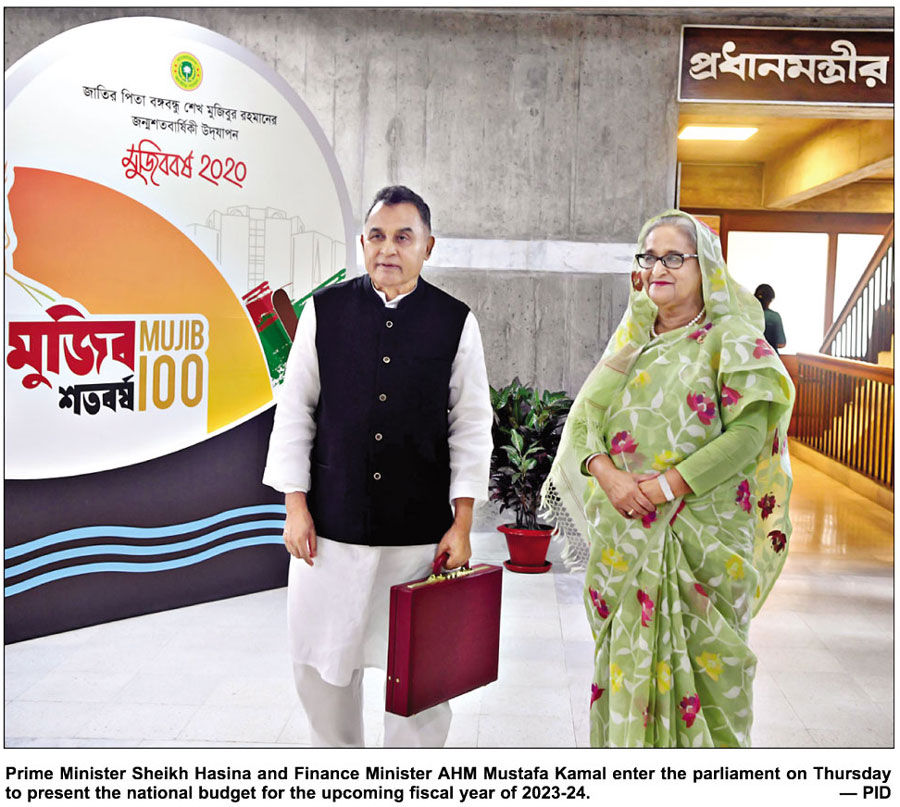
Economists and analysts — leave aside political opponents — see such paradoxical situation as the government of Prime Minister Sheikh Hasina, who is serving her third straight term and faces polls in months, placed in parliament Thursday this national budget with a substantial deficit funding.
The government estimates aggregate revenue earning worth Tk 5.0 trillion to be pooled from taxes and non-tax sources. The arithmetic leaves a deficit of Tk 2.62 trillion, which has to be managed by borrowing from home and abroad.
As foreign funding has been drying up in the context of lingering global crises stemming from the pandemic and the Ukraine war in lockstep with the pandemic coronavirus, recent trends show the government takes recourse to borrowing from domestic sources to make up for the budget shortfall. Here is a double bind for the government, as economists point out.
Two main sources are there for the domestic debt: banking system and the central bank. The country’s banks reportedly suffer from liquidity shortages for deposit squeeze for limited economic activity and job situation on the one hand and price spiral of consumer goods. As such, higher government bank borrowings create crowding-out impact on credit flow to private sector and hence contraction in production and job creation with their cascading effects.
On the other side is the option for borrowing from the central bank. “And banking on the Bangladesh Bank means printing money,” say economists by one voice. This ‘high-powered money’ fuels inflation, they say, citing the inexorable price rises in Bangladesh while inflation has been ebbing down in the West, and even in neighbouring India.
Economists say an expansionary budget placed Thursday for the fiscal year (FY) 2023-24 may fuel up the ongoing inflationary pressures on the economy instead of containing it.
Bangladesh’s economy has been facing macroeconomic instability on two counts — stubborn inflation and depleting foreign-exchange reserves.
Finance Minister AHM Mustafa Kamal unveiled his fifth budget with the claim that it has been crafted as “people-friendly budget” aligned with the vision of building up a “happy, prosperous and developed smart Bangladesh” by 2041.
The country’s annual fiscal blueprint, styled “Towards Smart Bangladesh Sustaining the Development Achievements in a Decade and a Half”, is deemed expansionary in the sense that the deficit is much wider in absolute terms, and in terms of the GDP, it is 5.2 per cent against the revised estimation at 5.1 per cent.
To feed the budget, Mr. Kamal relies on increased bank borrowing amounting to Tk 1.32 trillion. The bank-borrowing target is up by nearly 15 per cent from the revised budget estimation. The government has a target of total borrowing at Tk 1.55 trillion from domestic sources.
But borrowing largely from the central bank instead of commercial banks may emerge as “toxic” for the economy as it will help spike inflation as the central bank money is ‘high-powered money’ having multiple adverse impacts on the money market.
The inflationary pressures will be lower once the government borrows mostly from commercial banks as Mr. Kamal in budget speech mentioned that current challenge is to control inflation, improve the current-account balance and stabilise the foreign-exchange rate.
Contrarily, the finance minister says due to the decrease in the prices of fuels, food, and fertilizers on the global market, along with the adjustment to fuel prices on the domestic market and government initiatives to keep the food and supply systems normal, the inflation will remain much controlled in the next fiscal year and the annual average inflation is expected to stand at around 6.0 per cent.
The finance minister aims at getting funds worth over Tk 1.0 trillion from external sources but this seemed to be “ambitious” as the country cannot utilise the borrowed money for lack of structural reforms.
The World Bank (WB) under a budgetary support would like to extend financial support to Bangladesh over $1.0 billion but it also necessitates conducting structural reforms.
On resource mobilisation, the finance minister has a target of collecting Tk 5.0 trillion during FY 2023-24.
To get by, he seeks increased resources from indirect taxes, for example, VAT, on many goods which will also fuel up inflation on the economy now facing higher inflation almost over the past one year.
The finance minister eyes environmental taxes to be imposed on cars and higher taxes on tobacco products. The owners of second motorized vehicles will have to pay more taxes.
The widely used LP gas cylinder, software, plastic products, cement clinker, and electronic cigarettes may be pricier.
The list of a rate reduction of indirect taxes is comparatively smaller than the list of increase. Sweet manufacturing, handmade biscuits, locally manufactured fridges, washing machines, ovens, and locally produced agricultural machinery are proposed to be cheaper.
The tax-free income threshold has been widened by nearly 17 per cent to Tk 350,000 for FY 2024. And females and taxpayers above 65 years of age will enjoy a further higher ceiling—the threshold is raised from Tk 350,000 to Tk 400,000 for them.
“We want to harness all potentials of generating revenues,” Mr. Kamal told the House about how he would make ends meet by leapfrogging the odds and headwinds.
People needing to give at least Tk 2000 as mandatory tax while submitting returns if to take specific services is another pain amidst the stubborn inflation.
Around 3.2 million people submitted returns last year, against around 8.0 million TIN-holders. The rest used to take tax-identification number or TIN for various purposes.
The annual development programme or ADP in the total budget outlay is up more than 15 per cent over the revised budget estimation. It should have been downsized considering the lower mobilization of taxes and possible global recession, according to some leading economists.
They also said another component – a subsidy of 11.1 per cent of the budget estimation—should have been lowered to maintain austerity in the current challenging time.
Bangladesh’s economy has achieved average GDP growth during the last 14 years more than 6.7 per cent but now it is estimated at 7.5 per cent for FY 2024.
“To achieve the growth target, we will gradually come out of the contractionary policy and invest in ongoing and new growth-inducing projects, including the megaprojects,” the finance minister mentioned in his speech reflecting government aspiration for a march on higher trajectory matching the country’s LDC graduation.
Mr. Kamal also said for this purpose, the budget of the next fiscal year –FY 2024 — has set a higher target of raising the public investment to 6.3 per cent of the GDP.
There is a good move for the local market-oriented manufacturers as the finance minister has proposed to protect such industries from open-market competition.
But there is no change in slabs of corporate taxes.
The allocation for social-security programmes (SSP) has been augmented. A sum of Tk 1.26 trillion has been earmarked for the social-safety-net recipe, up by 16.58 per cent or 2.52 percent of GDP.
Under the SSP the number of elderly beneficiaries will increase from 5.7 million to 5.8 million. The monthly allowance will be raised after many years from Tk 500 to Tk 600.
The proposed budget for FY2024 has more or less influence of the IMF (International Monetary Fund) suggestions packaged in its loan.
As per the IMF suggestion, the proposed budget says the prices of electricity, gas, and fuels have been increased to reduce the subsidy expenditure.
The government has formulated a policy to establish a permanent system of formula-based price adjustments in the energy sector.
“We hope to finalise the formula-based price-adjustment system by September this year,” the finance minister told the lawmakers, mostly from the ruling Awami League and its allies and former allies-turned opposition.
In order to reduce the cost of supply and strengthen financial stability in the power sector, the government will phase out the payment of a minimum capacity charge by removing the clause of payment of minimum capacity charge at the time of contracting renewal of existing rental power plants or rent-operated power plants, according to the budget speech.
On a high note of optimism about a turnaround from the global –crisis-induced upset, the finance minister said they had begun preparatory work for building a ‘Smart Bangladesh’. There are four pillars of ‘Smart Bangladesh’: Smart Citizen, Smart Society, Smart Government, and Smart Economy.
The budget speech mentioned a ‘Smart Digital Leadership Academy’ has been established with the aim of making the people of the country ‘smart citizens’ donned with information technology.
Mr. Kamal rolls out a recipe for switchover to digital banking, as reports say the traditional banks are burdened with forged lending and loan defaults by big borrowers. Bangladesh Bank is working to work out strategies to broaden and accelerate financial-inclusion efforts through digital banks, he told the House.
“In FY2023–24, we hope to be able to launch a digital bank. At the same time, we are developing a machine-learning and artificial intelligence (AI)-based credit-rating system.”
With all this in command and in view, Mr Kamal hopes, it will be much easier to spot fake and anonymous borrowers, and at the same time, it will be considerably simpler for genuine borrowers to obtain loans.
jasimharoon@yahoo.com