
Experts urge careful review of govt school admission policy
FE REPORT | Tuesday, 17 March 2026
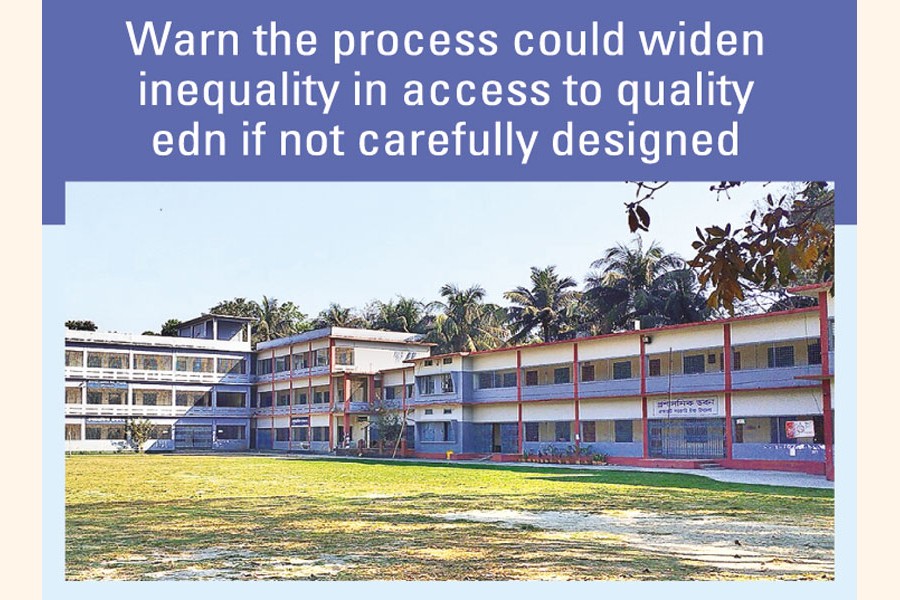
Education experts and policymakers have called for a careful review of Bangladesh's school admission policy, as the government considers scrapping the lottery-based system and introducing entrance examinations for government schools.
The issue was discussed at a policy dialogue in the capital on Monday, where participants warned that abrupt changes to the admission process could widen inequality in access to quality education, if not carefully designed.
The dialogue, titled "Education for Tomorrow in Light of the Election Manifesto: New Thinking, New Structure and New Initiatives," was organised by the Citizens' Platform for SDGs, Bangladesh at a hotel in Gulshan.
Rasheda K Choudhury, executive director of the Campaign for Popular Education (CAMPE) and a former adviser to a caretaker government, urged authorities to conduct a "reality check" before withdrawing the lottery-based admission system.
She said the government appeared inclined to abolish the system, but warned that any decision should be informed by ground realities.
Ms Choudhury questioned why the system was being scrapped when it had originally been introduced to address irregularities and intense competition in elite urban schools.
"Where is the lottery? It exists for the prestigious schools, not in the villages. So why was it introduced for these prestigious schools in the first place?" she asked.
According to her, the lottery system has helped create opportunities for disadvan- taged students, who might struggle to gain admission to reputed institutions.
Mahdi Amin, adviser to the prime minister responsible for the education and primary education ministries, said the government is considering replacing the lottery system with admission tests, citing dissatisfaction among parents.
Although the lottery was introduced to simplify admissions and reduce corruption, many parents now view it as opaque.
"Many parents see the lottery as a 'black box' system," Amin said, explaining that applicants often do not clearly understand how the selection process works.
He suggested that introducing examinations could increase transparency and competition in the admission process.
However, Amin emphasised that no final decision has yet been taken. The government plans to consult stakeholders and assess the potential impact on the education system before making any policy change.
He added that revising the admission policy is part of a broader effort to reform the education sector. Priorities include curriculum reforms, greater emphasis on technical and vocational education, reducing inequality in the education system, and strengthening technological skills among students.
During the discussion, Choudhury also raised concerns about possible political influence in school management committees.
Referring to a 2017 High Court ruling later upheld by the Appellate Division, she said individuals holding political party positions cannot be appointed as chairpersons of school managing committees.
"Education can be a political agenda, but it should not become a partisan agenda," she said, warning that she would return to court if the ruling was violated.
Responding to the issue, State Minister for Primary and Mass Education Bobby Hajjaj said the government is still working on policy guidelines and no final decisions have been taken.
He noted that in many communities local elders are often connected with political parties, making it difficult to find individuals completely detached from politics.
"From city to villages, you will see that local elders are connected with one political party or another. In that case, it would be difficult to find anyone entirely detached," he said.
Debapriya Bhattacharya, distinguished fellow at the Centre for Policy Dialogue (CPD) and chair of the session, clarified that the key issue is whether individuals hold official party posts.
"It is not about whether someone is connected. The question is whether they hold a party post," he said.
Hajjaj added that consultations with stakeholders would be held after Eid before finalising any policy decisions.
The dialogue also highlighted broader structural challenges in the education sector, particularly declining public investment.
Towfiqul Islam Khan, additional research director at CPD, said public spending on education has fallen to about 1.7 per cent of GDP, far below the 4.0-6.0 per cent benchmark. Actual utilisation of education expenditure declined further to around 1.3 per cent of GDP in FY2025.
Although successive policy documents have identified education as a national priority, budgetary commitments have weakened over time, he added.
bdsmile@gmail.com