
Export of apparel items to US declines, footwear and travel goods shine
Exporters say ME war uncertainty dents RMG demand in main destination
MONIRA MUNNI | Sunday, 5 April 2026
Main earner garment export to the US, Bangladesh' single-largest destination -- keep struggling amid demand drop, but footwear and travel-goods shipments recorded significant growth during the first two months of 2026.
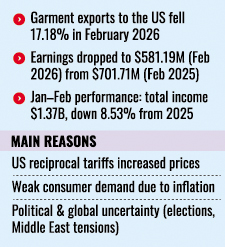
The country's apparel exports to the United States continued facing setback since the beginning of this calendar year, with a decline further by 17.18 per cent in February.
Readymade garment exporters attribute the fall largely to the impact of US reciprocal tariffs which enhanced garment prices and thus keeps eating up consumer demand.
And during the first two months of 2026, America's overall garment imports dropped by 13.47 per cent. But Vietnam, Cambodia and Indonesia gained despite the overall decline.
In February, Bangladesh earned US$581.19 million, in a fall from US$ 701.71 million in February 2025.
During the January-February period, Bangladesh's earnings from RMG shipments stood at US$1.37 billion, down from US$1.50 billion in the corresponding period of 2025. It marks an 8.53-percent fall, according to the Office of Textiles and Apparel (OTEXA), an affiliate of the US Department of Commerce, data released Thursday.
During the period, Bangladesh shipped 457.45 million square metres of apparel to the US, representing a 6.21-percent decrease, compared to 487.75 million square metres in the same period of January to February 2025.
Industry experts also warn that tensions involving the US-Israel war on Iran could create further uncertainty for the sector.
The OTEXA data reveal significant shifts in global apparel sourcing. Vietnam emerges as the top performer among major suppliers, followed by Bangladesh, recording 2.86-percent growth in export value to $2.70 billion and a 4.84-percent increase in volume to 790.23 million square metres.
Meanwhile, China that slipped to third apparel exporter to the US experienced a steep 57.65-percent decline in value to $1.17 billion and a 46.01-percent drop in volume to 823.26 million square metres.
India also faced headwinds, with exports falling 23.75 per cent to $728.92 million and volume declining around 20 per cent to 211.15 million square metres in the January-February period under review.
Overall US apparel imports contracted 13.47 per cent year on year to $11.73 billion during the first two months of 2026, reflecting persistent demand softness amid elevated inflation and cautious consumer spending.
Talking to the FE, Mahmud Hasan Khan, president of Bangladesh Garment Manufacturers and Exporters Association (BGMEA), said uncertainty surrounding new US tariff regimes dampened demand across manufacturing hubs.
"National elections also had a negative impact with buyers holding up certain portion of work orders over uncertainty," he says, adding though they expected a turnaround in export performance to the US after the tariff imposition, China and India are intensifying the competition on the EU market by offering aggressive lower prices.
Asked about the growth dynamics, he points to declining purchasing power in both the US and EU markets due to high inflation, hoping that the work-order situation might improve if the Middle East war eases.
Mohiuddin Rubel, deputy managing director of Denim Expert Ltd, says overall US apparel imports have declined, which has affected Bangladesh's shipments as well.
He also says the unit price of Bangladeshi garments exported to the US fell by 2.47 per cent, compared to 1.89 per cent for Vietnam, 21.56 per cent for China, 4.71 per cent in India and 0.13 per cent in Cambodia's case.
"Though China's massive decline creates a window of opportunity for Bangladesh, the country faces intensifying competition from regional rivals Vietnam and Cambodia," he notes.
Meantime, Bangladesh received US$72.71 million from footwear shipments to the US during January-February 2026, up from US$50.58 million in the corresponding period of last year, according to OTEXA data.
Earnings from travel goods stood at US$26.15 million in a 66.79-percent growth.
China's exports of footwear items to the US during the period declined by 53.29 per cent to US$804.45 million while that of Vietnam increased by 22.57 per cent to US$1.68 billion.
US travel-goods import from China declined by 50.53 per cent to US$209.14 million while that of Vietnam increased by 13.50 per cent to US$234.01 million, data showed.
When asked, Riad Mahmud, managing director of Shoeniverse Footwear Ltd, a unit of NPOLY Group, said the demand robustness did not decrease rather they are getting remarkable enquiries from US buyers.
"Buyers with specific requirement of certification are coming to Bangladesh," he says. Though overall global demand has slumped, the demand for footwear is rising.
He says despite the turmoil in global situation, they did not witness any order cancellation nor did they defer shipments.
As a strategic measure, he says, they encourage suppliers to make even early shipments by enhancing production efficiency by taking new measures like increasing manufacturing lines.
His company is also taking measure to hire foreign expertise, especially from China, to get knowledge and technological expertise despite a rise in cost.
Explaining the reasons for growth, he says orders are shifting from China from the labour-intensive sectors while Bangladesh has ample opportunity with huge labour forces and others.
Mr Mahmud says to increase local competitiveness, the government should come forward with sector-based measures like incentivizing or providing banking supports by identifying the sector-wise bottlenecks, especially related to transportation due to rise in fuel prices.
munni_fe@yahoo.com