
Extensive crop damage feared, marooned people in plight
Jubair Hasan | Tuesday, 26 August 2014
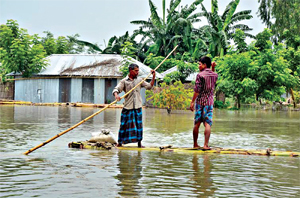
Overall flood situation deteriorated Monday in many parts of the country, mounting sufferings to tens of thousands of people and also extensively damaging cultivated aman and other crops.
Around 50,000 hectares of farmlands, mostly planted with Aman varieties, have been inundated in 12 flood-hit districts, according to the Department of Agriculture Extension (DAE) reckoning of the toll in the late-monsoon flooding.
Agriculturists have feared that the just-planted aman crops would severely be affected if the flood situation deteriorated further.
"A major part of the flood-hit crops will be affected if the situation does not improve within the next seven days," said Additional Director (Monitoring Cell) of Field Service Wing of the DAE Sunil Chandra Dhar.
He said over 50,000 hectares of cultivable land in 12 districts have now gone under water because of the floods. The districts include Kurigram, Gaibandha, Jamalpur, Sirajganj, Tangail, Bogra, Netrakona and Manikganj.
"Around 70 per cent of the inundated lands have been cultivated with broadcast Aman followed by 15 per cent planted Aman and the rest with vegetables," he added.
Fearing the damage to such crops, the DAE has taken some steps to help the farmers recoup the losses, Deputy Director (Monitoring Cell) of the Field Service Wing of the DAE Rafiqul Hasan said.
Under the initiative, they have sent a proposal to the ministry concerned for making a buffer seedbed in 100 acres of land from where different varieties of paddy could be distributed among the affected farmers, he said.
"We're expecting to get positive signal in two or three days from the ministry in this connection," he said. Meantime, the flood situation is deteriorating in the country as water was flowing above danger marks at 19 points of the Brahmaputra, Jamuna, Teesta, Surma and Dharla rivers, according to the Flood Forecasting and Warning Centre (FFWC).
River waters were flowing above the danger marks at 17 points a day before, according to the FFWC map counts in the wake of rain and onrush of water from upstream across the border.
The situation turned for the worst at Jariajanjail Point in Netrakona district where the water level of Kangsha River was above the danger mark by 1.47 metres while Shibganjdhalla River at Durgapur Point crossed the DM by 0.70 metre.
In the central parts of the country, water levels were on the rise Monday in major rivers, including the Padma, lower parts of the Jamuna, the Buriganga, the Turag and the Dhaleswari.
"In next three to four days, water will rise in the rivers of the country's central part," a sub-divisional engineer of the FFWC said.
Talking on the boon and bane that flooding could bring, agriculture scientist Dr MA Sobhan said the floodwater will be helpful for the Aman plants if it recedes in next few days. "Otherwise it will damage the just-planted crops." He suggested taking necessary measures like immediate arrangement for seedbeds so that the farmers can replace the affected crops with new ones when the water would go down the danger levels.
Besides, tens of thousands of people living in the flood-hit areas have been suffering from crisis of food, drinkable water and livable shelters as floodwater had washed away their belongings.
Talking to the FE, Disaster Management and Relief Secretary Mesbaul Alam said some 8,000 tonnes of rice and Tk 30 million in cash had already been allocated as general relief for the flood-affected people. He said they met with divisional commissioners on the flood situation and instructed them for ensuring equal distribution of the relief materials.
"There is nothing to worry as the ministry has adequate relief at its disposal to tackle any exigency," he said, adding that they have been closely monitoring the situation.
But, there are allegations that disbursement of the relief materials and cash support is inadequate against the demand as people in many flood-affected areas are yet to receive such relief supplies.