
Failed banks may hit other banks, disrupt economy
FE Report | Monday, 25 August 2014
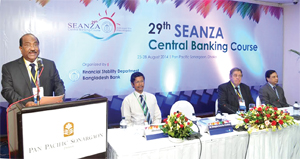
A senior central banker at a function in Dhaka Sunday cautioned that troubled banks could hit other banks and even disrupt the economy at large in a contagious effect if central banks and regulators cannot deal with such problems effectively.
Speaking at the inaugural session of a training course for central bankers from different countries, Deputy Governor of Bangladesh Bank (BB) SK Sur Chowdhury said central banks need to focus on identifying and addressing the 'domestically systemically important banks', generally known as D-SIBS, since they may transmit contagion risk to other banks.
"Their failure could cause linked failures of other banks and may even disrupt the real economy directly," said Mr. Sur, also chairman of the SEANZA Forum of Banking Supervisors.
He inaugurated the five-day 29th SEANZA (South East Asia, New Zealand, and Australia) Central Banking Course at a local hotel.
"Both individual D-SIBS and their regulatory authorities should develop their own contingency arrangements to handle any sort of banking crisis," the deputy governor said.
He said even in crisis situation, the most important task for the central bank is to maintain public confidence in the banking system and stem a run on deposits.
"It is the responsibility of the central banks to carry out prompt and preemptive actions with the best set of available information for dealing with rapidly changing conditions in the financial system," he observed.
He also said mutual efforts to promote the practice of information sharing and capacity building among regulators and central banks should be ongoing, and will definitely help strengthen their competencies for better macroeconomic management and financial stability, perhaps even preventing these crises altogether.
SEANZA is a regional forum comprising 20 central banks and four financial service regulatory authorities. The forum was formed in 1956. It is one of the oldest and largest regional central bank groups, established to promote cooperation among central banks by providing intensive and systematic training courses for central bank staffs.
"Banks in many countries are suffering a lot due to their high degrees of interconnectedness and investments in complex financial derivatives," the senior central banker noted.
Moreover, changes in regulatory requirements, continuing rapid development of the financial environment and infrastructure, as well as economic cycles, have all played their roles in propelling the aftermath of the global financial crisis into the creation of a broader and deeper financial system and regulatory regime, he told his audience from home and abroad.
Dr. Peter Sinclair, emeritus professor of Birmingham University, also spoke on the occasion.
Twenty overseas participants from 13 countries are taking part in the course, organised by the BB.
The participant countries are China, Korea, Indonesia, Macau, the Philippines, India, Malaysia, Nepal, Iran, Fiji, Germany, Sri Lanka, and Papua New Guinea.
Besides, 20 senior officials from the central bank of Bangladesh are participating in the course.
The course will cover an array of subjects with particular emphasis on financial stability, payment systems and macro-prudential supervision, the organisers said.