
Falling capital spending threatens growth prospects
FHM HUMAYAN KABIR | Sunday, 12 April 2026
Bangladesh is facing mounting fiscal pressure as capital expenditure continues to decline, raising concerns over the country's growth trajectory and poverty reduction efforts.
Analysts on Saturday noted that the shift towards higher recurrent spending was limiting the government's ability to invest in long-term development.
With revenue collection lagging and borrowing increasingly being used to cover routine expenses, economists say, the country risks undermining its economic resilience unless urgent fiscal reforms are undertaken.
Capital expenditure in the current fiscal year (FY2025-26) is likely to be squeezed further, as revenue collection may again fall short of the target, they added.
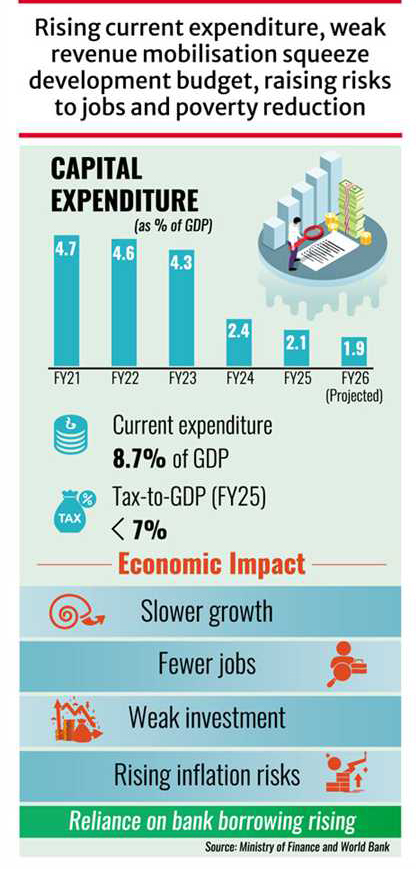
Economists say the contraction in capital investment alongside rising non-development expenditure is bad news for the economy. They have suggested increasing domestic revenue mobilisation to support higher development spending and attract more investment.
They warned that if the government fails to boost capital expenditure within a year or two, economic growth could slow further, job opportunities may shrink, and poverty reduction could become increasingly difficult.
The latest Bangladesh Development Update released by the World Bank has also highlighted this worrying trend in the country's fiscal management, as capital expenditure continues to decline even as current spending rises.
The Spring 2026 update, released last week, points to a significant squeeze on the development budget.
According to the report, capital expenditure is projected to fall to 1.9 per cent of GDP in FY2026, down from 2.1 per cent in FY2025 and 2.4 per cent in FY2024.
By comparison, capital expenditure stood at 4.7 per cent of GDP in FY2021, 4.6 per cent in FY2022 and 4.3 per cent in FY2023, according to data from the Ministry of Finance and the World Bank.
This downward trend comes at a time when the government is grappling with rising current expenditure, which is expected to reach 8.7 per cent of GDP in FY2026.
The report warns that rising subsidies -- particularly in the energy, gas and fertiliser sectors -- alongside elevated current spending are "crowding out" the investments needed for long-term growth.
When a country consistently experiences declining capital expenditure alongside rising operating or current expenditure, it creates a structural fiscal imbalance that can undermine long-term economic stability.
While operating expenses cover immediate government needs -- such as civil service salaries, interest payments and subsidies -- capital expenditure represents investment in future growth, including infrastructure such as roads, bridges, power plants and schools.
According to reports from the Citizen's Platform for SDGs and recent budget analyses for FY2025-26, the government has begun borrowing to cover operating expenditure (non-development costs), a practice not seen in decades.
In FY2025, which ended in June, operating expenditure stood at around Tk 4.60 trillion, while revenue earnings were approximately Tk 4.36 trillion, resulting in a revenue deficit of over Tk 230 billion that had to be financed through borrowing.
Economists say the implications of this trend are wide-ranging, including erosion of growth potential, crowding-out effects, risks to debt sustainability, deterioration in public services, reduced foreign direct investment (FDI) and increased inflationary pressure.
The World Bank noted that persistent structural weaknesses in revenue mobilisation, coupled with rising subsidies and high current spending, have compressed fiscal space and crowded out capital expenditure, which is projected to continue declining into FY2026.
Former World Bank Lead Economist Dr Zahid Hussain told The Financial Express that the government has little option but to adopt austerity measures, though these should not be prolonged.
"The government now needs to decide where austerity should be applied, to what extent and for how long," he said.
He warned that if weak revenue performance persists, the economy will face further stress, with lower investment, reduced employment and slower poverty reduction.
Chairman and Chief Executive Officer of Policy Exchange Bangladesh, Masrur Reaz, said fiscal discipline has weakened, resulting in higher operating expenditure and reduced development spending.
"Despite longstanding challenges, the government has yet to undertake meaningful reforms of the National Board of Revenue (NBR), further constraining fiscal space and limiting external borrowing opportunities," he said.
With limited scope for additional domestic borrowing, the government has reduced development expenditure, narrowing the scope for investment, employment generation and poverty reduction, he added.
Beyond traditional budget financing methods, the government should explore alternative funding sources both domestically and internationally, including resource mobilisation through the capital market, he suggested, noting that the country is unlikely to face an immediate crisis.
The World Bank report also pointed to historically low revenue collection. In FY2025, the tax-to-GDP ratio fell below 7.0 per cent for the first time in 15 years.
Although a modest recovery to 7.8 per cent is projected for FY2026, it remains insufficient to meet the government's spending needs.
To bridge the widening gap, the government has increasingly relied on domestic bank borrowing to finance the deficit.
This has pushed public debt to 39.5 per cent of GDP in FY2025, with projections suggesting it could exceed 45 per cent by FY2028, according to the World Bank.
The World Bank emphasised that restoring fiscal sustainability will require a dual approach: rationalising expenditure and accelerating revenue reforms.