
Fathoming the enigma called Novera
Shihab Sarkar | Friday, 15 May 2015
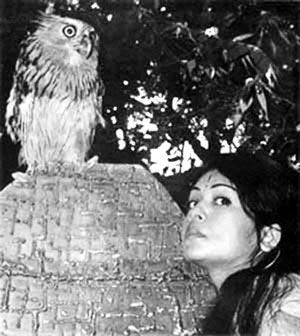
After passing nearly five decades in veritable reclusion, sculptor Novera Ahmed passed away at a village near Paris on last May 06. She was 85. (According to some, she was born in 1939. They say she was 76 when she died.)
In view of the socio-cultural milieu that prevailed in the 1950s in Bangladesh, then East Pakistan, the late sculptor can now unmistakably be identified as an iconoclast. Young Novera Ahmed was the embodiment of traits that go with the unconventional.
Infusing modernism and bold abstraction into our sculpture, she had immensely helped it set its foot on a solid base. In short, sculpture in this country began its triumphant journey under the tutelage of Novera Ahmed. It was she alone, who had pioneered this art form in this country.
Novera Ahmed emerged in a period, when, in the erstwhile Pakistan, women involved in the broader arts were viewed with disapproval. But the young sculptor was gifted with an inborn defiance. She couldn't care less for the hostile environs in which she had found herself. With careless abandon she picked her chisel and hammer, and went about producing her marvellous sculptures in a burst of creative surge.
The prime period of Novera's Dhaka-based creative trance spanned from 1956 to 1960. This phase of her career also saw the sculptor design the model of the Central Shaheed Minar in Dhaka. She accomplished the job in collaboration with artist Hamidur Rahman.
It was in 1957, when the construction of the memorial for the Language Movement martyrs began. The structure commemorated the martyrdom of students and youths who were killed in police firing in 1952. They were demanding Bangla be declared one of the state languages of Pakistan which the rulers vehemently opposed.
Unlike many of our artists and sculptors, Novera entered the Dhaka art scene fully prepared. She did not have to study her subject at any institution in the country. But she was no self-taught sculptor. Novera had her rigorous academic grooming at Camberwell School of Art in London, where she took Diploma in Design in the Modelling and Sculpture course in 1955.
She had academic stints also at Florence in Italy and Vienna in Austria. Although general critics and admirers discover the strong influence of British sculptor Henry Moore on her works, many identify the stamp of some others in her style. They include her teachers like British sculptor Jacob Epstein, Karl Vogel (Czechoslovakia) and Venturino Venturi (Italy).
However, despite the association of these great sculptors with her works, Novera Ahmed was able to stand out with a distinctive style of her own, and brilliantly at that.
Novera was, undoubtedly, prolific. From the mid-1950s onwards up to the late 1960s, the sculptor produced innumerable works. Her solo exhibition held on the Dhaka University campus in 1960 put 100 of her sculptures on display.
Titled Inner Gaze, it took place on the old Public Library premises. A few of her sculptures remaining stuck in the library garden even in the 1970s stood as sad reminders of the show. The works were lying in utter neglect for over one and half decades.
Sometime afterwards, the National Museum of Bangladesh took the responsibility of a number of these works. The museum organised a show with 30 of her sculptures in 1998. Novera's Dhaka solo exhibition was followed by her second in Bangkok in 1970. Earlier, in 1961, she participated in an exhibition in the Pakistani city of Lahore.
The year 1973 saw the sculptor's third solo show in Paris. A 100-day retrospective on Novera Ahmed was perhaps the most memorable event in the sculptor's life. It was held in 2014 in the French capital, which had already become Novera's home.
By that time she had psychologically moved far away from her motherland. Yet, perhaps adding to her enigmatic nature, the elderly sculptor, then on crutches, was said to have visited the Bangladesh embassy in Paris --- a few years before the retrospective.
She went there to collect a Bangladeshi passport. But she also told the official concerned at the embassy that she did not know Bangla. It was also said that the sculptor had become fleetingly emotional upon hearing the news of her Ekushey Padak award given by the Bangladesh government in 1997.
In the pre-independence artistic landscape of Bangladesh, Novera Ahmed emerged with a sudden creative blaze. Many would be tempted to liken her to a gust of wind or an onrush of water in primordial setting. In fact, the sculptor had personified bits of all the three spectacles.
Yet she was far from being uncontrollably wild. In spite of her off-beat style of work and living, Novera had never been oblivious of her prime identity of an artist. True, the form and content of her sculptures were completely new to the local connoisseurs; some pointed to the purely outlandish features of her works.
Yet a strong love for the agro-based land and its people had been ever-present in Novera's subconscious. In many of her works, we find Bengalee peasant women in their age-old movements and postures. These women, along with their children and husbands, appear in the sculptor's Family series.
Man-woman romantic love is also a recurring theme in her works. Rural women appear in her sculptures amid the apparently city-based female ladies caught in their urban gestures. Novera does not belong to the genre of irrationally angry or avant-garde artists with no definite mission. It becomes clear from the well-balanced form of her works.
Anarchy in creativity was not her forte. She had subtly employed classical restraint in her otherwise spontaneous freedom. Novera was consummately positive and 'pro-life' in artistic temperament. Maybe it had a lot to do with the recurrence of mothers in her sculptures.
In the non-figurative design of the Central Shaheed Minar, the sculptor portrays four unnamed language martyrs, with a mourning mother standing in the middle.
Novera Ahmed spent her childhood in Chittagong and Kolkata. She passed her secondary school certificate examination from a famous institution in the Indian city. She came to Dhaka in 1956 after successfully completing her diploma courses in Europe.
Her unconventional life-style notwithstanding, Novera was an impeccably Bengalee woman belonging to the soil. The village life in Bengal and its people in varied types of profession used to attract her. The sculptor developed a strong liking for the community of Vaishnabas-Vaishnabis. In a number of her works, done in different mixed media including metal, one is amazed to find the pervasive presence of nature and its awe-inspiring elements.
Upon making an attempt to cast a look into the inner world of Novera, one may not be wrong to find a dichotomy in her. Throughout her brief creative period, the sculptor kept being torn between two opposing selves.
In spite of her desperate effort at attaining harmony, Novera had tragically failed to reconcile her highly charged extrovert self with her equally strong introvert temperament. It was this inner dichotomy that may have prompted her restlessness, the abrupt decision to leave the country and the choosing of the life of an existentialist outsider. However, few great artists are free of self-contradiction.
In fact, Novera Ahmed was no enigma in her formative years. It was her extraordinary creative impulse, occasionally stifled by bitter realities, which had shaped her unpredictable and hypersensitive nature. Yet Novera continued working, with an inner turbulence tormenting her. She had stunned the local art world when she left Dhaka, never to return, in 1960.
As is not unusual with highly talented artists, hardly five years into her career Novera began to feel neglected, and withdrew herself into a world of her own. It was fathomless, and none had entry there. Knowing the reason why the sculptor left the country for Lahore in 1960 en route to Bombay and, finally, Paris will perhaps clarify her later self-exile.
shihabskr@ymail.com