
Financial autonomy in doubt as separate judiciary secretariat nears reality
GULAM RABBANI | Friday, 31 October 2025
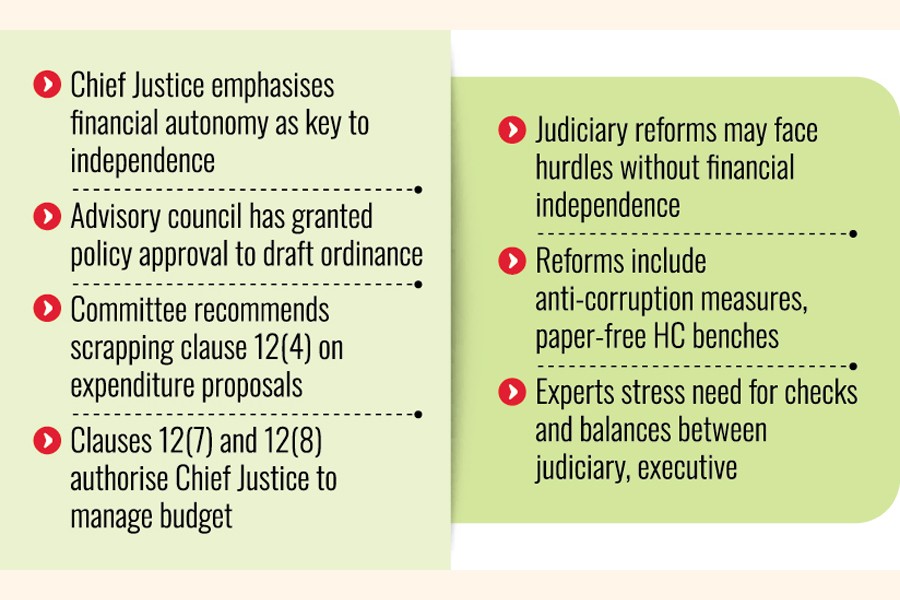
Although most disagreements over establishing a separate secretariat for the judiciary have been resolved, questions persist over whether it will actually enjoy financial independence.
The uncertainty arises from objections raised by the inter-ministerial committee on legal scrutiny of the Cabinet Division to a clause in the draft "Supreme Court Secretariat Ordinance 2025" that grants financial autonomy to the proposed secretariat.
People associated with the judiciary said that implementing the Judiciary Reform Commission's recommendations would face significant hurdles if the ordinance is approved without ensuring financial independence.
According to Supreme Court sources, the draft ordinance -- prepared by the High Court Division -- was sent to the Cabinet Division on October 13 through the law ministry. The next day, the inter-ministerial committee reviewed the draft and returned it to the ministry with 18 observations.
The committee objected to several clauses of the draft and advised the ministry to reconsider them.
It particularly suggested scrapping clause 12(4), which stipulates that any proposal from the SC secretariat regarding judicial expenditure cannot be changed without consulting the chief justice.
Clauses 12(7) and 12(8) would authorise the chief justice to allocate and utilise the SC budget. The committee recommended seeking the finance ministry's opinion on these provisions.
Masdar Hossain, a member of the Judiciary Reform Commission and a former Senior District and Sessions Judge, told The Financial Express that judicial independence requires financial autonomy.
He noted that without financial autonomy, the judiciary would still have to depend on secretaries of the executive branch for issues such as separate pay structures for judges, infrastructure development, and legal support.
"This dependence on the executive would definitely undermine the judiciary's independence, depriving it of the environment necessary to function with integrity and competence," he said.
On September 21 last year, Chief Justice Dr Syed Refaat Ahmed outlined a roadmap for judicial reform, identifying financial autonomy as a cornerstone of an independent judiciary.
"One of the key conditions for ensuring an independent judiciary is safeguarding its financial autonomy. To achieve this, the government must allocate a separate budget for the district courts under the Supreme Court and fully provide the funds requested by the SC to support judicial development and efficiency," the chief justice said in his speech.
However, the future of such autonomy now appears uncertain following the recent objections.
Supreme Court Registrar General Mohammad Habibur Rahman Siddiquee said that the advisory council has already granted policy approval to the draft ordinance, which may be tabled for further discussion at the next advisory council meeting.
Since the fall of Sheikh Hasina's government on August 5 last year following a mass uprising, the judiciary has undergone significant reforms.
The Supreme Court Judges Appointment Ordinance 2025 -- issued on January 21 this year -- introduced a system to appoint Supreme Court judges through an independent council. Under the new ordinance, 25 High Court Division judges were appointed on August 25, marking the first such appointments under any law or ordinance in the country's history.
In addition, the chief justice has introduced a series of reforms, including anti-corruption measures, paper-free High Court benches, the drafting of the Bangladesh Judicial Service (Formation) Rules 2025, separate courts for civil and criminal matters, creation of new judicial posts, and reformation of the Supreme Judicial Council.
Senior Supreme Court advocate Ahsanul Karim said that if the judiciary's separate secretariat functions transparently, and both the executive and judiciary operate within their defined limits, the reform could yield positive results.
However, he cautioned that the executive should not be completely excluded from the process, as total separation is neither desirable nor feasible.
"We need a system of checks and balances," he said, adding that Bangladesh should follow examples of countries that have successfully maintained equilibrium between the executive and the judiciary.
bikashju@gmail.com