
Fiscal space shrinks as subsidy burden rises
FHM HUMAYAN KABIR | Saturday, 20 December 2025
Bangladesh's fiscal landscape is facing a significant strain as the government's expenditures on subsidies and incentives surged over the last several fiscal years.
This sharp spike is largely attributed to a massive backlog of arrears in the power sector and the rising costs of agricultural inputs, primarily due to the depreciation of the taka against the US Dollar, Ministry of Finance (MoF) officials say.
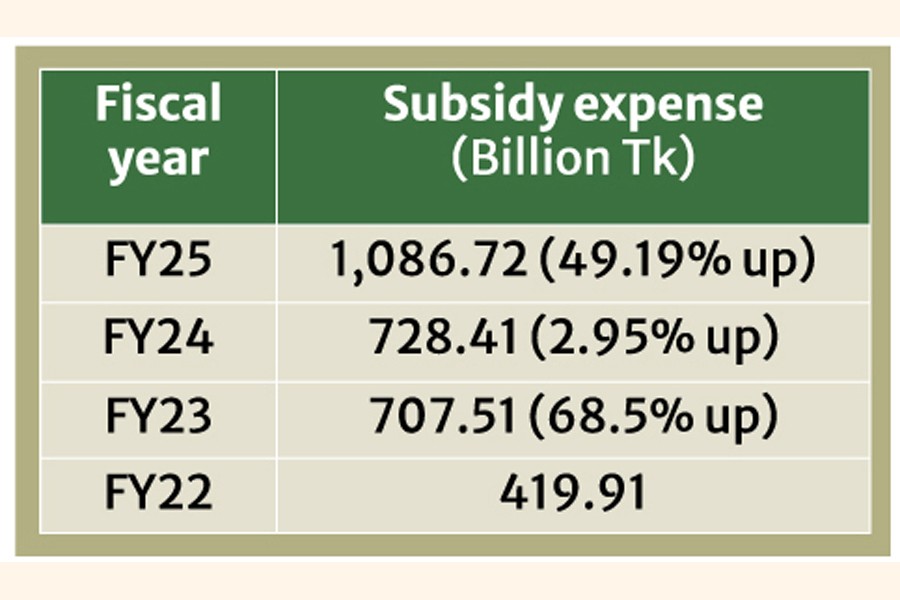
The government spent Tk 1,086.72 billion on subsidies in the fiscal year 2024-25, 49.19 per cent higher than that in FY24, official statistics show.
In FY24, the government spent Tk 728.41 billion from the national budget on subsidies for different sectors.
According to the latest budgetary data for FY25 and revised projections, the total allocation for subsidies and incentives has crossed a critical threshold, now accounting for nearly 20 per cent of the government's operating budget.
Over the last four years, subsidies for agriculture, power, energy, and some other sectors ballooned nearly two and a half times, resulting in massive fiscal pressure.
According to the finance ministry, the public sector subsidy in FY22 was Tk 419.91 billion mainly due to the post-Covid recovery assistance.
The figure jumped to Tk 1,086.72 billion in FY25.
In FY23, the government spent Tk 707.51 billion on subsidies, which went up in FY24 to Tk 728.41 billion mainly for the global fuel price spike.
The power sector remains the largest receiver of government support.
Subsidies in this sector alone have witnessed a dramatic rise to address the financial crisis within the Bangladesh Power Development Board (BPDB).
The power sector subsidy, which stood at roughly Tk 350 billion in FY24, increased significantly.
In some revisions, the figure is estimated to nearly double to Tk 700 billion to clear the outstanding dues to the independent power producers (IPPs).
The high "capacity charges" paid to private power plants and the increased costs of imported fuel (liquefied natural gas and coal) have created a massive deficit.
The BPDB currently loses an estimated Tk 4.80 for per unit of electricity sold.
Despite the global pressure to reduce subsidies, the government has increased its support for the agriculture sector to ensure domestic food security amidst high inflation.
Agricultural subsidies were revised upwards from Tk 175.33 billion to over Tk 250 billion in the current cycle.
The vast majority of this fund is spent on importing chemical fertilisers, including Urea, Diammonium Phosphate, Triple Superphosphate, and Muriate of Potash.
With global prices rising and the taka weakening against the USD, the government is paying a higher "trade gap" to keep fertiliser prices affordable for local farmers.
The nearly 50 per cent increase in these payments has raised concerns among economists and international lenders like the International Monetary Fund, the World Bank, and the Asian Development Bank.
While these subsidies protect consumers from the full brunt of global price hikes, they also limit the "fiscal space" available for health, education, and infrastructure development.
"The government is navigating a delicate balance between sustaining essential subsidies for the poor and aligning with fiscal prudence to manage a growing budget deficit," says a senior finance ministry official.