
Revised macroeconomic ratings for Bangladesh
Fitch justifies 10pc policy rate against high-inflation regime
Elevated inflation, recent decline in borrowing costs, need for fresh IMF funding prompt suggestion
FE REPORT | Thursday, 23 April 2026
An outfit of high-profile global rating-agency Fitch suggests Bangladesh should continue with its high policy rate in lending in the high-inflation regime, ostensibly nay-saying pleas for rate cut.
"We now expect the Bangladesh Bank to maintain its policy rate at 10 per cent over FY2026/27 instead of cutting the rate," says a BMI report, available Wednesday.
Business Monitor International or BMI is a Fitch Solutions company that provides macroeconomic, industry, and financial market analysis globally.
The subsidiary of the American-British credit-rating agency, Fitch, makes such suggestion in view of high projected inflation, recent decline in long-term-borrowing costs, and renewed need for International Monetary Fund financing.
"This is a revised outlook from our previous projection of a rate cut during the new fiscal year. The revision comes despite BB Governor Mostqaur Rahman's reported preference for lower interest rates."
The agency says their new forecast primarily reflects Bangladesh's present economic circumstances, as they expect headline inflation will remain above the central bank's 6.5-percent target over FY2026/27, "hitting a high of 8.6 per cent".
"This is partly due to base effects created by low food-price inflation during H1 FY2025/26."
The Fitch outfit also expects the Iran conflict to contribute 0.13- percentage points towards headline inflation for the coming fiscal year through higher energy prices.
"Elevated inflation threatens the BB's price-stability mission, making a rate cut in FY2026/27 difficult to justify," it opines.
The report mentions that surging inflation in recent years has also eroded real wages in Bangladesh.
"This was particularly pronounced for industry-sector workers, which comprise 21 per cent of the economy's labour force. Although the salary declines slowed in 2025, this comes atop five consecutive years of falling real wages."
It predicts that an uncontrolled supply-side shock to inflation will worsen this problem.
"This factor will make the BB even more cautious about cutting rates, which could cause inflation to run unchecked." Falling long-term borrowing costs presents another reason for keeping the policy rate high.
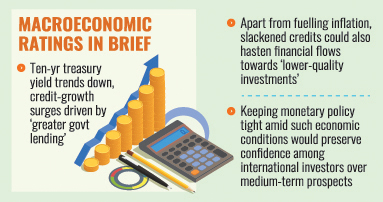
The 10-year treasury yield has trended down since January 2025, despite the policy rate's elevated level. Over the same period, credit growth surged, driven by greater government lending.
"Apart from fuelling inflation, looser credit could also hasten financial flows towards lower-quality investments. This effect is probable given the fragility of Bangladesh's banking sector," the agency cautions.
Finally, it mentions, Bangladesh's government is seeking US$3.0 billion in financial support from the International Monetary Fund (IMF) and the World Bank.
"The government's spending needs are real. Aside from cushioning the blow of the Iran conflict on Bangladeshi households, Dhaka will probably have to recapitalise several banks as it reforms the financial sector."
However, IMF support is likely to be contingent on the government preserving a degree of macroeconomic stability.
Keeping monetary policy tight when economic conditions support such a move would preserve confidence among international investors over Bangladesh's medium-term prospects.
jasimharoon@yahoo.com