
BD development planning redefined
Five-year Strategic Framework for reform, development coming
FE REPORT | Friday, 15 May 2026
Bangladesh's development planning is getting redefined as the newly formed BNP-led government is devising five-year strategic framework (FYSF) focusing reform and advances to chase a trillion-dollar economy.
The General Economics Division (GED) under the planning ministry is working to prepare the five-year economic-development strategy to be implemented between the year 2026 and 2030.
Policymakers, bureaucrats and experts participated in a three-day technical committee meeting Thursday to facilitate preparation of the FYSF.
After completing the technical workshop, GED Member Dr Monzur Hussain told journalist that they had already made a preliminary outline of the report which is being reviewed by the experts in the technical committee meetings over the last few days.
Speaking as chief guest at the second meeting of the 'Advisory Committee on the Preparation of Economic Strategy Paper' in the NEC Conference Room in Dhaka, Prof Rashed Al Mahmud Titumir, Adviser to the Prime Minister, said breaking the longstanding ineffective trend, the newly formed government is working to prepare "a new realistic, accountable and participatory strategy ".
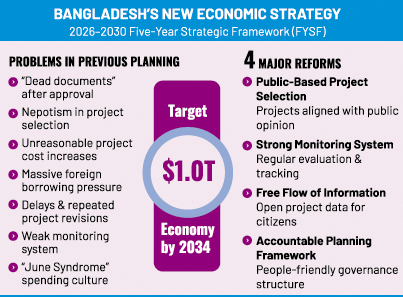
"In the past, most of the country's development plans would have practically become 'dead documents' from the day after their adoption, because effective initiatives were not taken to implement their goals and strategies," he adds.
Dr Titumir notes that project selection based on nepotism, unreasonable cost increases and plans inconsistent with reality have put the country's economy under pressure for a long time. "After taking office, the current government is re-evaluating these projects and taking necessary decisions, which are also consistent with expert opinions.
He says structural weaknesses were evident in the previous planning system and the massive foreign borrowing has brought the country's fiscal management under stress.
Delays in project implementation, multiple revisions, failure to appoint project directors on time, and trends like 'June syndrome' had made the entire planning system weak and ineffective, the PM adviser told the meet.
Highlighting four major reforms in the new planning framework, Titumir says the project- selection process will be aligned with public opinion, project progress will be monitored through regular monitoring and evaluation, free flow of information will be ensured, and the entire planning system will be transformed into a people-friendly and accountable framework.
He highlights that it is important to ensure transparency in projects run with people's tax money.
"If information is open, citizens will be able to verify the difference between government action and the actual achievements of the project themselves. This will further strengthen accountability and the rule of law."
The professor of development economics elucidates the new economic strategy's goal of transforming Bangladesh into a trillion-dollar economy by 2034. For this purpose, sector-wise plans, specific strategies, and measurable indicators are being set.
He further says in the past, the Planning Commission had worked only as a 'rubber stamp' in many cases, but now initiatives have been taken to transform it into an effective policymaking institution. In the new structure, comprehensive and sector-based goals will be set and projects will be taken up accordingly.
The meeting was chaired by former Planning Adviser Prof Wahiduddin Mahmud. State Minister for Planning Jonayed Saki was present as special guest. GED Member Monzur Hossain presented the keynote.