
Flood in south, drought in north
Sunday, 2 August 2015
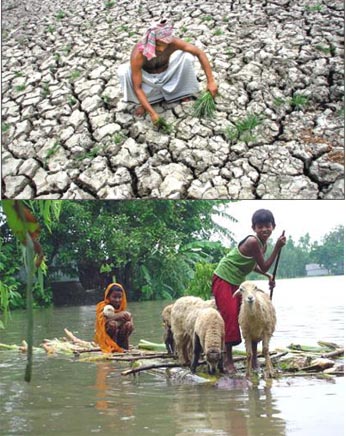
When the country’s southern districts have remained under flood waters during the rainy season, the northern districts are facing heat waves. Heavy rainfall, triggered by land depression with the influence of ‘Komen’ caused flood in several coastal districts of Khulna, Barisal and Chittagong divisions and Dhaka. Downpour also triggered landsides and hill slip in the three districts of the Chittagong Hill Tracts. Hill slip in Bandarban killed at least 7 people in Lama upazila and injured several others early Saturday. The land depression over central part of Bangladesh near Faridpur moved westwards and now lies over Khulna and adjoining area. The Met Office forecast more rains in southern and central districts in the next 24 hours under the influence of the land depression.
However, almost at the same time, several districts of Rangpur division have been experiencing unexpected hot-spell and drought. The drought is leading to a loss of crop production, food shortage as the seedbeds are being burned in sun-heat. Farmers in Lalmonirhat, Gaibandha, Dinajpur, Thakurgaon, Rangpur and Panchagarh districts are not getting enough water for paddy since the onset of Shraban month. The irrigation cost is also very high that incurs huge loss. Divisional office of the Department of Agricultural Extension (DAE) said ‘aman’ production, highly dependents on water availability, is being seriously affected due to the drought. Irregular characteristics of rainfall and global climate changes are the main causes of drought, experts say. According to them, it has created a threat on the ‘aman’ cultivation in the country’s northern-most division.
According to the DAE, in Rangpur, 162,576 hectares land was targeted for aman crops in the district, but seeds had been sowed in only 14,000 hectares of land.
In Panchagarh, 94,963 hectares land was targeted for aman cultivation, but seeds had been sowed in 68,255 hectares which is 71% of the target.
In Gaibandha, 119,945 hectares of land was targeted, but seeds had been sowed in 88,396 hectares.
In Nilphamari, seeds had been sowed in 60,000 hectares land which is 47% of 111,223 hectares of targeted land.
In Lalmonirhat, seeds had been sowed in 38,000 hectares of targeted 79,099 hectares land in the district.
In Dinajpur, seeds of aman crops had been sowed in 129,540 hectares while 253,963 hectares was targeted to bring under aman cultivation.
In Thakurgaon, aman seeds had been sowed in 84,040 hectares out of targeted 129,712 hectares, which is 61 per cent of target.
Analysing the aforesaid data, a large part of land remained uncultivable due to an acute crisis of water irrigation as drought is hitting the region, according to a news agency.
- mbz