
Food price spike fuels inflation to new peak
Feb rate hits 16-month high at 6.17 per cent
FE REPORT | Tuesday, 22 March 2022
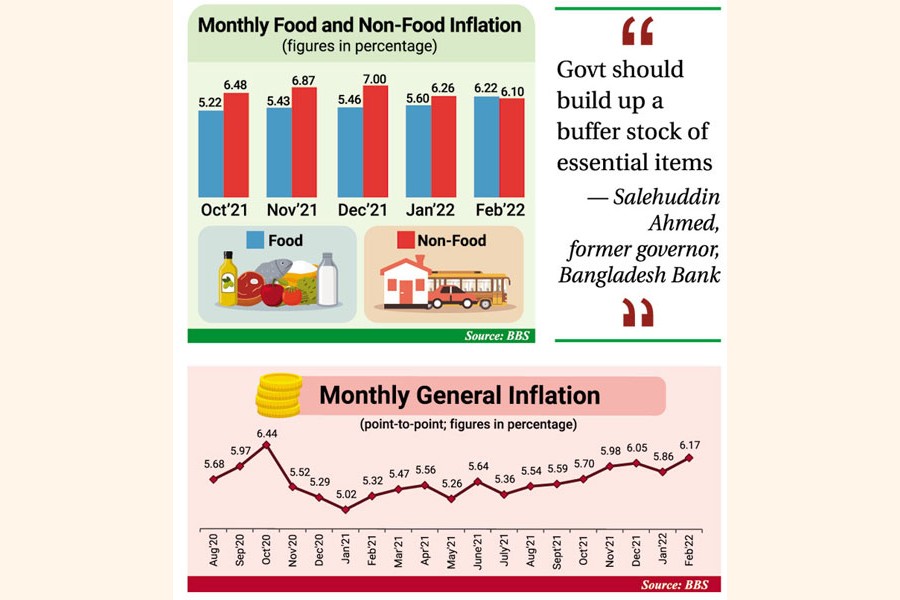
Bangladesh saw inflation rate breach 6.0-per cent bracket to hit a 16-month high in February, by official count, principally as spikes in foodstuff prices stoked the important macroeconomic barometer.
The national inflation rate, on a point-to-point basis, stood at 6.17 per cent in the past month in a climb-up from 5.86 per cent in January, according to latest statistics available with the Bangladesh Bureau of Statistics (BBS).
Earlier, it was in December last year when the inflation rate had crossed 6.0-per cent level into 6.05 per cent.
BBS time-series data also show that monthly inflation was at its highest level in October 2020 when the rate was recorded at 6.44 per cent. Thus, inflation in February this year is the highest in last 16 months.
Soaring costs of essential food items like rice, edible oils, vegetables and others fired up the overall inflation. The food-inflation rate increased to 6.22 per cent in the last month from 5.60 per cent in January this year, reflecting an unchecked hike in food costs across the country.
A sort of agflation or a general increase in prices of agricultural products put village people into suffering more as rural food inflation increased to 6.62 per cent from 5.94 per cent during the period under review. Food inflation in urban area recorded at 5.30 per cent in the last month against 4.85 per cent in January.
Food items along with beverage and tobacco carry 56-per cent weight of the consumption basket considered in estimating inflation rate on the basis of Consumer Price Index (CPI).
Overall inflation in the rural area also rose significantly to 6.49 per cent in February from 6.07 per cent in January.
Overall inflation in urban area, however, inched up modestly to 5.59 per cent from 5.47 per cent during the period under review.
Non-food inflation in national level as well as both the urban and rural areas was counted down during the period under review. Non-food items include transport, housing, clothing, medical and education. It carries 44 per cent of the total weight of CPI.
The BBS measures CPI for rural areas by taking 318 items and for the rural area it uses 422 commodities and services.
Economists have, however, long-been expressed doubt whether the BBS official figures on inflation properly reflect the real market situation especially when there is a upward trend of commodities' prices.
The South Asian Network on Economic Modeling (Sanem) in the first week has claimed that the overall inflation rate in the country is reached at double digit. In a study report, it argued that BBS compiles the consumer price index based on the result of the Household Income and Expenditure Survey (HIES) of 2005-06. The consumption pattern of the people has increased over time as a result of an increase in per capita income, but the BBS did not update the base even based on the HIES of 2016.
Meanwhile, the central bank is closely watching the country's inflationary pressure on the economy to avert any unwanted situation on price level.
The current trend in inflation was discussed at the latest meeting of Monetary Policy Committee (MPC), held at the Bangladesh Bank (BB) headquarters in Dhaka on March 02 with BB Governor Fazle Kabir in the chair.
"We're monitoring the inflationary trend closely in line with the MPC's decision," a BB senior official told the FE on Monday.
He also said the central bank may take effective measures after the Eid-ul-Fitr festival if the upward trend of inflation continues.
"The latest upward trend of inflation is mostly supply side phenomena. But it is still manageable," the central banker said while replying to a query.
Monetary Policy Statement for FY22 projected that the average CPI inflation would be moderated and tolerable at a targeted single-digit rate of 5.30 per cent.
The review, however, mentioned that during the first half of FY22, the actual average CPI headline inflation was 5.60 per cent which was slightly above the target.
Moreover, the central bank's inflation expectation survey earlier showed that the annual average rate of inflation is likely to cross 6.0 per cent level by the end of the current fiscal year (FY22). Above 6.0 per cent means it may even reach as high as 8.5 per cent by the end of December this year, according to the survey unveiled in the annual monetary policy review report released early in this month.
The BBS on Monday published its February issue of the regular report titled "Consumer Price Index (CPI), Inflation Rate and Wage Rate Index (WRI) in Bangladesh."
It also showed that average nominal wage registered 6.03 per cent growth in February from 5.92 per cent in January this year. When compared with national inflation rate of 6.17 per cent in the last year, it indicates that real wage eroded significantly as higher inflation is eating up the nominal income.
Former Bangladesh Bank (BB) governor Salehuddin Ahmed suggested the government to build up a buffer stock of essential items particularly rice, wheat and sugar to avert price hike of the essentials in the near future.
"Extortion particularly at the highways will have to be stopped immediately," Dr Ahmed said while replying to a query.
Such illegal activities influence the price level of essentials, according to the former governor.
"The government will have to take stern action against unscrupulous businessmen instead of nominal punishment through setting up mobile courts to ensure supply of essentials across the country smoothly," the senior economist noted.
asjadulk@gmail.com
siddique.islam@gmail.com