
Fuel-price hike breeds domino effect
Food, transport, trade costs set to spike
Bus-fare rise likely, truck rent up 15-20pc amid fuel crunch
MUNIMA SULTANA, YASIR WARDAD & MONIRA MUNNI | Monday, 20 April 2026
Food production, trade and transportation costs may increase further on fuel-price hike by Tk 15-20 per litre in Bangladesh amid an exigent global crunch.
Bangladesh uses about 4.35 million tonnes of diesel annually, and around 24 per cent of it is used in agriculture. About 80 per cent of irrigation depends on this fuel oil. It is also needed for land preparation, harvesting, threshing, and transporting crops.
On Saturday, the government increased diesel price from Tk 100 to Tk 115 per litre, octane Tk 140, up from Tk 120, petrol Tk 135, up from Tk 116, and kerosene Tk 130 in a rise from Tk 112.
Economists, agriculturists and businesspeople are concerned about domino effect of the fuel-price rises across a spectrum of economic activities, price indices and trade and transport.
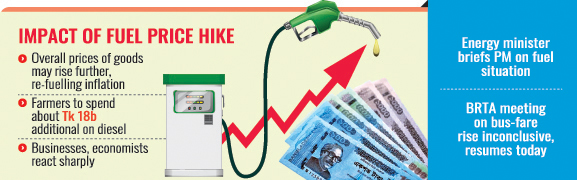
Agro economists say farmers may have to spend around Tk 18 billion more per year on diesel for farming.
"This will create pressure in two ways. First, higher production costs will make it harder for farmers to get fair prices. Second, food prices on the market may go up, increasing the cost of living, especially for low-income people," says former Bangladesh Agricultural Research Council (BARC) executive chairman Dr Wais Kabir.
He says Boro is now being harvested, so irrigation needs are lower. "However, costs for harvesting, threshing, and transport will increase due to higher fuel prices."
He notes that fuel-price hikes affect all sectors and will increase farmers' costs significantly, which may lead to higher rice prices.
Agricultural economist Prof Dr Rashidul Hasan says farmers are worried about reduced profits. Paddy prices are already low due to imports from India, and farmers are unsure about getting good prices for Boro.
"The fuel-price hike has made the situation worse."
Data show about 55 per cent of the country's rice comes from Boro cropping which depends fully on irrigation.
There are around 1.9 million agricultural machines in the country in the process of mechanization of agriculture, about 75 per cent of which run on diesel.
Prof Hasan feels ensuring diesel supply and providing subsidies are important to support farmers.
Group Director of TK Group Mohammad Mostafa Haider says the impact of fuel-price hikes on product prices cannot be measured immediately. He notes that global oil-and raw-material prices have already increased, along with transport costs.
As such, the businessman says, many product prices have already been adjusted. However, he believes transport fares should not increase again if fuel supply improves, as fares already went up earlier due to shortages.
And, in the meantime, transporters and the government authority concerned were in a meeting on Sunday night with a proposal on the table for bus-fare hike, too.
Recent data from the Trading Corporation of Bangladesh and the Department of Agricultural Marketing show prices of vegetables, edible oils, fish, and poultry on an upturn over the past two weeks.
Traders say truck and pickup-van fares for goods have already increased 15-20 per cent due to fuel shortages in many places.
Meanwhile, the fuel price hike has affected the transport sector as a whole.
The Fare Adjustment Committee under the Bangladesh Road Transport Authority met to discuss new bus fares for city and long routes on Sunday evening. The meeting ended inconclusively. The meeting discussed an increase of Tk 0.22 in fare per kilometre. However, the meeting resumes today.
Although buses charged regular fares on the first day, operators demanded fare increases to make up for higher fuel costs and earlier losses during the fuel crisis.
Some ride-sharing services also charged up to 50-percent higher fares on Sunday, citing fuel shortages and higher costs.
However, the Passenger Welfare Association of Bangladesh opposes fare hikes without fair representation of commuters in the decision-making process. They say fare decisions were previously "influenced by interest groups".
Water-transport operators have also demanded a 36-42-percent increase in launch fares, saying that their operating costs have risen sharply.
Currently, bus fares are Tk 2.12 per km for long-haul run and Tk 2.42 for city routes. Launch fares may also increase if the proposals get through.
Commuters have expressed concern about possible fare hikes, though many say they paid normal fares on the first day after the fuel-price increase.
Transport owners' leaders say fare adjustment is necessary after the fuel-price hike, while commuters argue that fares were not properly reduced when fuel prices fell in 2024.
Leaders of the country's apparel sector Sunday demanded uninterrupted supply of fuels amid the price hike and adjustment of the rate on a regular basis.
Economists term the decision 'good', suggesting regular price adjustment in line with global price indices.
Bangladesh Garment Manufacturers and Exporters Association (BGMEA) president Mahmud Hasan Khan, in an immediate reaction, says, "So far I know, the government has raised the fuel prices in line the understanding with the IMF."
He says the price must be adjusted on a regular monthly basis according to the global price indices, adding that 'adjustment means not only to raise the price but also reduce when global prices fall."
He, however, stresses that factories should get the fuel uninterruptedly as price hike will surely increase the production cost which for many reasons is on the rise.
Citing a rise in global market rates, the government Saturday increased fuel-oil prices at the retail level by Tk 15 to Tk 20 per litre.
Under the new pricing structure, diesel has been fixed at Tk 115 per litre, octane at Tk 140, petrol at Tk 135, and kerosene at Tk 130 per litre.
Talking to The Financial Express, Khan Monirul Alam, Managing Director of Fashion.Com, says his factory located at Ashulia faces five to six hours of load shedding daily.
To run two factories-medium in size--he needs 1200-litre diesel daily to operate generators during the electricity outage.
Due to the 15-percent hike in diesel prices, he will have to bear an additional financial cost of Tk 0.4 million to Tk 0.5 million monthly.
"As the generators are for backup supports and they also have a limited capacity, the machines are overheated, posing risk of possible accident," he says explaining the current situation.
Mr Alam says majority of the factories in the export industry have generators as alternative supports.
Echoing the BGMEA leader, Bangladesh Knitwear Manufacturers and Exporters Association (BKMEA) president Mohammad Hatem says there is no denying the fact that production cost will increase. "But the main problem is that we are not getting fuel."
"Last government increased prices of gas several times but we did not get the adequate supply of gas," he laments.
Talking to the FE, Bangladesh Institute of Bank Management (BIBM) director-general Dr Md Ezazul Islam says the latest fuel-price hike will fuel the inflation rate which has been on the higher side.
If the government does not raise the prices of fuel, it has to subsidize, which will put a negative impact on revenue policy, he says about a double bind.
Terming the raise 'good', he says the government also needs to adjust the fuel prices every month with the international market trends-reducing the rate when prices go down globally.
Distinguished fellow of CPD Prof Mustafizur Rahman says the price hike is made at a time when the government has to buy fuels at high rates amid uncertainties.
"It would affect most the direct users like transport, manufacturing and consumers," he says, adding that the government has to monitor the market strictly so that bus fare and other transportation price do not rise disproportionately but reasonably.
He also suggests strengthening the social-safety net to help low-and fixed-income groups who are already under pressure due to higher inflation.
Power, Energy and Mineral Resources Minister Iqbal Hassan Mahmood and State Minister Aninda Islam Amit met Prime Minister Tarique Rahman at the Secretariat on Sunday and briefed him on the country's fuel situation.
"They met the Prime Minister at his office at the Secretariat and informed him of the latest fuel situation," said Prime Minister's Additional Press Secretary Atikur Rahman Rumon.
After the meeting, the Energy Minister told waiting journalists that the government had no alternative but to hike the prices as fuel imports require foreign currency, and the adjustment was necessary to keep the situation at a tolerable level.
tonmoy.wardad@gmail.com, smunima@yahoo.com, Munni_fe@yahoo.com