
SWITCHING TO RENEWABLE ENERGY FROM LNG
For every $1.0 investment, country can get $17 of benefits: Study
FE REPORT | Tuesday, 31 March 2026
A study has suggested reducing dependence on imported fuels and moving towards a self-reliant energy system as investment in renewable energy (RE) can bring long-term economic benefits.
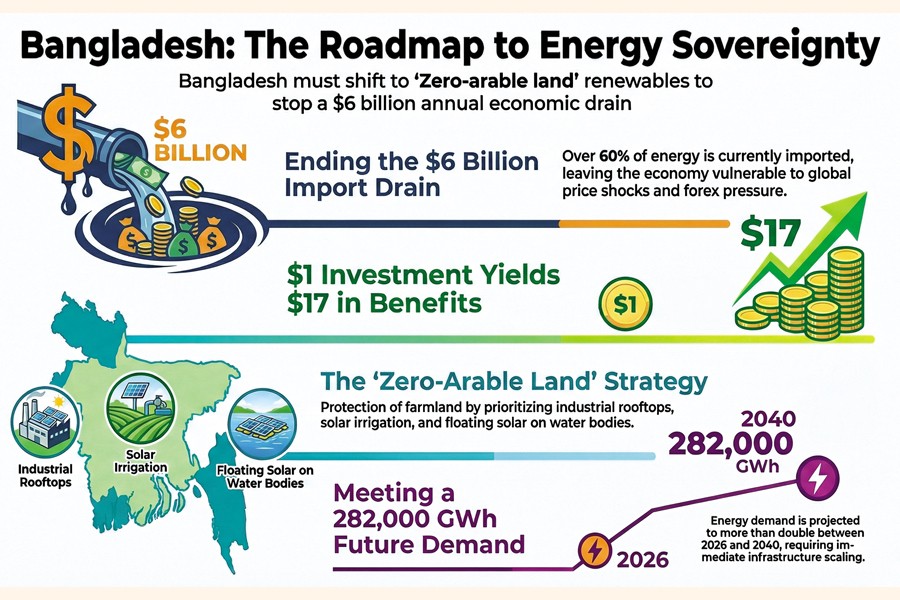
According to it, for every $1.0 spent on shifting from liquefied natural gas (LNG) imports to renewable energy, Bangladesh can gain up to $17 in overall benefits, including savings in fuel costs, reduced subsidies, and new job creation.
The findings were presented at a roundtable titled "From dependence to sovereignty: renewable energy investment roadmap for a just transition in Bangladesh" on Monday.
The event, organised by Change Initiative, was held at the CIRDAP auditorium in the capital's Topkhana Road area.
Dr AK Enamul Haque, director general of the Bangladesh Institute of Development Studies (BIDS); Mr Owais Parray, country economic adviser at the United Nations Development Programme (UNDP); and Dr Md Didarul Alam, director (joint secretary) of the Bangladesh Energy Regulatory Commission were present as the guests of honour.
Energy expert and a professor at the University of Dhaka Dr Badrul Imam, Chairman of Forum for Energy Reporters Bangladesh M Azizur Rahman, and President of the Bangladesh Environmental Journalists Forum Mostafa Kamal Majumder also spoke on the occasion, among others.
The event was moderated by M Zakir Hossain Khan, co-founder and chief executive of Change Initiative.
According to the study, Bangladesh now depends on imports for over 60 per cent of its energy needs, exposing the country to global fuel price shocks and putting pressure on foreign exchange reserves.
It warned that this could lead to an additional foreign exchange drain of $5-6 billion if the current trends continue.
The current energy mix in Bangladesh is still dominated by natural gas, furnace oil, and coal, while renewable energy accounts for only a small share.
This, the report said, must change to meet future demand and climate goals. It projected that power demand will rise sharply in the coming years.
Total energy demand may reach over 282,000 GWh by 2040, up from around 110,000 GWh in 2026. To meet this demand, the report suggested a "zero-arable land" strategy.
This means using rooftops, water bodies, and the existing infrastructure instead of farmland for renewable projects.
The goal is to protect food security while expanding clean energy. Three main areas were identified for growth, including rooftop solar in industries, solar-powered irrigation in rural areas, and floating solar projects on water bodies.
However, several challenges remain, such as lack of financing, limited access to technology, and gaps in policy implementation.
Speaking on the occasion, Dr AK Enamul Haque said although there is strong confidence in solar energy in Bangladesh's energy sector, its actual output and efficiency are much lower than expected. Despite having high installed capacity, real generation in the grid remains low, indicating technological limitations, weak management, and inadequate analysis, he said.
The sector is also heavily regulated, with different agencies imposing varying rules, which creates barriers to investment and efficiency, he also said.
In the past, even with significant investment, some initiatives - such as solar home systems - have not been sustainable, he said, pointing to weaknesses in policy.
M Azizur Rahman said there is significant potential in clean and renewable energy since the global market is increasingly demanding environmentally sustainable production, particularly in the export-oriented sectors.
saif.febd@gmail.com