
AMENDING MONEY LAUNDERING PREVENTION ACT
For unverified income, property itself can be sued
FHM HUMAYAN KABIR | Thursday, 22 January 2026
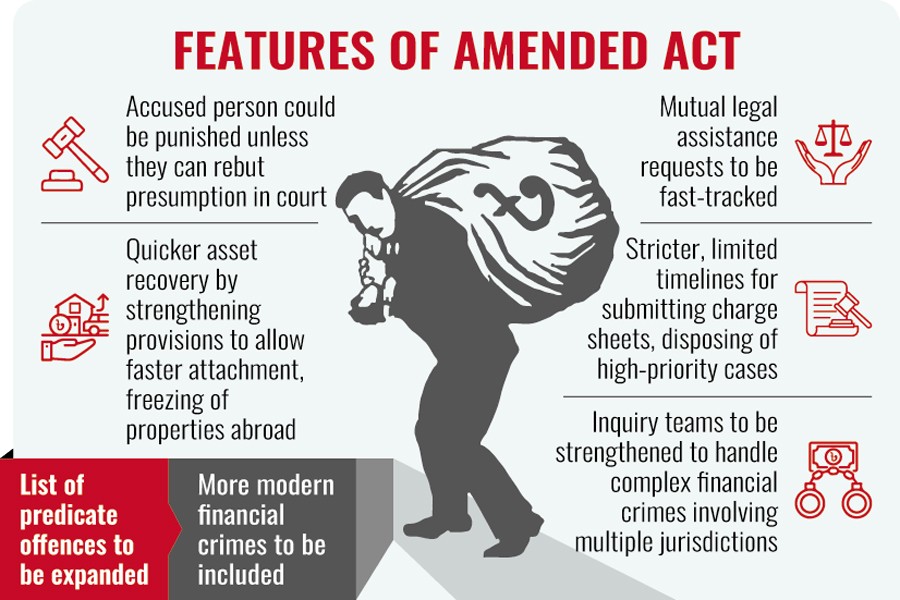
The government is going to amend the Money Laundering Prevention Act, allowing the state to sue the "property" itself if the owner cannot prove a legitimate source of income, officials say.
If the court presumes the accused person or entity is guilty of money laundering, the person could be punished unless they can rebut the presumption in court, the proposed amendment says.
Under the amended law, the accused person is bound to prove his non-involvement in the misdeeds to get relief from the money laundering case, officials say.
Finance ministry officials say the proposed amendment to the existing Money Laundering Prevention Act 2012 will be placed at the advisory council meeting on Thursday (today) for approval.
The government recently decided to amend the act to modernise the legal framework and accelerate the recovery of laundered assets from abroad.
In line with the decision made at the 30th meeting of the National Coordination Committee on the Prevention of Money Laundering and Terrorist Financing held last month in Dhaka, the amendment is going to be placed before the advisory council.
A senior finance ministry official says the proposed amendment focuses on removing bureaucratic bottlenecks that have historically slowed down the investigation and retrieval of illicit funds.
Asset recovery will be expedited by strengthening provisions to allow faster attachment and freezing of properties located outside the country.
The government aims to expand and clarify the list of predicate offences, updating and integrating more modern financial crimes, specifically targeting trade-based money laundering (TBML) like over-invoicing and under-invoicing, which are currently the primary methods for illicit capital flight from Bangladesh, say officials.
Under the current law, the process of requesting help from foreign governments (mutual legal assistance requests) is often stalled by domestic red tape.
The amendment proposes a fast-track protocol for mutual legal assistance requests, empowering the Bangladesh Financial Intelligence Unit (BFIU) and the Anti-Corruption Commission (ACC) to communicate directly with their foreign counterparts for asset freezing without waiting for a final conviction in a domestic court.
The amended law is likely to introduce stricter and limited timelines for the submission of charge sheets and the disposal of high-priority money laundering cases.
It can also accommodate more robust investigative powers to join inquiry teams to handle complex financial crimes involving multiple jurisdictions.
The amendment will allow the state to sue the "property" itself if the owner cannot prove a legitimate source of income, making it significantly easier to recover assets from offshore shell companies.
A senior Financial Institutions Division official says after finalising the proposed amendment, the state will be empowered to go for tougher action against the culprits who launder money outside the country.
Since billions of dollars have been laundered from Bangladesh over the years, especially by some politicians, bureaucrats, businessmen, and close allies of the toppled Awami League government, the amended law will expedite the recovery of laundered assets from abroad and punish the real culprits within a shorter possible time, the official adds.
According to the finance ministry, significant progress has already been made in identifying and securing laundered assets worth nearly Tk 661.46 billion, including domestic assets (attached or frozen) of Tk 556.38 billion and overseas ones (attached or frozen) of Tk 105.08 billion.
Ministry officials have informed the government's high-powered committee that 104 cases have been filed about the priority matters. Of these, charge sheets have been submitted in 14 cases, and verdicts have been delivered in four.