
Foreign ink brands imported thru bonded warehouse flood market
Kamrun Nahar | Friday, 11 July 2014
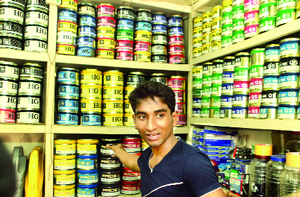
Local printing ink manufacturers are on the verge of shutting down their manufacturing units due to the uneven competition from the foreign ink brands imported through bonded warehouse of the country depriving the government of huge revenue earning from the sector, industry insiders say.
Many unscrupulous ready made garment industry and individual traders are indulged in the act with an aim to make quick profit in collaboration with a few dishonest customs and other officials. Facing the stiff competition, more than 50 per cent of the local manufacturers have already wrapped up their business while many are at stake with their investment as they hardly can make profit after paying the operational expenditures, duty, VAT, tax, marketing and transportation costs. Many foreign companies having joint investment plan in the sector have backtracked already while some joint venture partners are reluctant to invest further hampering the industry's growth.
"Additional printing ink has been entering our market using the bonded warehouse facilities which is not of any use for packaging in the garment industry. This is depriving the government of earning revenue and driving out the local manufacturers from competition," President of Bangladesh Ink Manufacturers and Owners Association (Bangladesh Kali Prostutkarak Malik Samity) Zakir Hossain told the FE recently.
He alleged that even various inks used for newspaper printing are imported availing these bonded warehouse facilities which has no use in garment industry packaging.
"We see these inks available at the local ink shops. We do not know how these inks come as those are not imported in the name of these shops. The price is very low for which our local inks cannot compete with it which ultimately will lead to closure of many such manufacturing units," said Mr Zakir, adding: many of the companies are in trouble with their current investment while most of them do not dare further investment in the sector.
Various ink brands including Daihan and Star gloss of Korea, App, MRT and Peony of China, and Micro Ink of. India have flooded the markets at Arambagh and Nayabazar in the capital. Some of the leading Bangladeshi ink brands are Toka, a joint venture company with Japan, Toyo, Supertone, Fuji, Taj, New Jamuna, and Crown ink.
Industry insiders said 90 per cent of the foreign brands available in the market come through the bonded warehouses against the 10 per cent commercial import for which the importers have to pay 25 per cent duty. There are as many as 100 ink selling shops in Dhaka, industry sources said.
Although there is no official data available, an estimated 4500 tonnes color ink and 3000 tonnes black ink are used in Bangladesh printing industry.
Industry sources said neighbouring India has become self reliant in ink manufacturing and exporting ink of every kind as the country has been able to attract joint investment of almost every international ink brand. Micro ink of Germany, Flint of the USA, DIC and Toyo Ink of Japan have investment in India.
Mr Zakir also managing director of Toyo Ink and Chemicals Bangladesh, said although the country has the capacity to produce 100 per cent ink required in the market, many companies are not using the full production capacity due to the distorted market. Moreover, many are reducing the production, he added. He said the demand for liquid ink is growing which is an annual 20 per cent than the paste ink of 10 per cent.
There is a market of Tk 10 billion in Bangladesh with about 20 companies supplying about 85 per cent of the total consumption. The companies in production have an investment of Tk 1.0 billion generating employment of about 300 people.
Former president of the association and the leading ink brand Toka manufacturer MA Momen said it's beyond their understanding how various international finished ink brands can be sold at much lower price.
"We import raw materials, paying duty, add value, pay tax and VAT, marketing and transportation cost, and after many stages make nominal profit. But now we cannot even survive as we cannot stand the competition of these unauthorised inks whose price should not be like this," said Mr Momen.
These inks are distorting the market and hampering the growth of the industry as the investors of this sector are gradually being ousted. There were about 40 ink manufacturing companies in the country whereas hardly 20 companies area in production now, he added. Number of members of the association is decreasing as they are finding ink manufacturing as non-profitable, he observed.
Referring to the huge growth of the printing industry of the country, Mr Momen said the national curriculum and textbook board (NCTB) prints books worth Tk 3.0 billion in a season, many paper mills have been established, printing ink and other chemical companies are there enough to make printing industry self- sufficient. But the weak policy and monitoring of the regulatory authority in the ink sector has been shrinking the industry gradually.
"Printing ink industry will face its natural death if the sales of the inks coming through the bonded warehouse are not taken care of. We are really concerned," said the veteran industrialist.
General secretary a of Bangladesh Mudran Shilpa Samity AFM Shah Alam said it is true that foreign brands entering through the bonded warehouses are sold in the markets at a cheaper rate. But local manufacturers have the capacity to supply 100 per cent of the total ink required in the market.
He said in printing the books of NCTB 100 per cent local ink is used. The newspapers also use local inks, he claimed. In cases of printing color materials, foreign brands are used sometimes.
"I think 15 per cent of the total demand is fulfilled by the foreign ink brands," said Mr Alam.
He suggested the local ink manufacturers should improve the quality and provide ink at a competitive rate. If they need to take the support from the government to do this, they should do it.
"We never want that any ink enters through unauthorised way to disturb the market. The ink users want same quality product like the foreign ones at the same cheaper rate," he added.
There are about 7000 printing and publication companies in the country. The government prints 280 million books in the country and 30 million in India for free distribution among the students which is a work of only four months. This year the target is 320 million copies. The printers sit almost idle for eight months, which indicates a huge opportunity is being missed by Bangladesh.