
Form an independent commission to address crisis in media industry
Media leaders urge govt at a discussion organised by MRDI
FE REPORT | Sunday, 14 June 2026
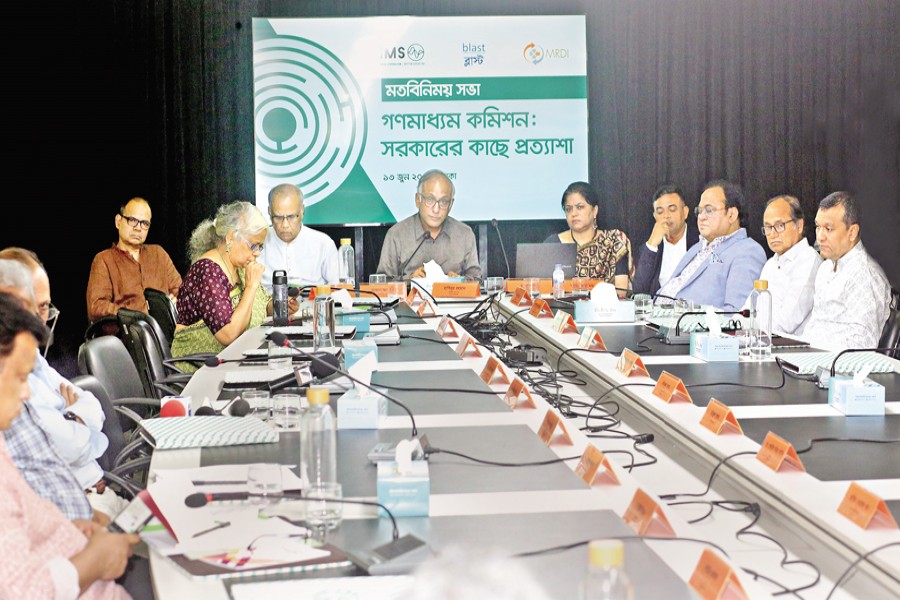
Leading editors, media owners, academics and journalists on Saturday called for the establishment of an independent Media Commission to address what they described as a deepening crisis in Bangladesh's media industry, marked by shrinking revenues, declining public trust, weak professional standards and the absence of institutional accountability.
The demand came at a discussion titled "Media Commission: Expectations from the Government", organised by the Media Reform and Development Initiative (MRDI) at The Daily Star Centre in the capital.
Bangladesh Legal Aid and Services Trust (Blast) and International Media Support (IMS) were co-organisers of the event.
Speakers from across the media spectrum argued that while the formation of a Media Commission could be a significant step towards reform, its success would depend on ensuring legal independence, transparency and the political will to implement its recommendations.
Participants painted a bleak picture of the country's media landscape, describing an industry struggling with economic instability, ethical shortcomings and structural weaknesses.
Many speakers also warned that the uncontrolled expansion of media outlets has created an unsustainable environment where competition for limited advertising income has weakened professional standards and editorial independence.
Consulting Editor of The Daily Star and Head of the Media Reform Commission Kamal Ahmed expressed cautious optimism about the government's initiative to establish a Media Commission, despite past disappointments over unimplemented reform proposals.
He described the current state of the media sector as one of "anarchy and chaos", arguing that meaningful reform would be impossible without first restoring discipline and accountability.
He proposed a "One Media, One House" policy to prevent excessive concentration of ownership and urged the digitisation of television rating point (TRP) measurements and newspaper circulation audits to eliminate manipulation and corruption.
Editor of The Financial Express and also member of the media reform commission Shamsul Huq Zahid questioned whether any commission could be effective without first addressing the structural disorder within the industry.
He pointed out that nearly 300 daily newspapers are currently published from Dhaka, although many reportedly have little or no readership and survive primarily through access to government benefits and advertisements.
He argued that unless the media sector itself is streamlined and professionalised, the creation of a commission alone would not produce meaningful change.
Editor of Daily Waadaa and former Press Secretary for Chief Advisor of Interim Government Shafiqul Alam strongly supported the proposed commission, describing it as a timely initiative.
He expressed concern over the rise of yellow journalism, plagiarism and what he termed "armchair journalism", where original reporting is frequently copied and republished without attribution.
Alam also called for stronger legal protections against defamatory and targeted reporting designed to damage businesses, organisations or individuals.
Barrister Sara Hossain said the draft of National Media Commission Ordinance, 2026 was formulated with the consultations of all relevant stakeholders.
She urged everyone to participate in the further consultation process to go ahead with the ordinance.
Professor Gitiara Nasreen said the commission should not be viewed as a cure-all solution but rather as an institutional guide capable of supporting long-term reform.
Ms Nasreen, also member of the media reform commission, described the media sector as operating in an uncontrolled environment while simultaneously confronting a growing struggle for survival.
Nasreen proposed the establishment of a dedicated research unit within the commission to continuously assess industry developments, monitor emerging challenges and formulate policy recommendations.
Association of Television Channel Owners (ATCO) General Secretary and Chairman of Ekushey Television Abdus Salam said the television sector was facing severe financial distress.
According to him, the advertising market has contracted by around 35 per cent while the number of television channels has expanded to 43.
Deputy Editor of Prothom Alo Lazzat Enab Masih drew attention to the deteriorating professional environment faced by many journalists, particularly outside major cities.
According to him, numerous rural correspondents receive little or no regular salary, creating conditions that encourage unethical practices and erode public trust in journalism.
Executive Editor of The Business Standard Sakhawat Liton questioned whether genuine independence was possible in a system where executive authority remains dominant.
MRDI Executive Director Hasibur Rahman outlined a possible framework for the commission covering print, electronic and online media.
He suggested that self-regulation, public participation and audience feedback mechanisms should form the foundation of the new body.
Dhaka Tribune Editor Reaz Ahmad called for unified standards across all media platforms and proposed introducing clear licensing criteria to ensure that only qualified organisations enter the industry.
Channel I Chief Executive Editor Zahid Newaz Khan raised concerns about the longstanding influence of intelligence agencies over media operations, questioning how an independent commission could function effectively if such interference continues.
Samakal Editor Shahed Md Ali stressed the importance of newspaper distribution networks and supply chains, issues he said are frequently overlooked in media reform debates.
Khabarer Kagaj Editor Mostafa Kamal criticised the cumbersome licensing process and intelligence clearance requirements imposed on media organisations and employees.
Agamir Somoy Editor Mostafa Mamun observed that journalism has increasingly become focused on exposing scandals and amplifying social media trends rather than providing balanced public-interest reporting.
Executive Editor of Sangbad Shahriar Karim, Programme Manager for International Media Support (IMS) Shakhawat Hossain, Diplomatic Correspondents Association, Bangladesh (DCAB) Executive Committee member Pantho Rahaman, member of the Media Reform Commission Jimi Amir and Daily Gramer Kagaj Editor Mubinul Islam also spoke at the event.
bdsmile@gmail.com