
Reversal of five Islamic bank mergers
Former board bids for regaining SIBL, petitions regulator
JUBAIR HASAN | Tuesday, 28 April 2026
A reversal of the five Islamic bank merger begins as former shareholders of Social Islami Bank Ltd officially appeal for regaining the troubled bank's conditional control through a new legal window.
The much-talked-about insertions into the newly enacted Bank Resolution Act 2026 that modified the merger-related ordinance of the post-uprising interim government, thus, begin to come into action.
Former chairman and sponsor shareholder of the shahirah-based bank Major (Retd.) Dr Md. Rezaul Haque, on behalf of the former board of directors, submitted Monday an application to Governor of Bangladesh Bank (BB) Md. Mostaqur Rahman in pursuant to the section 18(Ka) of the Bank Resolution Act, officials said.
Apart from Mr. Haque, the other signatory shareholders in the application are managing director of Hamdard Laboratories Dr Hakim Md. Yusuf Harun Bhuiyan, Alhaj Sultan Mahmood Chowdhury, Afia Begum and Md. Zahedul Alam Chowdhury.
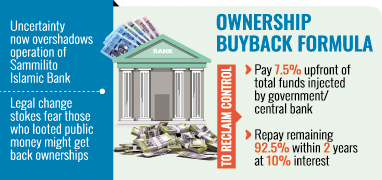
With the submission of the application, uncertainty looms large over operation of the emerging Sammilito Islamic Bank which was formed through merging five severely liquidity-hit shariah-based commercial banks last year.
The merged banks were Social Islami Bank, First Security Islami Bank, Union Bank, Global Islami Bank and EXIM Bank.
Talking to The Financial Express, the former chairman of Social Islami Bank, Mr. Rezaul Haque, said they had submitted the application under the section 18(Ka) of the act, which has created a window for the former shareholders to get back conditional control over the problem bank.
He thinks the bank can be revived as an independent bank through fresh capital injections, stronger governance, recovery of classified loans and improved liquidity support.
They pledge to restore transparency and accountability if the former board members are reinstated.
"We hope the central bank governor will give serious attention to our application and give us time to share our plans to make the bank rebound," he says.
Mr. Haque says they will comply with all the conditions in the Bank Resolution Act to get back their ownership in the bank.
"We are capable as we had given 20-percent cash dividend to the shareholders regularly since 2013 till 2016 before it was forcibly taken away by a controversial business group," he says, adding that their employees enjoyed 5-7 bonuses annually.
According to the interpolation of changes into section 18(Kha) of the Bank Resolution Act, former directors or shareholders of banks, merging or listed for mergers, can pay 7.5 per cent upfront of the amount injected by the government or the central bank to reclaim the banks. The remaining 92.5 per cent is to be repaid within two years at 10-percent interest.
Seeking anonymity, a BB official says they will scrutinize the application on various aspects. Thereafter, it will be placed before the BB board of directors.
"If the board members are satisfied, it will be sent to the ministry of finance for next course of action."
On a question over the operational fate of Sammilito Islami Bank, the central banker couldn't give any satisfactory response. "We are in the dark now as the progress of the newborn bank gets caught in limbo after the latest change in the Bank Resolution Act," he says.
The section 18(Ka) of the act, which was passed by parliament on April 11 last, sparked widespread criticism from various quarters who fear representatives from the group who looted public money from the banks might get back in the ownerships through using the amended law.
Before the mergers, the central bank on November 5 last year declared net asset value (NAV) of the shares of the five banks zero, citing deeply negative capital positions, and officially classified the institutions as non-viable.
Although all the five remain listed on the stock market, trading in their shares was suspended by the Bangladesh Securities and Exchange Commission (BSEC).
Under the merger plan, the government injected Tk 200 billion into the newborn bank, while another Tk 150 billion was to come from the deposit-insurance fund, creating a paid-up capital base of Tk 350 billion.
Of the government funds, it invested Tk 100 billion in Sukuk bonds while the remaining Tk 100 billion in cash remains almost intact in the Sammilito Islami Bank current account with the regulator.
According to the financial review of the bank, the ratio of classified loans rose to 64 per cent by end of August last year, which prompted the banking regulator to take it under its merger plan along with four other Islamic banks.
The total investment the bank had made until August 2025 was Tk 391 billion. Of the volume, around Tk 248 billion turned bad loans and it created severe liquidity crisis in the bank.
jubairfe1980@gmail.com