
INTERVIEW
Fresh pooled funds positioned to outperform older MFs
Says Midland Asset Management CEO in an interview with the FE
MOHAMMAD MUFAZZAL | Tuesday, 24 February 2026

Newly launched mutual funds (MFs) can leverage the attractive valuations of listed securities and the broader scope for portfolio diversification to generate higher returns than older funds.
Mohammad Samir Uddin, chief executive officer (CEO) of Midland Asset Management, said this in an interview with the FE amid the ongoing subscriptions of its two open-ended pooled funds.
As a new venture, the asset manager opened subscriptions for the two MFs - Midland Bank Growth Fund and Midland Bank Balanced Fund - on February 1. The subscription period will expire on April 12. The initial size of each fund is Tk 250 million. Mr Samir said older funds had been bearing persistent price erosion of listed securities in their portfolios, leading to losses. As a result, the funds failed to distribute dividends in the last two years.
Over the past few months, the prices of many listed securities have fallen further to historic low levels due to market volatility amid a liquidity shortage and macroeconomic worries. "In a situation like this, a completely fresh position by a fund will benefit its unitholders as the fund will not have to wait to recover any loss," said the chief of Midland Asset Management.
He said his company entered the market at a time when many lucrative stocks were being traded at almost their lowest prices.
DSEX, the broad index of the Dhaka bourse, has shrunk by about 10.36 per cent since January 1, 2023 and closed at 5,553 points on Monday.
"A newly launched fund will stay ahead of the old ones following any sustainable recovery of the equity market in the days to come," said Mr Samir.
Recent portfolio valuations of mutual funds already in the market also show that new fund managers performed better compared to the older ones.
Apart from the attractive price levels of listed securities, the asset manager's optimism is also rooted in the revised rules providing more freedom to asset managers to design portfolios and the newly elected government assuming office.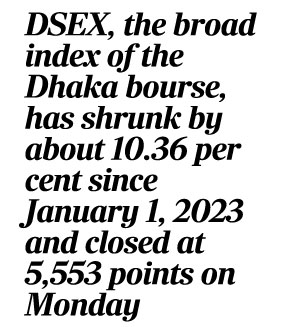 Previously, mutual funds - whether close-ended or open-ended - were required to invest at least 60 per cent of their money in listed securities. A majority of the funds injected more than 80 per cent into the equity market and subsequently faced portfolio erosion as the secondary market plummeted.
The revised rules, which came into effect in November last year, allow greater fund allocation - up to 60 per cent - in fixed-income securities. Alongside investing 40 per cent of a fund in government securities, 20 per cent can be kept in banks in the form of FDRs (fixed deposit receipts) and SND (short notice deposits).
The changes in the investment ceiling created an opportunity to secure higher returns, for example, from Treasury bonds, said Mr Samir.
A close-ended MF requires a good amount of cash to be available for the purpose of repurchasing units from investors. Such funds can be kept as SNDs, and the lucrative interest rate would also enhance the growth of the fund.
According to Mr Samir, many banks are now offering interest rates above 6.5 per cent on SNDs.
Moreover, he said, "We hope the market will be stable following corrective measures by the newly-elected government. That will also support our funds.
"We will be able to increase investments in the equity market following any sustainable upward trend of the market."
The Midland Asset Management head also said they had formulated a prudent investment strategy for the two funds.
The company has received positive responses from institutional investors regarding subscriptions to its two funds. The subscription of Midland Bank Growth Fund is expected to close before the stipulated time frame, Mr Samir added.
mufazzal.fe@gmail.com