
Friendship with Japan rooted in history
Mohammad Amjad Hossain from Virginia, USA | Sunday, 8 June 2014
Relations between Bangladesh and Japan date back to pre-liberation times when the former was a part of Pakistan. The government of Japan invested largely in erstwhile East Pakistan instead of West Pakistan for developing an industrial base. The first steel mill in Pakistan was set up in Chittagong. Two fertiliser factories in Sylhet and Ghorashal, Chandrogona Paper and rayon mills in Chittagong Hill Tracts were also established with Japanese assistance.
A special desk on Bangladesh was opened in the Japanese Foreign Ministry during the war of liberation. A senior Japanese diplomat disclosed this to this writer in 1988 when he was working as the First Secretary in the Bangladesh embassy in Bucharest, Romania.
The cordial relations that exist between the people of Japan and Bangladesh were amply demonstrated when the people of Japan contributed generously to the relief fund for the cyclone victims of Bangladesh in 1970 when the then government of Pakistan had shown a lukewarm attitude towards the sufferings of the people of erstwhile East Pakistan. During the war of liberation of Bangladesh, Japan extended its total support to the struggling people of erstwhile East Pakistanis which had been reflected in the wide coverage of news in the Japanese news media.
The undisputed leader of Bangladesh, Sheikh Mujibur Rahman was held in high esteem in Japan during the war of liberation. He was compared to Subhas Chandra Bose, a radical Bengali nationalist who had fought against the British Raj with the help of Imperial Japan. Japanese parliamentary leader Takashi Hayakawa, who mobilised public opinion in favour of Bangladesh, visited Bangladesh in February 1972 following the establishment of diplomatic relations between the two countries.
Since the establishment of diplomatic relations on February 10, 1972, relations between Bangladesh and Japan have been growing from strength to strength. Sheikh Mujibur Rahman, as prime minister, visited Japan in 1973 at the invitation of Japanese Prime Minister Kakuei Tanaka. He was given a rousing reception by both the government and members of the Japanese Diet. That was the turning-point in cementing relations with Japan in the post-liberation period.
In October, 1977, a Japanese hijacked plane landed at Dacca airport creating a serious concern in Tokyo. The government of Bangladesh under General Ziaur Rahman handled the problem with skill and all passengers were released safely and the hijacker was handed over to the Japanese government.
In 1981, Pan-Pacific Sonargaon Hotel, constructed with Japanese assistance, was opened in Dhaka.
When Japan was hit hard by earthquake and tsunami in March, 2011, the government of Bangladesh, under the leadership of Prime Minister Sheikh Hasina, donated $1.0 million for the affected Japanese people and also dispatched a search-cum-rescue team to assist the Japanese government in rescue opearation.
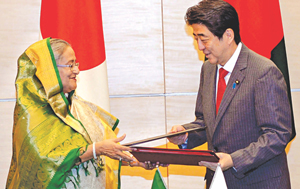
During her fourth round of visits to Japan in May this year, Prime Minister Sheikh Hasina, Bangladesh and Japan pledged to develop a Japan-Bangladesh comprehensive partnership plan. It goes without saying that since both the countries are prone to natural hazards, they need to cooperate in different fields of nature-related areas. In this area, the Japanese government gave assurance to the Bangladesh Prime Minister that Japan would provide cooperation package in areas of climate change and disaster risk. Japan also committed to provide $100 million for the construction of a bridge over the Padma.
It is gratifying to note that Japan would grant credit line on soft term to Bangladesh for socio-economic development in next four to five years' time while $1.18 billion to build a 200-megawatt power plant. The government of Bangladesh should take appropriate action to implement the power plant project in view of shortage of power for which economic development of the country has been suffering tremendously.
Japan and China are pioneers in building infrastructure in Bangladesh. Presently, Japan and China are having a serious problem over the issue of the Senkafu Islands. Therefore, Bangladesh needs to walk a diplomatic tight rope over the issue of the Senkafu Island.
The writer is a retired Bangladesh diplomat. amjad.21@gmail.com