
From chocolate baron to Ukraine president
Saturday, 7 June 2014
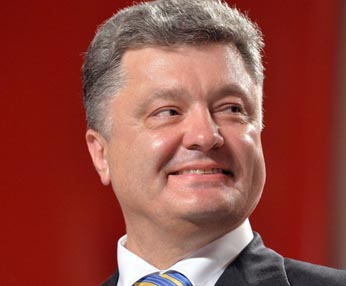
Petro Poroshenko, who will be sworn in as president of Ukraine on Saturday, is a billionaire chocolate baron whose revolutionary zeal turned him into a political comet. The pro-Western tycoon won an outright victory in a presidential election late last month with 54.7 per cent of the votes – a powerful mandate no one would have predicted just a year ago. He needs the mandate, as he assumes the reins of his country at a dramatic point in history when it finds itself at the centre of the worst crisis between East and West in Europe since the end of the Cold War. The crisis has centred around Russia's annexation of the Crimea, a Ukrainian peninsula jutting into the Black Sea, as well as an uprising by pro-Russian rebels in the east of the country.
- 'The dialogue has begun' -
This pits Poroshenko against Russian President Vladimir Putin, but Friday on the eve of the inauguration ceremony, the two met briefly as they both attended D-Day commemorations in northern France. ‘The dialogue has begun, and that’s a good thing,’ Poroshenko told Ukrainian television afterwards. He said that a Russian envoy would travel to Ukraine on Sunday, adding there was a ‘good chance’ of success. Success is indeed needed if he is to bring about the profound change he had promised for the country that he will now lead. ‘Soon we will end the war. Soon we will stamp out corruption. Soon we will begin European integration and establish democracy,’ he said last month. Opimistic? Perhaps. But he is a man can make tings happen, as his career proves, whether in business or in politics.
- Ukraine's Willy Wonka -
The tall, slightly greying tycoon is one of the country's 10 richest men with a fortune estimated at around $1.6 billion (1.2 billion euros) by Forbes magazine, which described him as Ukraine's Willy Wonka. A shrewd politician who has flip-flopped between governments for more than a decade, Poroshenko was the only Ukrainian oligarch to openly back the pro-European protest movement that ousted president Viktor Yanukovych, under whom he served briefly as economics minister. He was also the only politician to fly to Crimea in a bid to negotiate with pro-Russian troops who seized parliament after Yanukovych fell, but he was angrily chased off by demonstrators. While ready to talk with Putin, he has insisted two issues are not negotiable -- Ukraine's pro-Europe direction and Crimea, which he insisted ‘is and will remain Ukrainian’, according to AFP.