
From uprising to exclusion
Why women missing from Bangladesh's election
Doulot Akter Mala | Thursday, 12 February 2026
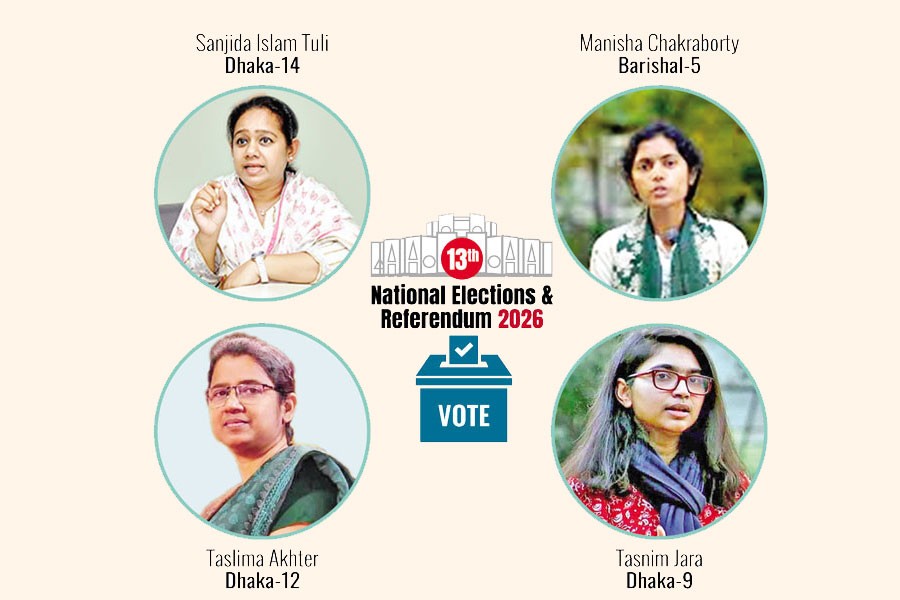
In Bangladesh's much-anticipated February 12 national elections, one contradiction stands out: the striking exclusion of women from the electoral contest in the democratic transition following the fall of the autocratic regime of Sheikh Hasina. Women played a visible and critical role in the student-led mass uprising that compelled Hasina to step down and flee the country. Their mass participation in the street movement raised expectations that long-standing political barriers were finally crumbling and that women would gain a stronger presence in formal politics. Instead, today's election marks a reversal. Women's participation has declined even compared to the last three elections, highly disputed for rigging, since 2014 under the Hasina government.
Statistics show only 4.10 per cent of candidates in the February 12 election, the 13th parliamentary election in the country, are women. This falls short of the minimum 5.0 per cent pledged in the July Charter referendum. Female participation in national elections is the lowest in Bangladesh among the regional peers, even lower than the 4.95 per cent in Pakistan's 2024 polls.
Across the region of South Asia, the picture is only slightly better. In India's 2024 Lok Sabha election, women made up 9.6 per cent of candidates-795 women out of 8,360 contestants. In Nepal's March 2026 general election, 11 per cent of candidates contesting under the first-past-the-post system are women. Bhutan's 2023-24 National Assembly election saw 9.7 per cent of candidates being from the womenfolk. In Sri Lanka's 2024 parliamentary election, although candidate data are limited, only 21 women were elected to the 225-member parliament, and the female candidates were estimated below 15 per cent.
In Bangladesh's 13th Parliamentary election, 2028 candidates are contesting 299 seats. Only 83 are women-about 4.10 per cent. Of these, 61 received party nominations and 20 are independent.
Alarmingly, 30 out of 51 political parties in the race have not nominated a single woman candidate, most being Islamist parties. Political shift is equally noteworthy. The number of candidates from Islamist parties has increased significantly compared to previous elections. Data from Transparency International Bangladesh (TIB) show that 33.25 per cent of total candidates in the upcoming polls belong to Islamist parties, compared to 9.50 per cent in 2024, 29.66 per cent in 2018, 1.10 per cent in 2014, and 22.11 per cent in 2008.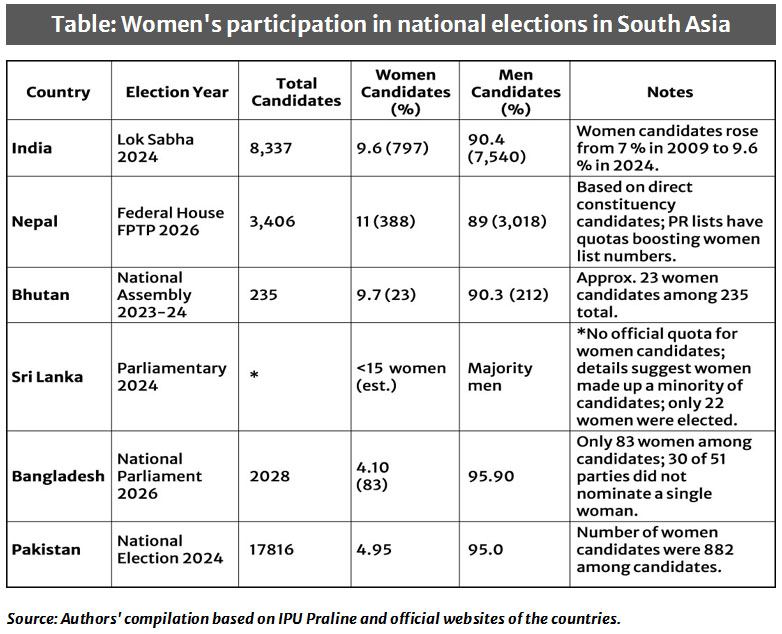 The rise of Islamist candidates is a key factor behind the decline in women's participation. Longstanding barriers such as money, muscle power, and regional dominance continue to shape Bangladesh's parliamentary elections, often described as a zero-sum game. Women remain structurally disadvantaged in accessing these resources.
In recent years, religious extremism has become an additional and increasingly powerful deterrent, further shrinking space for women in electoral politics.
Another major obstacle is an alarming rise in cyberbullying and the objectification of women. Online harassment, often extreme, abusive, and sexualised, has made political participation unbearable for many. When cyber-abuse goes viral, it does not target the woman alone, it engulfs her entire family. Many female candidates are mothers, and family support is essential for a political career. For those with children, enduring sustained and public attacks becomes an overwhelming burden.
TIB notes that women candidates are routinely defeated by the combined use of money, muscle power, and religion.
Even among newer political formations, women's participation has proved fragile. Several young women active in the July uprising joined the National Citizens Party (NCP). Some later quit, while others became inactive after the party entered a last-minute alliance with Jamaat-e-Islami.
Ironically, women's issues dominated election debates this year more than in any previous national elections-largely due to controversial remarks by Jamaat-e-Islami leaders about women's leadership.
In their election pledges, political parties have made numerous promises on women's welfare. The BNP manifesto pledges family cards for woman-head households and free education up to the master's level. Jamaat-e-Islami promises safer workplaces and reduced working hours during maternity. These commitments, however, ring hollow when women are underrepresented in candidacies.
This election was expected to mark a democratic reset after three consecutive polls widely described as flawed. Many Gen-Z voters, voting for the first time, were mobilised by the July uprising, in which women played visible leadership roles. Yet today, those women are missing out, not only from candidate lists but also from the advisory panel of the interim government.
The contradiction is stark. Women make up slightly more than half of Bangladesh's population, yet the gender ratio among election candidates is an alarming 96:4 in favour of men. Women's representation remained capped between 4.0 and 6.0 per cent over the past three elections: (i) 2014 (widely described as a unilateral election): 5.89 per cent; (ii) 2018 (contested election): 4.07 per cent; and (iii) 2024 (often termed a "dummy" election): 5.15 per cent.
Many expected the post-uprising election to break this pattern. Instead, over the past 18 months, women have largely disappeared from electoral politics. Many backtracked on their earlier decision to contest this poll. The unavoidable question is: what happened during this period that pushed the country's largest demographic group away from contesting the national elections?
In a nutshell, the prevailing culture of exclusion has compelled many women to stay away from seeking due share in leadership.Women-based groups have nominated nearly 30-per cent female candidates, but most are contesting in constituencies where their chances of winning remain slim. This exposes the gap between symbolic participation and meaningful political inclusion.
As Bangladesh awaits a healthy democratic transition, one truth remains unavoidable: democracy becomes partial and distorted when women are excluded. Women's participation in national elections is not merely a matter of fairness or symbolism-it is foundational to how democracy functions.
doulotakter11@gmail.com