
Fund allocation insufficient for many govt pry schools
Speakers air grievances at CPD conference
FE REPORT | Monday, 26 June 2023
 Monetary allocation for education and related activities are not sufficient for many government primary schools in the country, speakers told a conference on Sunday.
Inadequate and unequal funding in the primary education sector may also lead to different types of socio-economic inequalities in the later life of the individuals, they observed.
They suggested increasing involvement of the civil society in governing the schools to identify different challenges and get more benefit from the government investment for the primary education.
They came up with the views at a national conference on 'Investing in public primary education: local concern and expected actions' held at the KIB Auditorium in the city's Farmgate area.
The event was organised by the Centre for Policy Dialogue (CPD), county's leading think tank, in collaboration with the Citizen's Platform for SDGs, Bangladesh and Eco-Social Development Organization (ESDO) with support from the European Union (EU).
Local Government, Rural Development and Co-operatives Minister Md Tazul Islam attended the conference as the chief guest while CPD's Distinguished Fellow Dr Debapriya Bhattacharya was in the chair.
Member of the Parliamentary Standing Committee on the Ministry of Primary and Mass Education Shirin Akhter was present as special guest.
CPD Executive Director Dr Fahmida Khatun, its Distinguished Fellow Professor Mustafizur Rahman, and Syed Rashed Al Zayed Josh, a senior economist for the World Bank's Education Global Practice based in Dhaka, spoke on the occasion, among others.
CPD's Senior Research Fellow Towfiqul Islam Khan made the keynote presentation.
CPD recently conducted three surveys involving local youths in Gaibandha, Thakurgaon and Nilphamari districts on quality primary education with the participation of local representatives and stakeholders.
Over 400 stakeholders were interviewed during the surveys.
The survey findings were presented at the conference through the keynote presentation.
According to the surveys, the budgetary allocation of the Ministry of Primary and Mass Education as a share of GDP has decreased from 0.95 per cent in the FY 2016-17 to 0.69 per cent in the FY 2023-24.
Most of the survey respondents said allocations for the public primary schools are inadequate.
They suggested raising the allocation considering the local demand especially for the schools in Char regions.
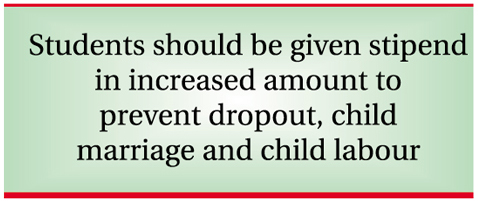
The surveys also recommended giving stipend to the students with increased amount to prevent dropout, child marriage and child labour.
The studies also suggested introducing midday meal at the primary schools as it can play a vital role in preventing dropout, addressing malnutrition problem and attracting more students to school, especially in the poverty-prone areas.
Fahmida Khatun said primary level education is the important pillar of one's education life.
"Due to inequality and lack of funding, many students do not get their desired jobs in later life," she said and added to lower the inequality, a good amount of investment is required.
"However, this investment is not merely for funding, it is also needed for enhancing skills of teachers and other stakeholders," she said.
Professor Mustafizur Rahman said funding for education is actually an investment.
"Investment at the early age education gives the highest return among all investments for education," he said.
He also said varied streams in primary education leads to division in society.
saif.febd@gmail.com