
Fund shortage threatens education for all
FE Report | Sunday, 26 April 2015
Speakers at a programme Saturday said although Bangladesh had made significant achievements in enrolment and completion of primary education, funding shortages had been working as a barrier to ensuring education for all.
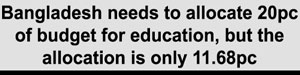
The experts said Bangladesh needed to allocate 20 per cent of its national budget in the education sector or invest 6.0 per cent of GDP in education which it had pledged to the United Nations. But in reality, the country allocated 11.68 per cent of its budget for education or less than 2.0 per cent of its GDP was invested in the education sector.
Bangladesh has achieved 97 per cent success in the education for all (EFA) against the target adopted in Dakar of Senegal in 2000. By this time policy framework for ensuring education for all has been strengthened, both the enrolment and completion of primary education have increased, the dropout rate in primary education has significantly reduced and there is a massive spread of education in the country.
The Campaign for Popular Education (CAMPE) organised the national level event as part of observing the Global Action Week 2015 in Bangladesh with participation of the children born in 2000, the year of adoption of the Dakar Declaration (Education For All) and MDGs.
Education Minister Nurul Islam Nahid was present as chief guest while former president of the Metropolitan Chamber of Commerce and Industry (MCCI) Rokia Afzal Rahman, education secretary Nazrul Islam Khan and CAMPE vice chairperson Manzur Hasan were present. CAMPE executive director Rasheda K Choudhury moderated the event.
In her opening remarks, Rasheda K Choudhury said all the developing countries which adopted the Dakar declaration have made progress in the education sector but still they need to go a long way.
She observed globally the budget deficit was still a serious problem for ensuring education for all.
She said a total of US$ 22 billion was required annually for ensuring universal education.
Nurul Islam Nahid said the government identified 1500 villages including those of backward areas like tea garden, hills, char and haor areas to set up schools.
Besides, there was no polytechnic institute in 16 districts, the minister said.
NI Khan said the education budget was insufficient both for coverage and for ensuring quality education as teachers should be paid more and they should be provided training.
He also said there is a trust of prime minister from where Tk 25 billion has been distributed among 14 million poor students as stipend since 2010. He noted the amount of stipend was insignificant and lack of research in education sector worked as a barrier to taking action.
The secretary also said there was no specialized school at upazila level and transportation problem is a major barrier for disabled children.
He announced there would be technical and vocational education institutes at the upazila level.
In Bnagladesh, only 45 per cent of the primary students get stipend. It is maximum 85 per cent in hard-to-reach areas. The dropout rate is 21 per cent and only 45 per cent of the total students who take admission to class six complete SSC. At present, about 11.9 million students are studying at the primary level. There is no representative data on the out-of-school children. But unofficial data shows four to seven per cent children are still out-of-school.
The event was designed around the theme ACTION with the slogan, 'I am fifteen, the future is mine! I Vote for Education'.
msshova@gmail.com