
G-20 diplomats fail on unity over Ukraine, war’s impact
Saturday, 9 July 2022
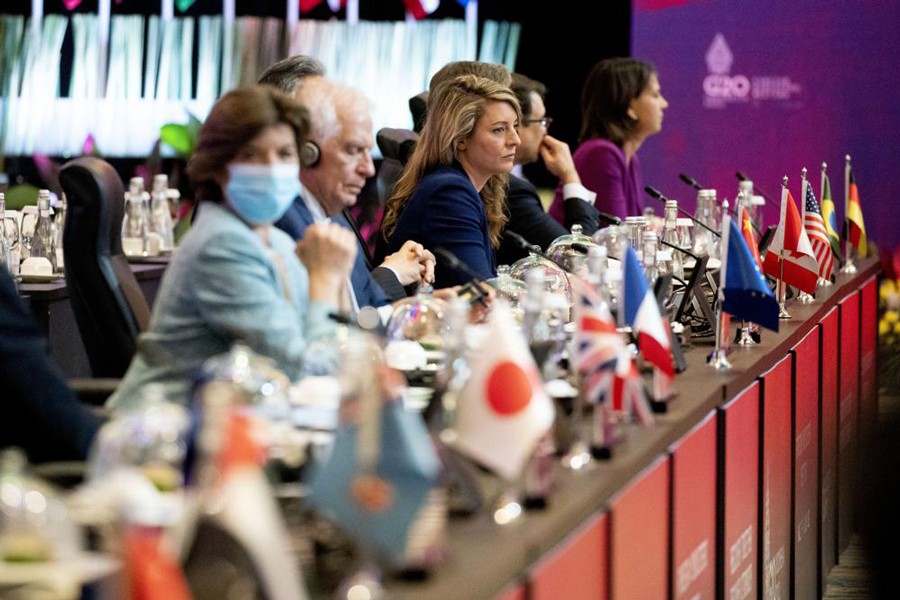
NUSA DUA (Indonesia), July 08 (AP): Deeply divided top diplomats from the world's richest and largest developing nations opened talks Friday with an appeal from the Indonesian host for an end to Russia's war in Ukraine.
As the foreign ministers from the Group of 20 confront multiple crises, including the lingering effects of the coronavirus pandemic, all are overshadowed by the war in Ukraine and its ripple effects, Indonesian Foreign Minister Retno Marsudi told the opening session.
She appealed for unity among the group - which included Russian Foreign Minister Sergey Lavrov, Chinese Foreign Minister Wang Yi, US Secretary of State Antony Blinken and several European counterparts - despite signs that any consensus on the matter would remain elusive.
"The world has yet to recover from the pandemic but we are already confronted with another crisis: the war in Ukraine," Marsudi told the gathering. "The ripple effects are being felt globally on food, on energy and physical space."
She noted that poor and developing countries now face the brunt of fuel and grain shortages resulting from the war in Ukraine and said that the G-20 has a responsibility to step up to deal with the matter or risk losing the world's faith in the multilateral rules-based international order that emerged after WWII.
The Ukraine war has shaken that order, she said, as Lavrov appeared to shuffle papers without expression at his seat in between the foreign ministers of Saudi Arabia and Mexico at the conference site in the Indonesian resort of Bali.
"Honestly, we cannot deny that it has become more difficult for the world to sit together," Marsudi continued. "The current world situation makes people lose faith in multilateralism and its capacity to respond effectively to global challenges."
"So it is our responsibility to end the war sooner than later and settle our differences at the negotiating table, not at the battlefield," she said. "The world is watching us, so we cannot fail."
Marsudi's comments were the only portion of the conference that was open to the media, although individual ministers are expected to hold separate one-on-one and smaller group meetings on the sidelines of the event, which is a precursor to a G-20 leaders' summit to be held at the same venue in November.
Notwithstanding her appeal, there was little prospect for achieving the kind of lofty consensuses on weighty issues that have been a hallmark of past gatherings. And, the group got a last-minute jolt with the resignation of British Prime Minister Boris Johnson, one of the champions of the West's hard line on Russia.
While Johnson's departure is unlikely to dent US and European efforts to promote a tough line on Russia among other G-20 members, it will almost certainly be seen as a sign of weakness by China and Russia.
They will face off against Blinken and his French and German counterparts who had expected to be joined by British Foreign Secretary Liz Truss. She instead left early to return to London to deal with the fallout from Johnson's resignation.
US officials say they are determined not to allow distractions to divert attention from what they believe should be the primary focuses of the Bali conference: the disruption to world food and energy supplies caused by Russia's war in Ukraine, blaming Moscow for its cause, and marshalling an international response to prevent further shortages that are already wreaking havoc in Africa, Asia and elsewhere.
Yet, with East and West so divided and North-South differences emerging, the potential for a G-20 agreement on a way forward appeared negligible.