
Garment industry changes women\\\'s roles in society
Monira Munni | Monday, 29 September 2014
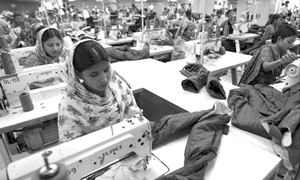
Hardship forced Shaheda to move to the capital city with her parents and siblings more than a decade ago from Kalikapur village in Narsingdi district. She is now an operator at a unit of Urmi Group at Tejgoan Industrial Area.
Shaheda first joined a garment factory at the age of 12 or 13 and earned only Tk 300 a month cutting thread. Now her earnings stood at TK 8,000 per month.
She has been working for 15 years in the garment factories with breaks, including her marriage. She joined back the job after the birth of her first child. During her second pregnancy period she, however, enjoyed four months of maternity leave with salary.
The job in a garment factory helps her to live in a city and send more than half of her monthly income to the family of her in-laws.
Shaheda represents tens of thousands of women who migrated from different parts of the country and work in the garment factories with the hope of better days.
The garment industry is crucial to the economy of the country as the sector employs about four million people, more than 80 per cent of whom are women.
Jobs in garment factories allow the young women, especially the unmarried ones, to leave their homes and save them from the curse of child marriage. They do not, of course, reject marriages rather postpone them until they reach adulthood and financial solvency. Moreover, working women tend to have fewer kids; this helps curb the country's rapidly growing population.
Shaheda's daughter reads in class three. Experts opine that women and their families realise that they can make more money with more education. Garment jobs are giving families more financial strength, allowing them to send their children to schools. Typically, some children stay in school while others take jobs and support the family.
The apparel factories have enabled the workers to meet their own basic needs and those of their family members. Remittances from garment workers have also created redistribution of wealth from city to countryside and helped to raise the status of women in their families and communities.
The traditional gender norms of women's sole responsibility for domestic work has changed to some extent as their work in the garment factory has encouraged their husbands to share the burden.
Sheuli, a 20-year-old girl, has decided to leave her husband following his second marriage, thanks to her workplace that empowered her enough to take her own decision.
If there were no garment industry, young girls like Sheuli would have lived in villages or worked as housemaids in towns.
"I am happy here in Dhaka as I take my own decisions. I can earn money and help my family," Sheuli said with a smile on her face.
However, the health risks of the low-skilled work and conflictions with married life tend to make the garment industry unsustainable for many women over the long run.
Women are employed in the export-oriented industry to exploit the comparative advantages of their disadvantages - such as the low price of their labour, their lower bargaining power, and their docility compared to male workers.
Industry insiders said that garment workers, particularly female workers, generally are young (average age 19), unmarried, with little education or training, no prior work experience, of rural origin and from poor families.
Women suffer the worst from poor working conditions because they hold low-skilled jobs where occupational hazards are greater due to overcrowding, poor ventilation and inadequate fire-prevention measures.
There are frequent cases of female workers being trapped in factories during extra hours at night.
But despite such predicaments, garment factories are a boon for poor women, says Nazma Akter, president of Sammilito Garments Sramik Federation.
"The sector has directly benefited women from the poorer section of the rural population through employment opportunities," she added.
This has reduced marginalisation of women who were previously excluded jobs in the from formal sector. It has also narrowed the gender gap in many spheres, including participation in labour force, social prestige, control over income and decision making, she said but the coin has other side, as well.
"They are not aware of what rights they have, so they cannot say anything. But when a woman garment worker knows her rights, she can demand them from the factory."
The women garment workers suffer from many diseases, including malnutrition, acidity and body pain due to long, tiring work, Nazma said. They even refrain themselves for long hours from going to toilet as they need permission from their line chiefs which are often denied, causing various types of infection, especially urine infection.
Subrina Akter, a doctor at Awaj Foundation, said 70 per cent of her patients come with the complaints of body pain, 10 per cent of them have urine infection while malnutrition is very common.
According to a recent survey conducted by the Alliance, a north American initiative, revealed that about 66 per cent of its surveyed workers report regularly feeling body pain - the top issue is neck ache (52 per cent), followed by pain in legs and/or feet (49 per cent) and headaches (45 per cent) after a full day of work.
Workers from sewing and packing departments suffer more from physical pain compared to their counterparts in other departments. These findings indicate that a large majority of surveyed workers perceive that their work is having a negative impact on their health.
Rupali, a garment worker whose case is just opposite to Shaheda, lost her job because of her pregnancy. She did not want to reveal the name of her factory as she dreams to join there again after giving birth to a baby.
A recent government survey conducted on 653 garment units revealed that about 30 of the factories do not provide maternity leave and allowances.
Still hundreds of thousands of women flock to Dhaka and other garment hubs in Bangladesh every year because the factories pay more than the women could earn in villages.
The minimum wage is TK 5300, raised in December 2013 from Tk 3000 set in November 2010. In 2006, it was Tk 1662 and in 1994, Tk 930 up from Tk 627 in 1985.
According to industry leaders, more than 80 per cent of the total garment factories follow the minimum wage structure announced by the government in December 2013.
The workers are now worried about workplace safety, Nazma said. The workplace safety initiatives by western retailers, she added, create panic among the workers as they are the victims of such move that resulted in their unemployment.
"There is no other industry that can absorb so many female workers with little schooling or skills," Md Atiqul Islam, president of the Bangladesh Garment Manufacturers and Exporters Association (BGMEA), said.
The sector, which started its journey in early 80s, has uplifted the fate of millions of people over the last three decades, he said.
Women are gaining independence, they move around the city, make their own decisions and support their families and old parents in the villages, he added. He observed, "All of this is a very positive sign for our country."
When asked about health hazards, the BGMEA president explained different initiatives which have been taken to ensure workplace safety, including hospital facilities, and labour standards. "It is the duty of the government to ensure the basic needs of a citizen", he maintained.
munni_fe@yahoo.com