
Global economy faces systemic crises
Muhammad Mahmood | Sunday, 5 November 2023
Kenneth Rogoff very early this year wrote in an article that with inflation on the rise and the era of ultra-low interest rates over, there could be a systemic crisis. The latest UN Trade and Development (UNCTAD) report published in early October set out the overall situation facing the global economy and warned of stalling global economy, with growth slowing in most regions from last year and only a few countries bucking the trend.
According to the report the global economy is expected to grow at only 2.4 per cent this year, with slight rise to 2.5 per cent in 2024 describing it as 'flying at stalled speed'. It then added that "Without decisive action, the fragility of the global economy and array of diverse shocks risk evolving into systemic crises".
The report further added that the global economy is wrecked by lower investment and growth, increased domination of large multinational corporations, financial speculation, falling share of labour income and rising social inequality. That the global economy did not experience a systemic financial crisis in 2022 remains a miracle given the rising inflation and interest rates and increased geopolitical risk arising out of the Russia-Ukraine conflict.
Furthermore, public and private debt having risen to record levels during the era of low interest rates, the global financial system faces a huge stress test. The banking crisis in the US and Europe early this year was a foretaste of that test. The crisis was caused by rising interest rates to combat rising inflation.
In fact, on October 31 Jordan Thomas, Chairman of the Swiss National Bank (SNB) (central bank of Switzerland) confirmed the seriousness of the March baking crisis in Switzerland when he said that the SNB's intervention was "crucial" in avoiding a "financial crisis" worldwide.
Many of the assets, such as bonds and mortgage backed securities, lost market value as rates climbed. In the US, yields for 10-year US Treasury notes have more than tripled since the end of 2021, climbing to 5 per cent-- its highest level since before the GFC of 2007-08. Rising bond yields indicate decline in the value of bonds in the secondary market.
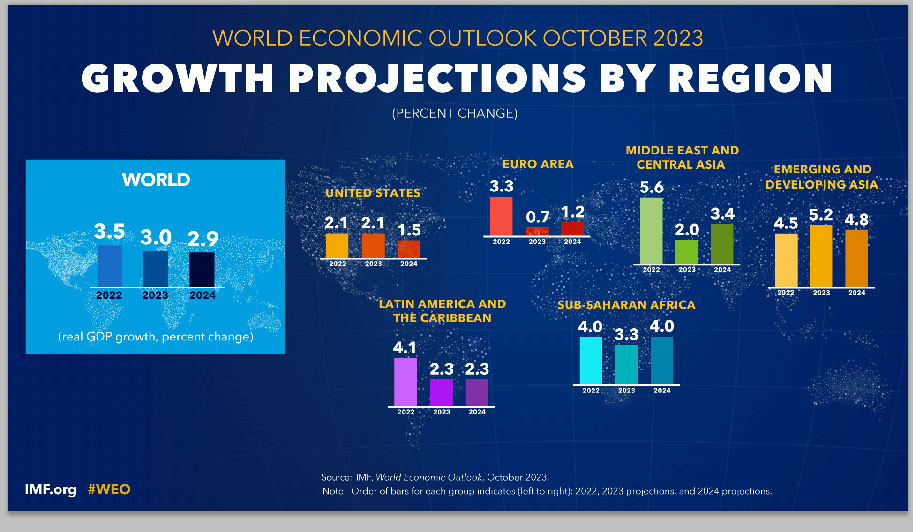
The IMF in its updated World Economic Outlook expressed the view that "Inflation could remain high and even rise if further shocks occur, including those from intensification of the war in Ukraine and extreme weather-related events, triggering more restrictive monetary policy".
While monetary policy is tight, its impact is significantly moderated by countervailing expansionary fiscal policy measures, e.g., the US budget deficit is currently running at 5 per cent of GDP. Such a high level of budget deficit is usually run during recessions and wars.
Meanwhile, the selloff of the US$25 trillion US bond market, one the foundations of the global financial system is continuing. The immediate cause of the selloff is the yield on the 10-year treasury bond rise by nearly one percentage point since the end of July. This was an unusually large increase in such a short period of time caused by rate tightening by the Federal Reserve (the Fed).The major function of bond market in the US is to finance US government debt.
Mohammad El-Erian writing in the Financial Times expressed the view that despite the rise in interest rates 'there is now genuine doubts who will readily absorb the additional supply of government debt associated with high deficits".
However, the fall in bond prices and rise in yields also has other causes other than interest rate hikes. There are doubts whether the market can absorb the already elevated and increasing levels of US government debt, much of it is the result of increased military spending, now standing at US$ 33 trillion. To add to the problem, foreign buyers, notably Japan and China, were pulling back.
In an event at the Economic Club of New York on October 19, The US Federal Reserve chair Jerome Powell said that the Fed would proceed "carefully" indicating rates would not be lifted at the next meeting. While appearing to downplay the prospect of an immediate rate rise, Powell did not rule out in the future. The UNCTAD report warns of lingering investment concerns, especially in the light of prolonged high interest rates.
The heightened geo-political tensions and conflicts like the Russia-Ukraine conflict and the US and the EU backed Israeli genocide in Gaza also featured in Powell's speech as new risks and said that the "highly elevated" geopolitical tensions "pose important risks to global economic activity".
In fact, the Fed again last Wednesday (November 1) decided to keep interest rates at the same level at 5.25 per cent - 5.5 per cent. The rates remain at their highest level since 2021, causing sweeping effects on the US economy. However, the Fed declined to commit that the current monetary tightening cycle is over, rather will continue to evaluate the "extent of additional policy framing."
The Bank of Japan (BoJ) has kept interest rates at zero or negative for decades. The BoJ kept its key short-term interest rate unchanged at (0.1) per cent [negative] and that of 10-year bond yields at around 0 per cent in its October meeting. This indicates that in addition to ultra-low interest rates, the BoJ has also engaged in yield curve control capping its 10-year bonds to zero.
Since July, the long-term interest rate has been capped at 1 per cent, an increase over the previous cap of 0.51 per cent. In a quarterly outlook report, the BoJ revised higher inflation forecasts for FY 2023 and 2024 to 2.81per cent from 1.31 per cent and 1.21 per cent, respectively, exceeding its 21 per cent target. In view of the increase in real interest rates around the world, the yen's depreciation and higher inflation expectation as already mentioned, Japan may have to abandon its zero to negative interest rates.
But a higher interest rate regime will put enormous pressure on the Japanese government where the country's public debt as of March 2023, is estimated to be approximately US$9.2 trillion, or 2631per cent of GDP, and is the highest of any developed nation. 43.31per cent of this debt is held by the Bank of Japan. This massive public debt definitely constrains policymakers' options for managing long-term growth.
Also, ultra-low interest rates have been the glue holding the Eurozone together. But now the rapid interest rate rises have changed that calculus. Now a sustained wave of monetary tightening could expose these major economies in the world as pockets of vulnerability.
In fact, the report indicates that Europe is on the edge of recession, grappling with a rapid tightening of monetary policy and strong economic headwinds, with major economies slowing down and Germany already contracting. Stagnant to falling real wages across the continent, compounded by fiscal austerity, are dragging down growth.
On China the report says that China, though showing signs of recovery from last year, faces weak domestic consumer demand and private investment, China, however, has more fiscal policy space than other large economies to address these challenges.
The volume of global debt stood at US$305 trillion in the first quarter of this year, of which developing countries owe more than US$100 trillion, up from US$75 trillion in 2019. This amounts to 250 per cent of developing countries' GDP. The Institute of International Finance ((IIF) which is the association or trade group for the global financial services industry in a report suggested that the combination of such high debt levels and rising interest rates has driven up the cost of servicing, triggering concerns about leverage in the financial system. Despite such a situation, the IIF expects debt levels to continue to increase rapidly.
Commenting on developing countries, the UNCTAD report adds that debt burden, the silent weight on many developing countries, remains a major concern. Rising interest rates, weakening currencies and sluggish export growth have combined to squeeze the fiscal space for essential needs, transforming the growing debt service burden into unfolding development crisis.
Global trade will also face an unfavourable environment as economies slow down. The Global Financial Crisis (GFC) of 2007-08, was essentially caused by the deregulation of financial markets. Following the GFC, there has been a steady decline in the flow of goods and services as reflected in the declining trade/GDP ratio which declined from 25 per cent in 2008 to 20 per cent in 2020.
The report also contains an important chapter detailing the link between financial speculation in commodity markets and rising costs of basic foodstuffs. In fact, a major component of the inflation surge has been the escalation of food prices and other necessities such as fuel and energy. More interestingly major commodity trading companies have also become major financiers to governments and Private Corporation and carry out speculation on the future direction of prices.
The demise of the Bretton-Woods system in 1971 fostered the emergence of neoliberalism which gave rise to financialisaton. This could be understood in the current context as a distorted financial arrangement based on the creation of artificial financial wealth which is completely disconnected from the creation of real wealth, that is, from the real economy where the production of goods and services take place. The report also pointed out that "profiteering from financial activities now drives profits in the global food trading sector". In this sector speculative activities are carried out not only by banks, hedge funds and other financial institutions but leading food trading companies are also actively involved in it.
muhammad.mahmood47@gmail.com