
Go beyond trade, invest in BD, Hasina urges Indian businesses
Exporting products to NE Indian states, Nepal, Bhutan, SE Asian countries easy
Thursday, 8 September 2022
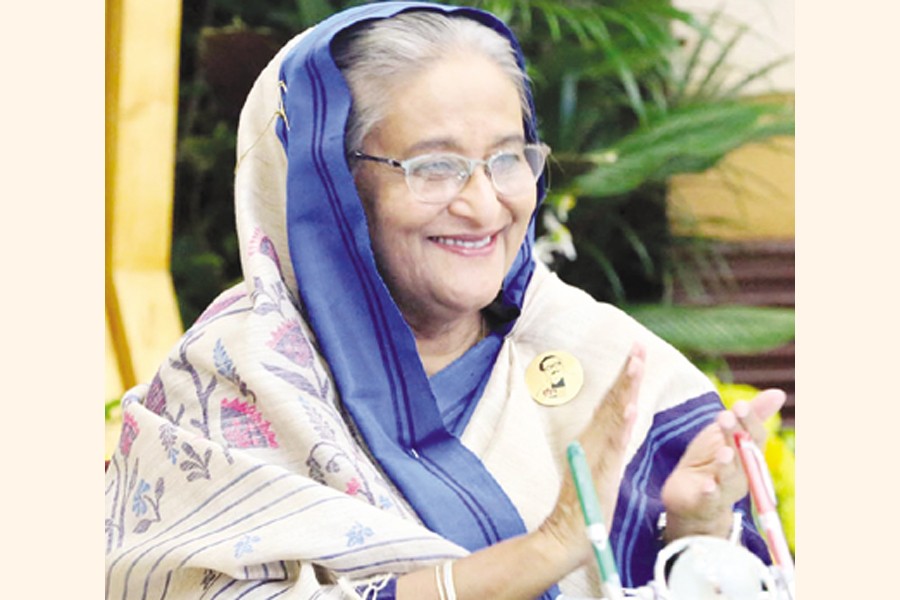
Prime Minister Sheikh Hasina has urged Indian businesses to invest in Bangladesh, which she says has the most liberal investment regime in the region with a wide array of facilities, attractive incentive policies, and consistent reforms, reports bdnews24.com.
The prime minister said that 100 special economic zones and 28 high-tech parks are being established in Bangladesh to encourage investment and rapid economic development.
At least two dedicated special economic zones at Mongla and Mirsharai are being developed for the Indian investors, she said.
Indian investment would further pave the way to harness the goodwill of the two friendly countries, and bring economic prosperity to the region, the prime minister said in her speech to the Bangladesh-India Business Event in New Delhi on Wednesday.
Highlighting Bangladesh's unique location, Hasina said it would enable Indian investors to export their products to not only the northeastern states of India, but also to Nepal, Bhutan, and to Southeast Asian countries.
In the last ten years, the total bilateral trade between Bangladesh and India grew impressively, with the balance heavily in favour of India, she said.
At present with its improved manufacturing capacity, Bangladesh is prepared to supply quality products at competitive prices to the Indian market. "We, therefore, invite Indian importers to look at Bangladeshi products."
The country has implemented mega projects to accelerate the growth of industries and to take full advantage of our strategic location, she said.
Mentioning the Padma Bridge, constructed with Bangladesh's own funds, and several other infrastructure projects including the first metro rail project MRT Line-6, the Karnafuli Tunnel, and the Dhaka Elevated Expressway, Hasina said they would contribute substantially to the country's GDP growth.
"I would urge Indian investors to consider possible investments in infrastructure projects, manufacturing, in energy and transport sectors."
Indian investors and business houses can set up industries in Bangladesh through buy-back arrangements by reducing time, cost and resources, she said.
To enable larger gains, Bangladesh-India cooperation should go beyond trade, she said. "It should include investment, finance, services, technology transfer, and be placed within the context of regional cooperation."
In the 2021-22 fiscal year, the total amount of FDI inflow to Bangladesh was $1.37 billion, while the proportion from India was only $15.751 million, or only 1.15 percent.
Hasina said that Bangladesh and India have the best of relationships and it is known as a role model of neighbour diplomacy. The two countries, sharing 54 common rivers and a 4,000 km-long border, do not have disputes, she said.
"Bangladesh is India's most important development and trading partner. India receives the highest number of tourists and medical patients from Bangladesh."
Thousands of Indian nationals are working in Bangladesh, contributing to the economies of both nations, the prime minister said. "Indeed, the time is ripe for the Indian business community to focus more on Bangladesh and take advantage of its economic growth, cheaper cost and huge consumer base."
The COVID-19 pandemic and the war in Ukraine have greatly affected global trade and caused significant increases in commodity and fuel prices worldwide, said Hasina. "It has severely affected the established supply chain."
She said it was heartening to note that despite the ongoing challenges, India remains among the foremost fastest-growing major economies in the world.
Bangladesh has, since the devastating Liberation War in 1971, come a long way as a sovereign, independent country, the prime minister said. "From those days of famines and food-aid dependency, Bangladesh is today self-sufficient in food. It is now one of the largest global producers of rice, vegetables, grains, and fresh-water fish - to name a few."
Bangladesh, which had in the past suffered from natural calamities, is today a global example of disaster preparedness and management. It has also achieved huge socio-economic success, attained impressive growth and is thus dubbed a 'Development Miracle', the prime minister said.