
Stabilising Fuel Supply
Govt appoints tag officers, deploys BGB at fuel depots
FE REPORT | Sunday, 29 March 2026
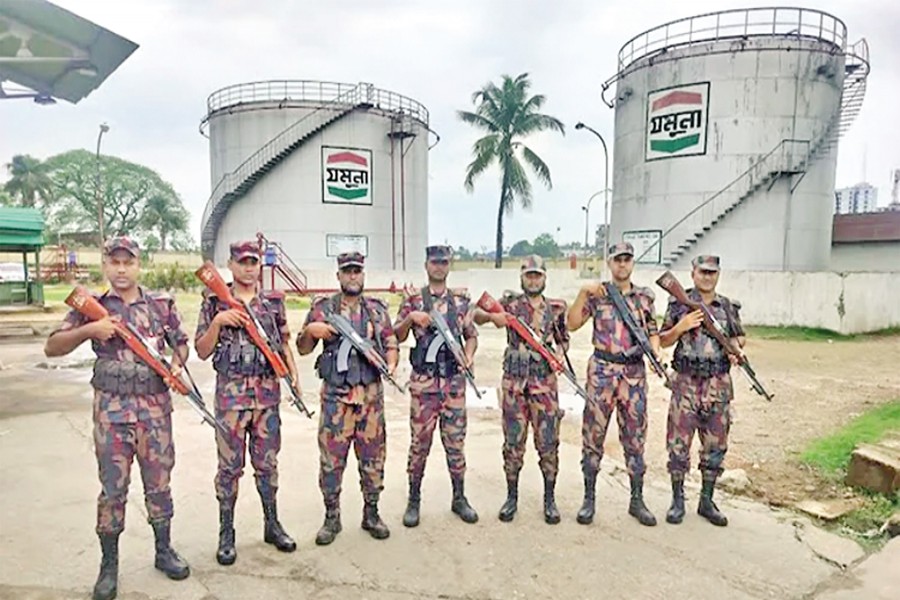
The government has stepped up monitoring of the country's fuel supply chain by appointing tag officers at petrol pumps and deploying Border Guard Bangladesh (BGB) personnel at key depots, as motorists in the capital continue to suffer for acute short supply of fuels.
The Energy and Mineral Resources Division said the measures were taken to prevent hoarding, ensure disciplined distribution and maintain uninterrupted supply amid disruptions linked to the ongoing Middle East conflict. Officials, however, reiterated that the country had sufficient fuel reserves.
According to a circular from the Ministry of Power, Energy and Mineral Resources, tag officers have been assigned to petrol pumps to supervise fuel distribution, enforce regulations and report any irregularities to higher authorities.
The initiative aims to improve transparency and accountability at the retail level.
The circular said the country has sufficient fuel stock despite the ongoing disruptions.
However, BGB personnel have been deployed at 19 major fuel depots across nine districts since March 25.
These include depots in Dhaka, Kurigram, Rangpur, Rajshahi, Sylhet, Moulvibazar, Cumilla, Brahmanbaria and Sunamganj.
BGB Public Relations Officer Md Shariful Islam said the deployment followed directives from the Ministry of Home Affairs and was being carried out under a coordinated plan supervised by BGB headquarters.
Personnel have set up temporary base camps at strategic locations, including remote areas, to monitor depot operations closely.
They are conducting regular inspections and enforcing administrative and security measures to prevent hoarding, illegal storage and any attempts to disrupt the supply chain.
Authorities said intelligence surveillance has also been strengthened to tackle potential sabotage and ensure swift response to any untoward incidents. Close coordination is being maintained with depot authorities to facilitate real-time information exchange.
At the same time, BGB has intensified patrols along border areas, including riverine routes, and increased surveillance at land ports and checkpoints to prevent fuel smuggling.
Vehicles involved in import-export activities are being regularly searched as part of the enhanced monitoring.
Despite these measures, a deepening mismatch between supply and demand has created severe hardship for motorists in Dhaka, with long queues forming at petrol pumps and many stations running dry.
On Saturday, the impact of the shortage was visible across several parts of the capital, including Shahbagh, Tejgaon, Mohakhali, Banasree and Bijoy Sarani.
Field visits found that many petrol pumps remained temporarily closed due to lack of supply, while those still operating struggled to handle the surge in demand.
At several stations, queues of motorcycles, private cars and other vehicles stretched beyond main roads into adjacent streets, forcing commuters to wait for hours in uncertainty.
Some filling stations, including Sikdar Filling Station and Eureka Enterprise, continued to operate under pressure, while others such as Trust Filling Station in Bijoy Sarani were forced to suspend sales after exhausting their stock.
Authorities at Trust Filling Station said fuel was dispensed until early morning before supplies ran out, adding that operations were expected to resume later in the day once fresh stock arrived.
Motorists described the situation as increasingly frustrating and disruptive. "I have been standing in line since morning and still haven't received fuel," said a motorcycle rider waiting at a filling station in Mohakhali. "I had to leave my work, and it's causing further problems."
Others said the crisis had become routine. "Due to the shortage, this happens almost every day. Even after waiting for hours, sometimes we get fuel, sometimes we don't," said a private car driver in Tejgaon.
Several drivers expressed uncertainty over whether they would be able to refuel even after long waits, noting that pumps often run out of fuel before their turn arrives.
Pump operators attributed the situation to irregular fuel supply and delays in tanker movements from central depots.
They said deliveries have failed to keep pace with rising demand, worsening the pressure on operational stations.
In response to the crisis, the Bangladesh Petroleum Corporation (BPC) has introduced a fixed schedule for fuel release from its main installations and depots, reports bdnews24.com.
Under the new system, distribution will take place between 7:00am and 3:00pm daily.
The corporation said the structured timeline is intended to streamline supply and ensure a more organised distribution process for filling stations and dealers.
Additionally, BPC has directed all petrol pumps to display detailed daily supply information on visible boards.
This includes the type of fuel available, the average daily supply received in March 2025 and March 2026, and the quantity received on the current day.
The directive came into effect at 12:00pm on Saturday.
The government has also intensified enforcement through mobile courts and monitoring drives.
According to official data, 293 operations were conducted across 62 districts in a single day, resulting in 78 cases and fines totalling Tk 315,550.
In Jamalpur, a mobile court fined a petrol pump Tk 50,000 after discovering around 2,500 litres of petrol stored in 12 drums, despite claims from the operator that stocks had been exhausted.
The penalty was imposed under the Consumer Rights Protection Act, 2009, for creating an artificial crisis.
talhabinhabib@yahoo.com, sajibur@gmail.com