
Govt eyes practical reforms in media, telecom sectors
Information minister signals policy overhaul, Wage Board review
FE REPORT | Friday, 10 April 2026
The government is moving towards a more pragmatic approach to reforms in the media and telecom sectors, aiming to address longstanding structural and regulatory gaps.
The focus is expected to be on actionable changes grounded in research rather than theoretical frameworks.
The reform push comes as policymakers review existing laws, institutional practices and industry standards, with an emphasis on transparency, accountability and sustainability in the media landscape.
In line with its election manifesto, the BNP government will introduce necessary reforms to Bangladesh's media and telecom policies, Information Minister Zahir Uddin Swapan said on Thursday.
He said a committee has begun research and reporting on state-controlled media outlets and reforms will be based on its findings.
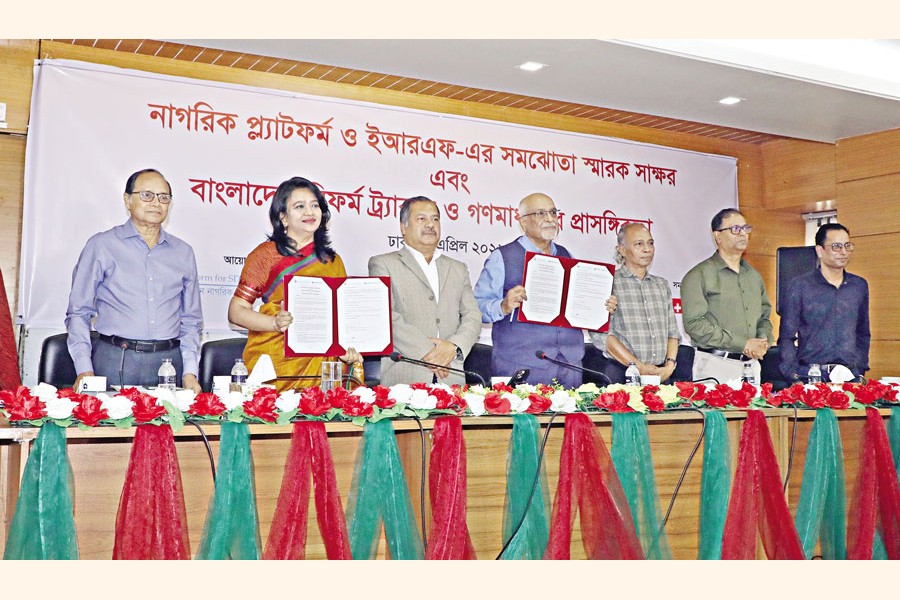
The minister made the remarks at a Memorandum of Understanding (MoU) signing ceremony held at the Economic Reporters' Forum (ERF), organised jointly by the ERF and the Citizen's Platform for SDG Implementation. The event was presided over by ERF President Doulat Akter Mala.
Under the MoU, signed between the Citizen's Platform for SDG Implementation and the ERF, the platform will monitor government reform activities in collaboration with journalists.
The information minister said telecom and media policies are currently under review. "Once finalised, we will proceed with implementation based on the findings," he said.
He also mentioned that Bangladesh's media and broadcasting system will be restructured following the model of the British broadcasting system.
Furthermore, work is underway to determine compliance with the journalists' Wage Board.
The minister added that plans are in place to quickly formulate an advertising policy involving all stakeholders in the media industry.
"We must stop the spread of misinformation and collective misrepresentation regarding circulation. We need to work together to prevent disorder in cyberspace," he said.
Dr Debapriya Bhattacharya, Convener of the Citizen's Platform and Distinguished Fellow at CPD, said reform must be cross-cutting, people-oriented and reflective of public sentiment.
He noted that reform is a dynamic process. "To sustain economic progress, reforms must continue over time."
Without transparency, accountability and a clear vision, reforms cannot succeed, he added.
Shamsul Haq Zahid, Editor of The Financial Express, expressed frustration that the Media Reform Commission report prepared during the interim government period has yet to be implemented.
"I am disappointed because I was part of it. We submitted the commission's report in March 2025. The then head of government, Dr Yunus, asked us to separately list urgent, implementable items. However, even those have not been enacted," he said.
He noted that the condition of newspapers is currently very poor, with advertisement rates falling significantly.
He also pointed out that, despite having lower actual circulation, English-language newspapers are unfairly compared with Bangla newspapers in terms of advertising rates, which he said is not acceptable.
"If the government implements the reforms based on the commission's report, our media will be modernised," he added.
Referring to two approaches to journalism, New Age Editor Nurul Kabir spoke about "engaged journalism" and "detached journalism". He argued for engaged journalism, where reporters actively challenge irregularities, injustices and corruption.
In response to a question, he said journalists may need to act as activists during national crises, but cautioned against crossing into partisan positions.
At the event, ERF General Secretary Abul Kashem expressed concern over the journalists' Wage Board issue, saying that while there is discussion about introducing pensions for journalists, there has been little progress on establishing a minimum pay structure.
He noted that the 8th Wage Board was awarded in 2013 and has not been updated since, even though government employees' salaries have doubled in the meantime.
Mr Kashem also pointed out that the government announced a 9th Wage Board in 2018, but it has been implemented only at the Bangladesh Sangbad Sangstha (BSS).
"If there is no proper salary structure, how will journalists survive long enough to receive a pension?" he asked.
tonmoy.wardad@gmail.com