
Economic woes from oil crossing $120 threshold
Govt may have to spend extra Tk 610b annually
Every $10 increase in Brent crude price per barrel translates into $1b additional annual expenditure for Bangladesh: Study
FE REPORT | Sunday, 29 March 2026
Bangladesh faces a looming economic challenge stemming from global oil price crossing a critical threshold of US$120 per barrel amid the escalating Mideast tensions, with an extra burden on its cautiously tailored budget.
Researchers at a press briefing Saturday warned that such an oil surge could impose a huge burden of Tk 610 billion in additional annual spending to fuel the country's economy.
Their note of alert is underlined with serious concerns about economic sustainability, industrial growth, and employment.
Change Initiative has carried out a study on this score where the researchers have revealed that every $10 increase in Brent crude-oil price per barrel translates into nearly $1 billion in extra annual expenditure for Bangladesh.
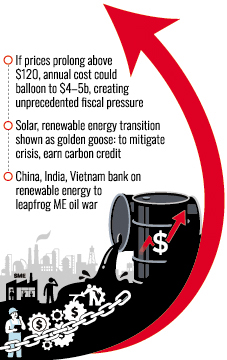
The country imports about 95 per cent of its energy needs, and this dependency leaves the economy "highly vulnerable to global market volatility", the study notes, in the wake of energy blockages in the Gulf amid the hit-and-kill US-Israel war against Iran. If prices remain above $120 for an extended period, the annual cost could balloon to $4-5 billion, creating unprecedented fiscal pressure.
The small and medium enterprise (SME) sector, which accounts for 70-80 per cent of national employment and contributes 25-30 per cent to gross domestic product (GDP), is expected to be hit hardest. Rising fuel costs would increase production expenses, reduce competitiveness, and potentially trigger widespread job losses.
Analysts caution that prolonged subsidies are not a viable solution, and the government may eventually be forced to adjust energy prices, risking de-industrialization.
Chief researcher M. Zakir Hossain Khan points out a blessing in disguise out of the crisis, emphasizing that "while the situation is dire, it also presents a chance for Bangladesh to accelerate its transition toward renewable energy".
He notes that countries such as China, India, and Vietnam have successfully invested in renewables to stabilize their industries, and Bangladesh must follow suit to safeguard its future.
The study reveals that rooftop solar installations in industrial zones could reduce operating costs by 30-50 per cent while cutting carbon emissions significantly.
In fact, utilizing just 10 per cent of unused space in industrial parks could generate 57 megawatts (MW) of solar power, reducing emissions by over 51,000 tons of carbon dioxide annually.
Expanding this to 20 per cent could double the capacity, further strengthening energy independence.
Researchers also highlighted the potential for carbon-credit revenues, estimating that Bangladesh could earn around $0.40 million annually by reducing emissions in SME clusters.
Sectors such as leather, plastics, packaging, and light engineering have been identified as priority areas, with the potential to cut emissions by up to 49 per cent through targeted interventions.
The urgency is underscored by Bangladesh's Nationally Determined Contribution (NDC) target, which aims to reduce 69.84 million tonnes of carbon-dioxide emissions by 2035.
Achieving this goal will require immediate and decisive action to transform the energy landscape.
As global oil prices continue to climb, Bangladesh stands at a crossroads.
Failure to act could result in economic instability, job losses, and weakened industrial capacity.
But with bold investments in solar and other renewable sources, the country has the opportunity to not only mitigate the crisis but also position itself as a leader in sustainable industrial growth, the study concludes.
Azizjst@yahoo.com