
Govt moves to overhaul sanctions regime ahead of FATF mutual evaluation
Officials say decision will ensure faster information flow, stronger sanctions enforcement
REZAUL KARIM | Sunday, 18 January 2026
The government has initiated a sweeping overhaul of the national sanctions framework to plug loopholes in the financing of weapons of mass destruction (WMD), sources familiar with the development said.
The move is being seen as a high-priority strategic step to align domestic regulations with the United Nations Security Council Resolution (UNSCR) 1540 and to ensure a favourable outcome in the upcoming Financial Action Task Force (FATF) Mutual Evaluation.
The decisions were taken at a recent meeting of the National Committee on the Implementation of Sanctions Related to Terrorism Financing and Proliferation Financing, chaired by Foreign Secretary Md Asad Alam Siam.
When contacted, an official said the present government has taken multiple initiatives, including the recovery of money and assets allegedly siphoned off from the country.
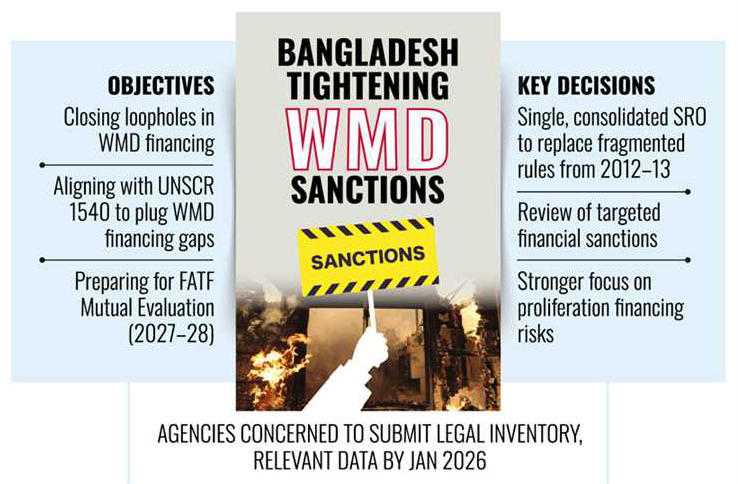
He said the effectiveness of the existing statutory regulatory orders (SROs) governing targeted financial sanctions was reviewed, and the meeting agreed that a new consolidated SRO should be issued to replace fragmented and outdated regulations enacted in 2012 and 2013.
Officials concerned noted that the current legal framework no longer fully reflects evolving international obligations under FATF standards.
The committee discussed Bangladesh's preparations for its fourth round of FATF Mutual Evaluation (2027-2028), with particular emphasis
on risk assessment related to the proliferation financing of weapons of mass destruction.
Representatives of the Bangladesh Financial Intelligence Unit (BFIU) informed the meeting that the evaluation would assess both the adequacy of the legal framework and the effectiveness of implementation across government agencies.
The committee agreed that stronger inter-agency coordination and data-sharing would be critical to demonstrating compliance.
To address gaps in risk mitigation, the meeting decided to form a core working committee involving key ministries and agencies, including the ministries of foreign affairs and home affairs, Bangladesh Bank, BFIU, the Anti-Terrorism Unit of Bangladesh Police, the National Board of Revenue (NBR), and the Ministry of Shipping.
The core committee will assess risks, identify institutional responsibilities, and recommend operational measures to prevent the financing of WMD proliferation.
The committee also approved the expansion of primary contact points under the UNSCR framework to improve implementation and coordination.
New agencies proposed for inclusion include customs authorities, civil aviation and maritime authorities, the Bangladesh Road Transport Authority, and counter-terrorism units of the police.
Officials said the decision would ensure faster information flow and more effective enforcement of sanctions across borders, ports and transport sectors.
The meeting reviewed progress on the implementation of UNSCR 1540, which obliges states to prevent non-state actors from acquiring nuclear, chemical or biological weapons.
It decided that Bangladesh would move towards formulating a national action plan, updating regulatory policies, and compiling a comprehensive inventory of laws and regulations relevant to non-proliferation.
The relevant ministries have been instructed to submit the required data to the foreign affairs ministry within a specified timeframe.
The committee further instructed all concerned ministries, divisions and agencies to nominate focal points and submit updated information by early January 2026 to support regulatory updates and international reporting requirements.
Officials said the measures would not only enhance Bangladesh's compliance with global non-proliferation norms but also strengthen the country's standing in the upcoming FATF assessment.
rezamumu@gmail.com