
Govt pursuing a reform-based economic agenda to address current challenges
Says Dr Rashed Al Mahmud Titumir
FE REPORT | Sunday, 7 June 2026
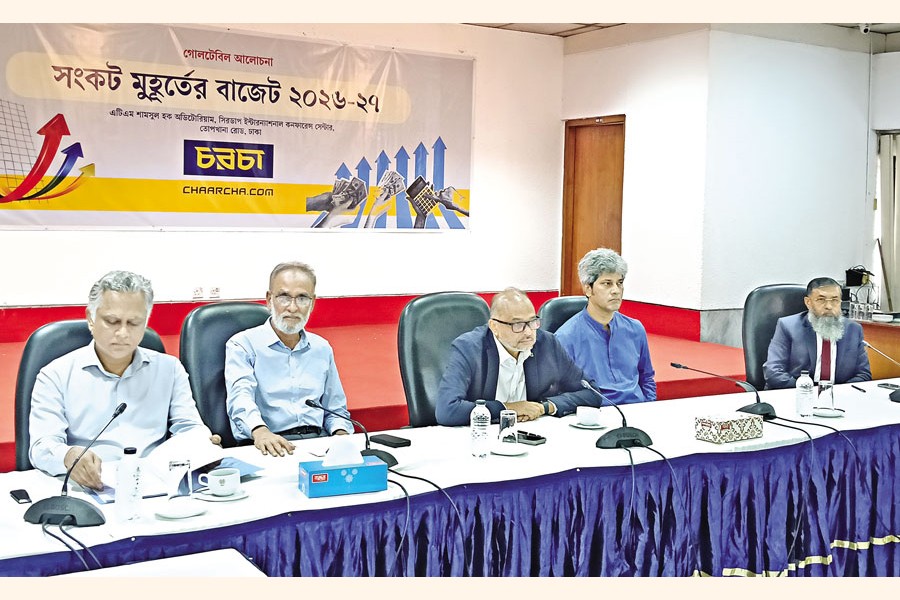
The government is working on a new economic model aimed at transforming Bangladesh into a $1.0 trillion economy by 2034 while ensuring that the benefits of growth are shared across society under the philosophy of a "Bangladesh for All", Prime Minister's Finance and Planning Adviser Dr Rashed Al Mahmud Titumir said on Saturday.
Speaking at a roundtable discussion titled "Budget for a Crisis Moment 2026-27" at the CIRDAP International Conference Centre in the capital, Dr Titumir said the government was pursuing a reform-oriented economic agenda to address current challenges and build a more inclusive growth model.
"The government's philosophy in addressing the present crisis is 'Bangladesh for All'. We want to ensure economic growth whose benefits reach every section of society," he said.
The event was organised by chaarcha.com and attended by State Minister for Planning Zonayed Abdur Rahim Saki as the special guest.
Dr Titumir said the government was focusing on reducing bureaucratic complexities, carrying out administrative reforms, creating a level playing field for domestic and export-oriented industries and introducing business-friendly policies to stimulate investment.
He also disclosed that the government was preparing a Tk 600 billion restructuring package to revive closed industrial units.
The discussion took place amid persistent inflation, sluggish private investment, employment challenges and growing uncertainty in the global economy.
Addressing the seminar, Mr Saki revealed that the government had approved 1,270 new development projects for inclusion in the Annual Development Programme (ADP) for fiscal year 2026-27.
The projects were selected from nearly 1,600 proposals submitted by various government agencies.
He said 1,333 development projects are currently under implementation, of which 1,150 will continue into the next fiscal year, while the remainder are expected to be completed by the end of June.
According to the state minister, the government has adopted a more coordinated approach to development planning to avoid the disconnects that affected many projects in the past.
Referring to the banking sector, Mr Saki said restoring confidence in financial institutions was essential after years of challenges that had affected both depositors and legitimate businesses.
He added that creating a supportive environment for new entrepreneurs was also a key policy objective.
Apex Footwear Managing Director Syed Nasim Manzur called for major reforms to the tax regime and investment climate.
He proposed reducing the corporate tax rate from the current 27.5 per cent to 20 per cent, in line with competing economies such as Vietnam.
Mr Manzur also urged the government to ensure a stable tax policy framework for at least three years and introduce digital and risk-based audit systems in tax administration.
"The greatest concern for foreign investors is uncertainty in tax rates. Today it is 20 per cent, tomorrow it becomes 22 per cent and the day after 18 per cent. Such unpredictability discourages investment," he said.
He argued that the existing 15 per cent VAT rate was too high under current economic conditions and suggested introducing two or three VAT slabs to ease the burden on businesses and consumers.
Highlighting infrastructure constraints, Mr Manzur pointed to the lack of modern storage and cargo-handling facilities at airports.
"It is surprising that we aspire to export $40 billion worth of goods while lacking adequate storage facilities for raw materials at the airport," he said, adding that the shortcomings were causing significant losses and inefficiencies.
He also noted that around 74 per cent of healthcare expenditure in Bangladesh is borne directly by households, underscoring the need for reforms in healthcare financing.
BKMEA President Mohammad Hatem called for bringing the entire taxation system under a proper legal framework.
In a satirical remark, he said businesses were being "illegally robbed" under the existing tax system and demanded meaningful reforms.
Policy Exchange Bangladesh Chairman and Founder Dr M Masrur Reaz highlighted the country's longstanding energy challenges, saying the crisis had begun well before recent geopolitical tensions in the Middle East.
"We had an energy shortage long before the Iran war. Supply remained below demand, which interrupted production and industrial output," he said.
President of the Institute of Cost and Management Accountants of Bangladesh (ICMAB) Md Kausar Alam said one of the key features of the proposed budget was its emphasis on rebuilding trust among stakeholders.
"The unique aspect of this year's budget is regaining trust -- trust among citizens, foreign stakeholders, local investors and taxpayers," he observed.
Researcher and rights activist Maha Mirza called for a significant increase in agricultural spending, proposing that the sector's budget allocation be raised from 5.0 per cent to 10.0 per cent.
She argued that strengthening agriculture was essential for ensuring food security, protecting rural livelihoods and supporting sustainable economic development.
Other discussants included former finance secretary Muslim Chowdhury and Prof AKM Waresul Karim, dean of the School of Business and Economics at North South University.
The session was moderated by Chaarcha Editor Sohrab Hossain.
bdsmile@gmail.com