
Govt securities become hotcakes on rate rises
Windfalls from high-rated treasuries redirecting investors from bourses, banks
JUBAIR HASAN | Wednesday, 11 October 2023
Rate rise now makes government securities lucrative investment instruments and economists think sure-fire windfalls from the secure treasuries may redirect investors from bourses and banks.
Banks themselves and individuals, lured by higher gains, have already begun making beeline to put their funds in treasury bills and bonds, officials and bankers said.
Such growing participation in the auctions of risk-free government securities comes as a latest blow to the commercial banks which fear huge liquidity tightness in the days ahead as both institutional and individual depositors have already started diverting their funds into the treasury products.
Treasury bills and bonds are the risk-free investment instruments through which the government borrows to meet its budget-financing shortfalls.
Sources at Bangladesh Bank (BB) said the central bank as part of its inflation-checking move recently raised the policy rate by 75 basis points to reach 7.25 per cent. Because of the leap in returns on investment the rates in the government securities increase to a level which is much higher than that of the deposit rates in the banking system.
And this rise of rates, in fact, helps allure banks, institutional and individual investors into the treasury auctions, the sources said.
According to BB statistics, the latest cut-off yields on 91-day, 182-day and 364-day treasury bills rose to 9.25 per cent, 9.50 per cent and 9.75 per cent respectively from 7.45 per cent, 7.60 per cent and 8.25 per cent.
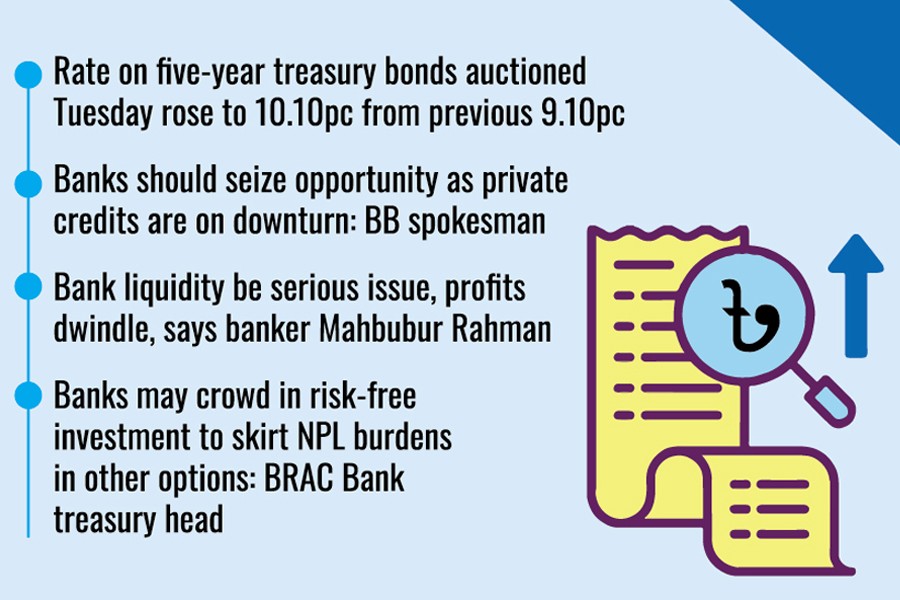
The rate for five-year-long treasury bonds, which were auctioned Tuesday, rose to 10.10 per cent from previous rate of 9.10 per cent.
On the other hand, the rates on deposits in the banking system are now hovering in-between 7.0 per cent and 8.0 per cent, according to the industry insiders.
Seeking anonymity, a BB official said they were receiving growing response from the banks in participating in the auctions of T-bills and T-bonds, which is "a good sign".
The official said the central bank wants to curtail the inflationary rate below 8.0 per cent by coming December and the growing rate in government securities will certainly help achieve the target through reducing the availability of credits on the money market.
The higher rate will attract the commercial lenders to stake their money on the treasury instruments which will help reduce the volume of excess liquidity in the banks. On the other hand, people and institutions having funds will also feel encouraged to invest in government securities to reap comparatively higher gains in this critical period of time when there are not many viable investment options.
"If people or institutions don't have enough money to spend, they will not. So consumption demand will be lessened and it will help reduce the inflation rate," the central banker says, adding that it will also put pressure on the banks to raise the deposit rate further to generate funds.
Spokesperson for the central bank Md Mezbaul Haque says government securities have become a sustainable investment option for banks and individuals right at the moment as their yields are higher than that on many savings instruments in commercial banks.
He also mentions another benefit -- the tax at source on the profits is 5.0 per cent which is 10 per cent for any other savings schemes in the commercial banks. "So, it is a viable investment option for the common people."
He suggests that banks should seize the opportunity to invest more in the government securities as private-sector-credit growth continues on a downturn in recent months.
According to the BB data, the volume of excess liquidity in the country's banking industry continues rising, reaching Tk 1.80 trillion as of August 2023. It was Tk 1.66 trillion in the previous month. The aggregate excess liquidity in banks was recorded at Tk 2.0 trillion in June 2022.
The private-sector-credit growth contracted to 9.75 per cent in August 2023 from 14.01 per cent in August 2022.
Talking to the FE writer, Treasury head of BRAC Bank Md Shaheen Iqbal theirs is one of the leading banks in terms of investment in the treasury instruments and they have intensified their focus more because of the higher rate.
"We're now receiving good response from the individuals who want to invest in government securities to gain more," he said.
He feels that banks having credits will happily take this risk-free investment opportunity at this time as there is a risk of NPL (non-performing loan) involved in investing in other options.
"So, if the risk-free lending rate is close to the risky lending rate, banks will throng to the risk-free one," he says.
Contacted, Managing Director and CEO of Mutual Trust Bank Limited (MTB) Syed Mahbubur Rahman said banks would invest more in government securities as this is more secure and effective return is higher, which will reduce lending capacity of the banks.
Also, because of higher returns, institutional and individual investors have already started diverting their funds into the government treasury instruments. At the same time, banks have to buy dollars from BB to meet their import liabilities.
"So, liquidity will be a serious issue in the banking sector in coming days," the banker forecasts.
The experienced banker cites an apparent paradox in current banking regime -- that the rate on deposits in banks keeps adjusting upwards on a daily basis while the lending rate cannot be adjusted for six months once it is fixed.
"So, the pressure on the banks' profitability will continue, which is happening at a time when banks' earnings from trade is fast getting reduced."
jubairfe1980@gmail.com