
Govt set to dig deeper for funding BR
Jasim Uddin Haroon | Wednesday, 25 March 2015
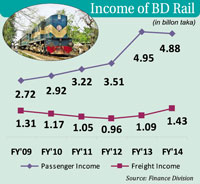
The government may have to dig deeper for funding the state-run Bangladesh Railway (BR) as the restive politics casts an adverse impact on its revenue income.
Officials said the ongoing political turmoil continued to impact on the revenue earnings of the BR, especially from the passenger service, despite raises in fare.
Senior officials at the railway ministry said the figures available with them so far in the current fiscal year (FY) were too frustrating.
"We cannot forecast what will happen to our revenue at the end of the fiscal year," said one of the officials.
The earnings from carrying passengers registered a negative growth of 1.41 per cent to Tk 4.88 billion in the FY 2013-14, official data revealed.
In the past fiscal, the country had faced series of political programmes on the caretaker government and election issue. The tensions and troubles heightened mainly during October-December period in 2013.
The country's economy has been facing similar disruptive programmes since this past January, hitting the railway incomes alongside substantial economic losses in many other sectors.
The senior officials at the railway ministry feared that the fall in passenger-transportation earnings would worsen this fiscal year further for the nonstop blockade coupled with hartals since January.
One of the officials said the government's financial support is set to rise this year to meet its essential cost because of the troubles.
BR usually takes more than Tk 6.0 billion from the government.
The earning from the railway transportation was supposed to have a significant boost as its rates had been hiked after more than 20 years.
The government raised the railway fares by more than 80 per cent on an average since October 2012.
"We got a tremendous revenue growth in 2010-13, by 41 per cent to Tk 5.95 billion, as a result of upward revision of railway fares," he said.
However, the income growth from freight charges was on the way up.
The growth of earnings from goods transportation registered at 31.19 per cent in 2013-14, and volume to 2.22 million tonnes.
It is believed the rise is mainly due to the raise in the fares.
Railway officials said cargo movement between Chittagong seaport and Kamalapur ICD remained almost static but rise in the fares helped grow the revenues from the cargoes.
Railway-insiders said the political turmoil slowed the traffic movement, leading to fall in the growth of revenues.
They pointed out that if fishplates in a particular area are uprooted, many scheduled trains suffer setbacks for that.
Such schedule disruption also affects the revenues.
Md Sabah Uddin, an economist at the Bangladesh Railways, told the FE that the productivity of rails, in terms of coaches and locomotives, had fallen following the unrest on the political front.
He said: "Bangladesh's railway productivity is usually lower than even India's, but it fell sharply amid the political troubles."
He said an engine could ply more than 1600 kilometres in India, but in Bangladesh it is less by 600 kilometres.
Productivity in terms of coaches remained also low in Bangladesh by one-fourth in comparison with India.
Mr Sabah, however, pinned his hopes for an increase in railway incomes and services on a set of government measures taken in aid to the sector.
The plans include building alternative 125 rail lines on the Dhaka-Chittagong route.
Bangladesh has now 2,877 kilometres of railway--mostly of metre gauge.
BR has 258 locomotives with 1,472 coaches, as of 2013.
The railway has a deficit of around Tk 6.33 billion-despite substantially raising the fare rates.
Its total earning from passengers, goods and other sources is around Tk 9.29 billion and total expenditure amounts to around Tk 15.62 billion
jasimharoon@yahoo.com