
'Govt to raise supply, cut demand growth'
FE REPORT | Friday, 10 June 2022
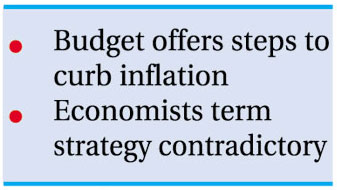 Finance Minister A H M Mustafa Kamal, in his budget speech on Thursday, said the government's main strategy for the next fiscal year (FY), 2022-23, would be to increase supply while reducing growth in demand.
The national budget has proposed some measures to tame the high inflationary pressure, as the global and local consumer price index (CPI) are already showing a rising trend.
"We have carefully designed the budget proposals for subsidies, incentives and sector-wise allocations for FY 2023, keeping in mind our core policy objectives of containing inflation and achieving targeted economic growth."
The government is committed to contain the rising trend of inflation by addressing inconsistencies between supply and demand, the minister said.
The government has revised its current FY inflation target upward to 5.8 per cent due to the rising trend of CPI, and also set a target to keep inflation within 5.6 per cent in next FY.
Meanwhile, economists in their reactions said the government's proposed strategy of lowering growth of demand and boosting supply is contradictory.
Bangladesh's macro economy has fallen into pressure due to the soaring inflationary trend, affecting the country's poor- and middle-income people.
The point-to-point inflation in the recent months is showing a higher trend.
According to the Bangladesh Bureau of Statistics (BBS), the point-to-point inflation increased to 6.29 per cent in April.
The global financial institutions, including the International Monetary Fund, the World Bank and the Asian Development Bank, forecasted higher inflation in the near-term.
The finance minister said: "The government is committed to contain the rising trend of inflation by addressing inconsistencies between supply and demand."
Although inflation remained under control until the first quarter of this year, there has been a recent spike, mainly due to external and some internal factors.
The causes of inflation at the global level include, among others, rising inflation in trade partners, rising oil prices, depreciation of BDT against USD, disruption of global supply chain, and the Russia-Ukraine crisis - all of which are largely beyond control, the minister also said.
"Internal factors include the post-Covid economic recovery, which is leading the economy to full employment. The government has, so far, refrained from adjusting domestic prices of chemical fertilisers, gas, and power to control inflation, and is also providing additional subsidies."
"Given the above context, there are two major challenges for Bangladesh. Firstly, usual price hike in the international market, and secondly, controlling imported inflation in the local market - originating from the price hike in the international market," he added.
The minister further said Bangladesh will require an extra US$8.2 billion funds in 2022 compared to that in 2021 due to price hike of nine essential commodities - crude oil and refined oil, LNG, wheat, fertiliser, palm oil, coal, soybean oil, maize and rice.
"Besides commodity prices, prices of industrial raw materials and other consumer goods as well as cost of international transportation are also rising. Consequently, there is a pressure of imported inflation in the local market."
About some measures to weather the higher CPI trend, Mr Kamal said: "We have introduced sales of essentials through TCB, so that the low-income people of the country can buy daily necessities at lower prices. In addition, a significant portion of the poor people has been brought under the social security programmes."
"We have earlier discussed the measures we will take in the coming budget to contain inflation. Considering all these measures, I expect that the average inflation will be 5.6 per cent in the next fiscal year," he opined.
Meanwhile, Research Director of Centre for Policy Dialogue (CPD) Dr Khandker Golam Moazzem told the FE that the government's philosophy of containing demand and swelling supply is not reflected in its tax measures in the new national budget.
"As the external impact on the inflationary pressure is much higher than the internal impact, it is imperative to make a balance between the internal and the external factors. But we do not see proper action (in this regard) in the national budget."
"The government should expand the social safety-net programmes for giving relief to the low-income people from the shock of inflation. But the safety-net allocation in the national budget has comparatively declined, which is not a wise decision," Dr Moazzem opined.
The national budget has proposed to expand the local industries for import substitution, but it still has a big question about the growth of investments in the future days, he added.
On the other hand, South Asian Network on Economic Modeling (SANEM), in its budget reaction, said the proposed budget acknowledges the rising inflationary pressure.
However, the expectation of limiting average inflation to 5.6 per cent in next FY is quite ambitious, given the current context and shifting global economic factors.
"The main strategy to contain inflation, as outlined in the budget, is increasing the supply along with reducing the growth in demand. It stands in contradiction with the medium-term policy strategy, which aims to focus on consumption and investment to increase the domestic demand and export to increase the external demand."
"More importantly, it would not be prudent to focus policy action on demand side, whereas the inflation is being pushed by supply-side costs, and this may have depressing implication for the economy."
"Balance between macro-economic targets and development goals through policy coordination has not been reflected accordingly," the SANEM said in a statement.
kabirhumayan10@gmail.com