
Defying IMF suggestion
Govt to stick to its guns on tax exemptions
Doulot Akter Mala | Saturday, 25 April 2026
The government is unlikely to withdraw the time-bound tax-exemption facilities as suggested by the International Monetary Fund (IMF).
Officials say although the IMF has advised the government to abruptly phase out tax exemptions to raise the country's tax-to-Gross Domestic Product (GDP) ratio to 9.21 per cent by the next fiscal year, the authorities are expected to proceed cautiously to avoid legal complications.
In the past, attempts to withdraw time-bound tax exemptions, particularly for oceangoing ships and electrical and electronic goods, triggered legal challenges, prompting the High Court to stay the implementation of revised tax rates.
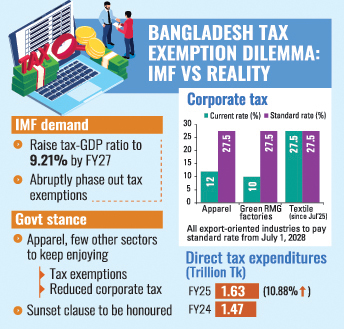
A senior tax official says the National Board of Revenue (NBR) has decided to continue tax exemptions and reduced corporate tax rates for several sectors, including apparel exporters.
Under the current plan, all export-oriented industries will be brought under the standard corporate tax rate starting July 1, 2028.
At present, apparel exporters pay a corporate tax rate of 12 per cent, while green readymade garment (RMG) factories enjoy a lower rate of 10 per cent.
In contrast, the standard corporate tax rate for these industries is 27.5 per cent.
The NBR initially considered withdrawing these reduced rates in the current fiscal year to ensure parity between the RMG sector and other industries, including textiles.
However, the plan was later shelved, allowing a two-year transition period to ensure predictability for exporters.
Textile manufacturers, meanwhile, have been subject to the full 27.5 per cent corporate tax rate since July 2025, after previously benefitting from reduced rates.
Another senior NBR official, speaking on condition of anonymity, says the government must honour the "sunset clause" under its tax exemption policy, despite IMF pressure and the urgent need to boost domestic revenue.
"Any abrupt withdrawal could be interpreted as a breach of contract," the official says, adding that taxpayers retain the right to challenge such decisions if benefits are withdrawn before the agreed deadline.
The official acknowledges that the situation has become increasingly complex as the government faces mounting pressure from the IMF to eliminate tax expenditures.
Recently, NBR Chairman Abdur Rahman Khan, at a pre-budget meeting, admitted that the tax authorities were struggling to manage widespread exemptions, which had significant fiscal costs.
Direct tax expenditures were estimated at Tk 1.63 trillion in FY25, up from Tk 1.47 trillion in FY24.
Mahmud Hassan Khan Babu, president of the Bangladesh Garment Manufacturers and Exporters Association (BGMEA), says phasing out reduced tax rates may not necessarily lead to higher revenues.
He notes that apparel exporters already pay around 20 per cent tax on profits through a 1.0 per cent source tax on export proceeds.
"If the government wants to increase corporate tax, it must reduce the source tax," he says.
He adds that the BGMEA is scheduled to meet the NBR tomorrow (Sunday) to present its detailed budget proposals.
Babu also points out that the absence of an effective tax refund system in Bangladesh raises the actual tax burden on exporters beyond intended levels.
doulotakter11@gmail.com