
Govt\\\'s interest payments mark a steep rise
FHM Humayan Kabir | Saturday, 31 May 2014
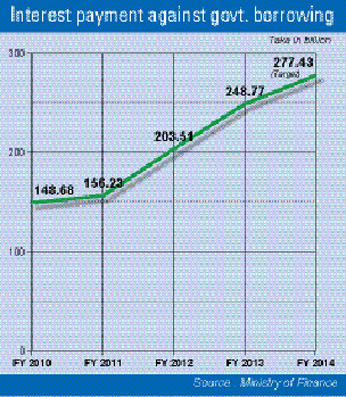
The government's interest payments against its debts, both domestic and foreign, have been on the rise in recent years mainly due to its enhanced borrowing for meeting the growing budget deficit, officials have said.
Officials at the ministry of finance (MoF) said the government has already spent nearly one-seventh of its total revenue budget target on interest payments in the first three quarters of the current fiscal year (FY) 2013-14.
An MoF official said the government paid Tk 194.44 billion in interest on domestic and foreign loans in July-March period this fiscal, which was equivalent to 14.26 per cent of the total non-development budget.
In the Tk 1.55 trillion non-development budget for FY 2014, the government has earmarked Tk 277 billion or nearly 18 per cent of the budget for payment of interest.
Of the interest paid during the July-March period of the current fiscal year, the government paid Tk 181.69 billion for domestic loan and Tk 12.75 billion for foreign loan.
The government has set aside Tk 277 billion funds for paying the interest for the loans coming from the financial, non-banking financial and other domestic borrowing, and for the external borrowings in the current FY 2014.
The government has projected a budget deficit of Tk 550.24 billion or 4.6 per cent of the Gross Domestic Product (GDP) in the Tk 2.22 trillion worth of the national budget in the current fiscal year.
Out of the deficit, the government will borrow Tk 143.98 billion from foreign lenders, Tk 259.93 billion from the domestic banking sector, Tk 79.71 billion from non-banking sources, and the rest of the amount is expected to come from the grants from donors.
In the last FY 2013, the actual budget deficit (excluding grants) was Tk 452.10 billion, which was 4.4 per cent of GDP in the Tk 1.73 trillion annual expenditures.
During the last fiscal year, the government paid total Tk 248.77 billion as interests -- Tk 223.06 billion on domestic loans and the remaining Tk 15.70 billion on external loans.
In FY 2012, the government paid total Tk 203.51 billion in interest -- Tk 188.03 billion on domestic loans and Tk 15.48 billion on external debts.
In FY 2011, the government paid Tk 156.23 billion in interests -- Tk 142 billion on domestic borrowing and Tk 14.23 billion on external debt.
Development analysts said the growing borrowing to finance the budget deficit could affect private investment creating a "crowding out effect" on the private sector.
They said the expenditure on interest payments is always a burden on the economy if it does not ensure quality investment.
Development analyst Dr Mirza Azizul Islam said the next fiscal year would be a challenging one for the government to supply adequate funds to minimise the budget deficit.
"The government may propose a Tk 2.50 trillion worth of budget. It may have Tk 1.50 trillion revenue income target through NBR, Tk 250 billion higher than that of the revised budget this fiscal. I think it will be difficult for the government to realise such a huge revenue," Dr Islam said while talking to the FE.
Dr Islam said: "The government is spending nearly 18 per cent of the non-development budget in the budget for servicing the interests. Out of the sum, nearly 90 per cent goes for paying interests on the domestic borrowing. So, the government should reduce dependence on internal borrowing."
He has said the higher bank borrowing not only leaves impact on the private investments, it also raises inflationary pressure on the economy.
Dr Islam, who was also the finance and planning adviser of a caretaker government, has said the growing interest payment hampers the budgetary expenditure flexibility.
Development researcher Dr Zaid Bakht told the FE that spending for the interest payment would not be a problem if the government checked pilferage of the public funds and ensured quality development work of the country.
He said: "Budgetary funds for the interest payment need to be spent from the revenue income of the government. If the government can reduce its dependence on domestic borrowing, the pressure on revenue income could be cut. And more expenditure for development work could be met."
Dr Bakht has suggested exploring the potential of external lenders, who could supply more concessional loans for minimising the budget deficit.