
Greater dependence on external sources sought
Jasim Uddin Haroon | Monday, 1 December 2014
The government has approved the maiden debt strategy with a paradigm shift in the pattern followed for borrowing resources to finance the budget deficits.
Under the strategy the government will have the option to borrow from the external sources 60 per cent of resources needed for deficit financing. Currently, Bangladesh borrows around 60 per cent of resources from the domestic sources.
According to the deficit financing mode of the budget for the fiscal 2014-15, the government will borrow over 63 per cent from the domestic sources, mainly from banking sources and through the sale of treasury bills and bonds and saving instruments.
The Tk 2.5 trillion budget of the current fiscal year leaves a deficit to the tune Tk 490 billion which is targeted to be met through domestic and external borrowings.
Finance Minister AMA Muhith approved the country's first-ever debt strategy on November 23. It was prepared by the Cash and Debt Management Technical Committee of the Finance Division.
The Finance Division earlier had elicited opinion from the agencies and persons concerned on the issue. It received many suggestions from the Bangladesh Bank, Economic Relations Division, Comptroller and Auditor-General office and others concerned.
Styled medium-term debt strategy (MTDS), it has been designed with the objective of minimising government cost and risk involving debt portfolio.
The MTDS is also aimed at meeting the borrowing requirement of the government in time and development of domestic debt market.
The strategy will help the government assess its options to choose an appropriate borrowing mix to optimise the debt portfolio, according to the statement on the objective.
It is expected that it will help develop capital market by way of revealing to the creditors the plan of government borrowing.
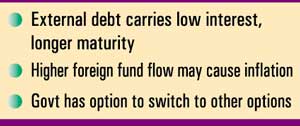
An official at the Finance Division told the FE Sunday that they suggested the higher external borrowing as the best option as the cost of such funds is low and those often mature over a long period.
He said option three (3) of the strategy is the best one for the country in consideration of medium terms.
According to the option three, some 60 per cent of the public borrowing should come from the external sources.
"We analysed all options, in our view, and found higher external option most favourable for Bangladesh for the medium term considering both cost and risk," said the official, wishing anonymity.
The rate of interest in external borrowing is usually low, particularly that of concessional and semi-concessional external credits. Bangladesh's most external loans are usually concessional in nature.
But the official said government might take other options whenever they will emerge as the best tool for borrowing.
The other option is the existing borrowing mix with focus on domestic sources. And another strategy is to raise external non-concesional loans by floating sovereign bonds on the international market to raise capital for funding large projects.
However, many argue that higher inflow of foreign credits might cause inflationary pressure on the economy.
However, the strategy suggests that there is need for borrowing database as the present preservation of borrowing data are scattered.
The ERD maintains record of public external debt data while the Bangladesh Bank (BB) and the National Savings Directorate (NSD) keep record of wholesale and retail domestic public debt data respectively.
It advocated that the domestic debt instruments may broadly be divided into two categories: marketable debt securities and non-marketable debt securities.
Marketable debt securities are treasury bills and bonds that are regularly issued and auctioned by government to finance budget deficit. Primary dealer banks are the main participants in the auction held at the central bank.
On the other hand, non-marketable instruments are ways and means advance (WMA), overdraft credit (ODC), general provident fund and different saving certificates.
The WMA and the ODC are not included in the strategy as these items used for cash recording are of ad-hoc provisions made by the Bangladesh Bank to meet cash imbalances of the government.
It is learnt that the International Monetary Fund (IMF), one of the Bretton Woods institutions, has been pressing the government for long for formulating the strategy as a conditionality tagged with IMF- sponsored loan.
jasimharoon@yahoo.com