
Green, sustainable financing surged in Oct-Dec 2025
SAJIBUR RAHMAN | Sunday, 12 April 2026
Green finance disbursement by banks and non-bank financial institutions (NBFIs) posted a modest rise in the final quarter of 2025, while sustainable finance recorded a sharper increase, signalling a continued shift towards broader sustainability-linked lending.
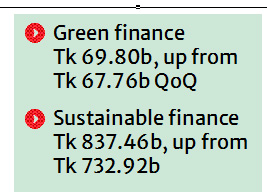
Latest data from Bangladesh Bank (BB) show that green finance disbursement stood at Tk 69.80 billion in the October-December quarter, up from Tk 67.76 billion in July-September.
In contrast, sustainable finance disbursement climbed significantly to Tk 837.46 billion during the period, compared to Tk 732.92 billion in the previous quarter.
The trend indicates that financial institutions are increasingly prioritising sustainability-linked financing beyond conventional green investments.
For 2025, banks and financial institutions set a green finance target of Tk 678.21 billion and a much larger sustainable finance target of Tk 5.42 trillion, based on their net loans and advances outstanding as of December 31, 2024.
To meet these goals, institutions are required to allocate at least 5.0 per cent of total loans and advances to green finance and 40 per cent to sustainable finance by the end of 2025.
Despite policy support, green finance still accounts for a relatively small share of overall sustainable financing.
BB data show that "other sustainability-linked finance" dominates with a 35 per cent share, followed by sustainable MSME financing at 33 per cent.
Sustainable agriculture accounts for 13 per cent, while green finance makes up only 8.0 per cent of total sustainable finance. Socially responsible financing constitutes the remaining 11 per cent.
The breakdown suggests that while sustainability-linked and MSME financing are gaining traction, there remains considerable scope to expand green and socially responsible financing.
As of December 31, 2025, total outstanding sustainable finance stood at Tk 3.94 trillion, reflecting a growing pipeline of sustainability-focused investments.
Meanwhile, utilisation of the climate risk fund remained limited at Tk 153 million during the October-December quarter.
Bangladesh Bank introduced its Sustainable Finance Policy in December 2020 to promote inclusive and environmentally responsible economic growth, aligned with national commitments such as the Nationally Determined Contributions (NDCs), Bangladesh Delta Plan 2100 and the National Adaptation Plan. The framework was updated in 2023 to reflect evolving priorities.
However, participation remains uneven across institutions.
During the reporting quarter, 56 out of 61 banks and only 12 out of 34 finance companies reported exposure to sustainable finance.
Analysts say stronger policy enforcement and incentives will be key to scaling up green financing and ensuring a more balanced distribution across sectors.
"While growth in sustainable finance is encouraging, green finance continues to lag, indicating that climate-focused investments are yet to gain sufficient traction," said Dr Masrur Reaz, chairman of Policy Exchange Bangladesh.
"To accelerate green financing, banks need stronger policy support, improved project pipelines and risk-sharing mechanisms to address investment challenges," he added.
sajibur@gmail.com