
ADB redoes economic forecasts for BD
Growth ramped up to 6.0pc for FY23
Revised rate close to govt prediction
FE REPORT | Thursday, 20 July 2023
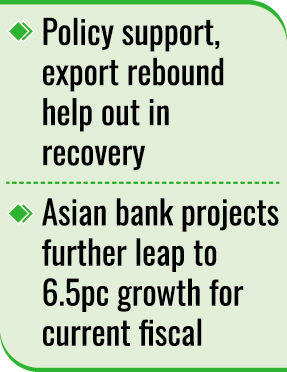 Policy support and export rebound lifted Bangladesh's economic growth in the past fiscal higher than the Asian Development Bank had predicted. The Bank now puts the rate at 6.0 per cent.
The revised gross domestic product (GDP) growth in the just-past financial year (2022-23) comes in ADB's Asian Development Outlook (ADO) July 2023 report released Wednesday.
Earlier in April, the Manila-based lender forecast 5.3-percent GDP growth for Bangladesh-down the country's official calculation.
Now the bank's redone arithmetic in the ADO takes the figure close to the rate Bangladesh Bureau of Statistics (BBS) had estimated a couple of months ago at 6.03 per cent.
The Asian Development Outlook or ADO, rolled out from the ADB headquarters in Manila, also keeps up Bangladesh's growth projection to 6.5 per cent for the current FY2023-24 in view of the advances on stream.
Explaining the pickup in the economy the outlook says: "On the supply side, manufacturing firms of all sizes leveraged supportive government policies to contribute to growth."
Crop losses to floods, cyclones, and droughts were partly offset by subsidies, incentives, and other measures, the ADB report notes about the policy props.
And the service sector was buoyed by higher warehouse and support activities and health and social services.
On the demand side, the ADB assessors have noticed growth in public consumption having outpaced expectations, "as did public investment".
However, the ADO April 2023 forecast for growth in FY2024 is unchanged to 6.5 per cent.
On the ongoing global economic concern related inflation, the 2023 inflation forecast for South Asia is kept as it was at 6.4 per cent while the 2024 projection revised up markedly to 8.1 per cent.
For India, where price indices are reportedly moderated, the inflation projection for FY2023 is reduced slightly from 5.0 per cent in ADO April 2023 to 4.9 per cent and maintained at 4.5 per cent in FY2024.
As food and oil prices moderated, inflation eased below the 6.0-percent upper bound of the monetary policy target, the ADB states in the outlook.
The Asian development financier hoped the Brent crude prices in 2023 should lower headline inflation, but core inflation, which excludes food and fuel, is expected to be stubbornly high.
The Bhutan inflation projection for 2023 is revised down after fuel prices dropped more than expected.
Similarly, the inflation forecast for Sri Lanka is revised down on account of declining prices of food, transportation, and utilities, as well as base changes for the consumer-price index or CPI.
In contrast, 2023 inflation projections for Bangladesh and Nepal are revised up, and actual inflation in Pakistan in FY2023 was higher than projected, leaving the sub-regional forecast unchanged.
Continued demand-side pressures in Pakistan play an outsized role in the upward revision to the sub-regional inflation forecast for 2024.
Meanwhile, the ADB has projected a faster growth for developing economies in the Asia-Pacific region this year, as the continued easing of pandemic restrictions boosts consumption, tourism, and investment.
With the lifting of the zero-COVID strategy in December last year, the Chinese economy is expected to grow 5.0 per cent this year and 4.5 per cent in 2024, compared with 3.0-percent growth in 2022.
India is projected to expand at a rate of 6.4 per cent in 2023 and 6.7 per cent in the next year, due to "healthy domestic demand".
Economies in Asia and the Pacific are projected to grow 4.8 per cent this year and next year, improving on the 4.2- percent growth in 2022, according to the ADO April 2023.
Excluding the PRC, developing Asia is expected to grow 4.6 per cent this year and 5.1 per cent in 2024. The region's inflation, meanwhile, is forecast to moderate gradually toward pre-pandemic levels, though there is considerable variation across economies.
"Improved consumption and investment are boosting recovery in many regional economies, offsetting the impacts of elevated food and energy prices caused by the Russian invasion of Ukraine and other global headwinds," says the report.
Tourism and remittances are trending upward as pandemic restrictions ease further. In many tourism-dependent economies, visitor arrivals are steadily improving toward pre-pandemic levels, the ADB outlook notes.
kabirhumayan10@gmial.com