
COST OF DENIAL OF MUST-DOS IN ECONOMY, GOVERNANCE
Growth sans governance reform risks instability
Economists warn during review of state of reforms
FE REPORT | Saturday, 18 April 2026
Rapid economic growth, if not accompanied by governance reforms, may ultimately undermine development and trigger instability, economists warn during a review of Bangladesh's politico-economic milieus.
The speakers came to such conclusion at a virtual discussion organised by the South Asian Network on Economic Modeling (SANEM) on Friday, as the country passes through crises and a rebound by turns.
Delivering the keynote titled 'The costs of denial: how economic growth undermines governance reform', Dr Shantayanan Devarajan, Professor at Georgetown University in Washington, DC, cautions that periods of strong growth often lead policymakers and international agencies to overlook governance failures.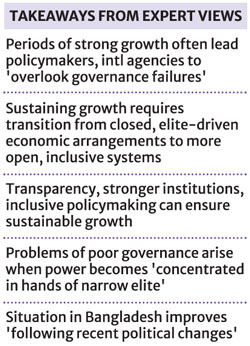 "There is a tendency to focus on outcomes such as GDP growth and poverty reduction while ignoring the processes through which these results are achieved," he says.
This, the professor warns, can be "dangerous" if growth is driven by practices that undermine human rights or suppress civil society, raising questions about sustainability.
Drawing on global and regional experiences, he argues that the rapid growth seen in many developing regions between 2000 and 2015 "masked deep-rooted governance problems, which later contributed to political instability, declining investment and slower growth".
Commenting on the keynote, Dr Kunal Sen, Director of UNU-WIDER, describes the argument as a "provocative hypothesis", noting that economic growth can carry the seeds of its own reversal if governance issues remain unaddressed.
He observes that in regions such as Africa and South Asia, growth slowdowns after 2015 were closely linked to unresolved institutional weaknesses, which eventually led to instability and declining investment.
Dr Sen emphasises that sustaining growth requires a transition from closed, elite-driven economic arrangements to more open and inclusive systems. "Governance and economic reforms must proceed together rather than sequentially."
The discussion also featured noted economists Prof Rehman Sobhan and Dr Mustafizur Rahman from the Centre for Policy Dialogue (CPD).
Noted economist Rehman Sobhan opines that problems of poor governance arise when "power becomes concentrated in the hands of narrow elite, influencing the banking and financial sectors, businesses and politics".
He observes that the situation in Bangladesh has improved following the recent political changes, adding that a functioning democracy can help a country overcome such structural constraints.
Mustafizur Rahman, Distinguished Fellow at the CPD, notes that the processes through which economic outcomes are achieved have significant implications for the sustainability of growth.
He points out that while Bangladesh has experienced robust economic expansion, income disparities remain stark, with a wide gap between the top five per cent and the bottom 40 per cent of the population.
Moderated by SANEM Executive Director Dr Selim Raihan, the session underscores the need for transparency, stronger institutions and inclusive policymaking to ensure that growth remains sustainable over the long term.
bdsmile@gmail.com