
Gulf crisis hits Dhaka hotels
GULAM RABBANI | Wednesday, 11 March 2026
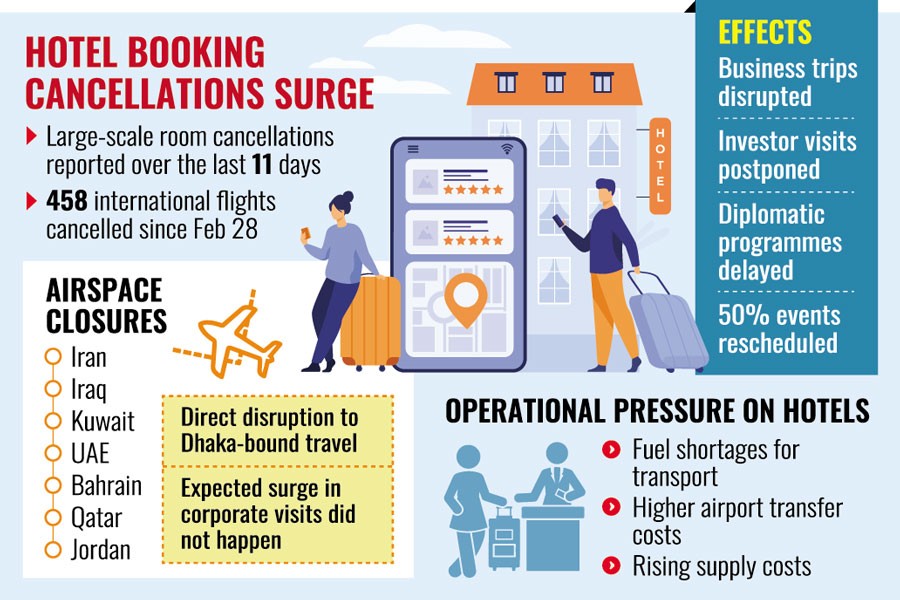
Dhaka's luxury hotels have been experiencing a significant number of room- reservation cancellations over the past 11 days following an escalation of the Middle East conflict.
"Tremendous cancellations have taken place over the last 11 days since February 28," said Tuhinoor Sultana, Cluster Public Relations Manager of The Westin Dhaka and The Sheraton Dhaka hotels.
She said the cancellations are largely linked to the suspension of flights to several Middle Eastern destinations, which has disrupted travel plans of guests who usually stay at top-tier hotels in the capital.
Airlines operating from Hazrat Shahjalal International Airport (HSIA) in Dhaka and Shah Amanat International Airport in Chattogram have cancelled a total of 458 international flights over the past 11 days since February 28, following the US-Israel attack on Iran, with most of the affected services bound for Middle Eastern destinations, according to the Civil Aviation Authority of Bangladesh (CAAB) officials.
Due to the ongoing war, Iran, Iraq, Kuwait, United Arab Emirates, Bahrain, Qatar and Jordan temporarily closed their airspace on 28 February, directly impacting Dhaka operations.
Most of the passengers travelling to these destinations are usually Bangladeshi migrant workers. However, a significant number of businessmen, investors and tourists also come from these Middle Eastern countries, and their travel has now been completely disrupted as flights have been suspended due to the war.
"The Westin Dhaka is located in the heart of the capital, making it convenient for guests to move around the city. As a result, we usually receive a large number of guests, but the current disruptions have significantly impacted us," said Sultana.
However, she declined to disclose the exact number of cancellations, describing it simply as "huge".
She also noted that guest flow generally slows during the months of Ramadan, which is considered a seasonal trend in the hospitality sector.
"However, we had expected a different scenario this year. With a new government assuming power through an election and a stable situation prevailing in the country, we hoped that investors would visit Bangladesh and a series of business discussions would take place," she said.
According to her, hotels were anticipating increased business travel and higher occupancy during this period. But the ongoing US-Israel-Iran conflict has created uncertainty, affecting expected business prospects in the hospitality industry.
"We expected upcoming business opportunities, but the situation has now become highly uncertain due to the war," she added.
Echoing Sultana, Fariaz Morshed Chowdhury, Acting Director of Sales and Marketing at the Pan Pacific Sonargaon Dhaka, told The Financial Express that they were also uncertain about the expected increase in their business in the upcoming months due to the Middle East war.
"The country had been expecting a noticeable increase in corporate travel after the new government assumed office, as several new agreements and bilateral discussions with different countries were anticipated. However, many of these developments have largely stalled due to the ongoing conflict in the Middle East," he said.
Morshed Chowdhury further said the number of meetings, events and exhibitions has also declined in recent weeks. Several international, local and government-level bilateral events, including diplomatic programmes that typically attract foreign experts and delegations, have either been postponed or cancelled. Nearly 50 percent of such events are now being rescheduled due to the uncertain situation.
He added that the war has also created additional operational challenges, particularly related to fuel supply. Due to fuel shortages and rationing, hotel authorities are facing difficulties in arranging transportation for guests from the airport. Previously, fuel was procured from designated sources, but the current rationing system has forced transport operators to search for fuel at multiple stations throughout the night.
According to him, if transportation costs continue to rise because of fuel constraints, the cost of raw materials used in hotel operations could also increase, putting further pressure on the hospitality sector.
bikashju@gmail.com