
Harmonising incongruities in tax measures
Ferdaus Ara Begum | Wednesday, 29 January 2014
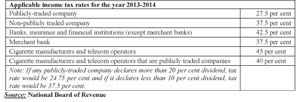
In an era when most developing countries are adopting fundamental reforms to simplify their tax payment systems, Bangladesh cannot lag behind. The government has taken steps to ensure simplicity and transparency in its tax administration system. These steps have made it easier for businesses to pay taxes in a transparent manner. The information and communications technology (ICT)-based solutions are being provided to make tax payments more transparent and more conducive to business growth. Yet, a lot needs to be done to remove distortions in tax policies and address policy shortcomings.
Historically, Bangladesh ranked below many South and South-East Asian countries in terms of tax-GDP (gross domestic product) ratio. But the scenario is changing fast, with tax revenue growing at 20 per cent per annum and the tax-GDP ratio becoming healthier. The National Board of Revenue (NBR) has commenced a five-year (2011-2016) modernisation plan. The plan targets reforms of tax administration to broaden the tax net and make it easier for taxpayers to go through the process of paying taxes. The NBR is also working on charting out reforms specific to wings of the NBR.
RELATIVE IMPORTANCE OF TAX SOURCES: A thorough consultative review of the policies and regulations governing taxation is necessary to identify areas where business growth is being unnecessarily constrained, where the tax regime is creating wrong incentives (such as incentivising import over local manufacturing), and where tax-related policies can be best used to stimulate investment and job creation.
There are different areas through which the NBR generates revenues: tax on income and profit, value-added tax, import duty, export duty, excise duty, supplementary duty and other taxes and duties. Of the total tax in FY 2012-13, income and profit segments represented 31.45 per cent, while revenue collected from VAT was 36.05 per cent, import duty and export duty earned 12.94 per cent and 0.04 per cent respectively. Contribution of excise and supplementary duty were 0.89 per cent and 17.78 per cent respectively, while a minor amount of revenue was also collected from miscellaneous sources.
Individuals and companies in Bangladesh pay income tax according to the provisions of 'The Income Tax Ordinance (Ordinance No XXXVI of 1984) and Income Tax Rules 1984' (SRO 39-L/85) and the complementary Finance Act of each year.
CONTRADICTIONS IN MINIMUM TAX POLICY: An interesting section (Section 16 CCC) in the Income Tax Ordinance, 1984 makes it mandatory for a company to pay a minimum tax according to the following provision. The provision reads: "Charge of minimum tax-(1) notwithstanding anything contained in any other provisions of this ordinance, every firm having gross receipts of more than taka fifty lakh (Finance Act 2013, Act No 25) or every company shall, irrespective of its profits or loss in an assessment year for any reason whatsoever, including the sustaining of a loss, the setting off of a loss of earlier year or years or the claiming of allowances or deductions (including depreciation) allowed under this Ordinance, be liable to pay minimum tax at the rate of zero point five zero (0.50 per cent) per cent of the amount representing such firm's or company's gross receipts from all sources for that year."
Here, 'gross receipts' means: (a) all receipts derived from the sale of goods; (b) all fees or charges for rendering services or giving benefits including commissions or discounts; and (c) all receipts derived from any heads of income.
A similar section on 'Charge of Minimum Tax' under 16CC was included by the Finance Act 2006 and subsequently omitted by the Finance Act 2008, raising an ambiguity in the very definition of where and how this should apply.
The policy of minimum tax was a bit different in 2006. As per section 16CC, charges of minimum tax (1) were applicable to a company in the case where, for any reason whatsoever, including the sustaining of a loss, the setting off of a loss of an earlier year, the application of tax credits or rebates, or the claiming of allowances or deductions (including depreciation and amortization deductions) allowed under this Ordinance or any other law for the time being in force, tax is not payable or paid by such company for an assessment year, or tax payable or paid by such company for an assessment year is less than 0.25 per cent of the amount representing such company's turnover formal sources for that year or taka five thousand whichever is higher. The Income Tax Ordinance, 1984 (The Income Tax Ordinance, 1984, Ordinance No. XXXVI of 1984) came into force 'to consolidate and amend the law relating to the income tax'.
The charge of the minimum tax is a deviation from the existing regulations of income tax law. In the Ordinance, the very meaning of income is contradicted while minimum tax is imposed. Under chapter five of the Income Tax Ordinance, 1984, seven specific heads are used to determine income. These are (a) salaries; (b) interest on securities; (c) income from house property; (d) agricultural income; (e) Income from business or profession; (f) capital gains; and (g) income from other sources. Minimum tax or turnover tax does not fall in any one of the categories termed under the heads of income.
The concept of minimum tax or turnover tax as it was repealed from the Finance Act 2008 is a concept of the value-added tax (VAT), an indirect tax, in the tax regime of Bangladesh. The Value Added Tax Act, 1991 (Act 22 of 1991) under Section 8, stated 'Turnover Tax-(1) any producer or manufacturer or trader of taxable goods or provider of taxable service, who is not required to be registered under section 15 (The Value Added Tax Act, 1991), shall pay turnover tax at the rate of 3 per cent of his annual turnover. Therefore, compensating a company in terms of minimum charge is a way out from the concept of income tax law to maximize the revenue collection in a distorted way.
BUILD RESEARCH: The provision of minimum tax is causing a burden to the business community. Business Initiative Leading Development (BUILD) initiated a study in September 2013 with the objective of identifying the appropriate policies to create an attractive, equitable and competitive tax regime and to harmonise incongruities in tax structure in Bangladesh. The specific targets of the study were to analyse the impact of the charge of minimum tax under section 16CCC and suggest remedial measures for rationalisation of how minimum taxes are used.
BUILD found regulatory anomalies in different areas. Income tax is a direct tax whereas minimum tax under Section 16CCC is imposed on a firm's or a company's gross receipt even where a firm or a company incurs a loss. Therefore, the minimum tax section is a deviation from the principle of The Income Tax Ordinance, 1984 to levy tax on income only. The principle of minimum tax is also an aberration from the VAT law which deals with the turnover tax whereas the objectives of the VAT law and the Income Tax Ordinance differ substantially.
The minimum tax imposed by the Finance Act 2013 on a firm's or a company's gross receipts from all sources and the minimum taxes on turnover from all sources for that year (or taka five thousand, whichever is higher) are the same in principle and application. Section 16CC was omitted by the Finance Ordinance 2008 and therefore Section 16CCC should also be repealed on the same grounds. The Section 16CCC grossly disregards the principles of the International Financial Reporting Standards (IFRS) and also indirectly nullifies the whole purpose of the Income Tax for a firm or company. A VAT law is adequate enough to collect taxes as the section is a replica of the VAT law as it charges a firm or company on gross receipts.
The company may add 0.50 per cent to levy on the consumer to offset the loss on the tax which would increase the tax burden to the consumer. In such a way, the tax would be quite similar to the application of the VAT law of the country. According to the ITO Section 20, income tax will be charged under certain tax scheme, including income from business or professional fees. But to be in the scheme of 'income from business or profession' the business entity has to follow the section 28 where income taxes over losses on gross receipt are not written. In these circumstances, there is no clear indication of why the authority is charging minimum taxes on loss! Contradiction among different clauses of the income tax law confuses tax payers to pay taxes in a transparent manner, which has been termed as one of the inherent flaws of the tax policy causing evasion of taxes.
According to the government, a few companies show losses for years together to avoid taxes. In India, the loss carry-forward time is eight years, while in Laos, losses can be carried forward for three years. In Cambodia, it is five years while in Pakistan the loss carry-forward time is six years. Minimum tax rate in Laos and India is zero while the rate is 1.0 per cent in Cambodia and 0.5 per cent in Pakistan and Bangladesh respectively.
A few weeks ago, BUILD presented its research findings to a wide audience of government and private sector stakeholders in its taxation working committee meeting, chaired by the NBR Chairman while Members, Customs, VAT and Income Taxes were present. There were a large number of private sector representatives along with high-level government officials to interact on the issue and scrutinise the case and recommendations put forward by BUILD. These echoed the private sector's request for revising the contradictory policies of paying minimum tax.
BUILD suggested for the repeal of section 16CCC of the income tax ordinance, 1984 introduced by the Finance Act 2013-14. Reducing the rate of minimum tax rate from the existing level of 0.50 per cent to 0.25 per cent (as it was in 2009-10).
BUILD further suggested that a flat rate of BDT 5,000 for each company can be an option in keeping with the target of revenue collection target of the NBR. On the other hand, duration of the loss carry-forward time can be reduced keeping first two years of losses exempted from tax.
The more confusing the policies are, the more 'tax consultants' can charge to explain to businesses how to remain 'tax compliant'. But things are changing and improving for the better.
The writer is CEO, Business Initiative Leading Development (BUILD). ceo@buildbd.org