
Hearing on Adani payment dispute begins in Singapore early August
M AZIZUR RAHMAN | Wednesday, 29 July 2026
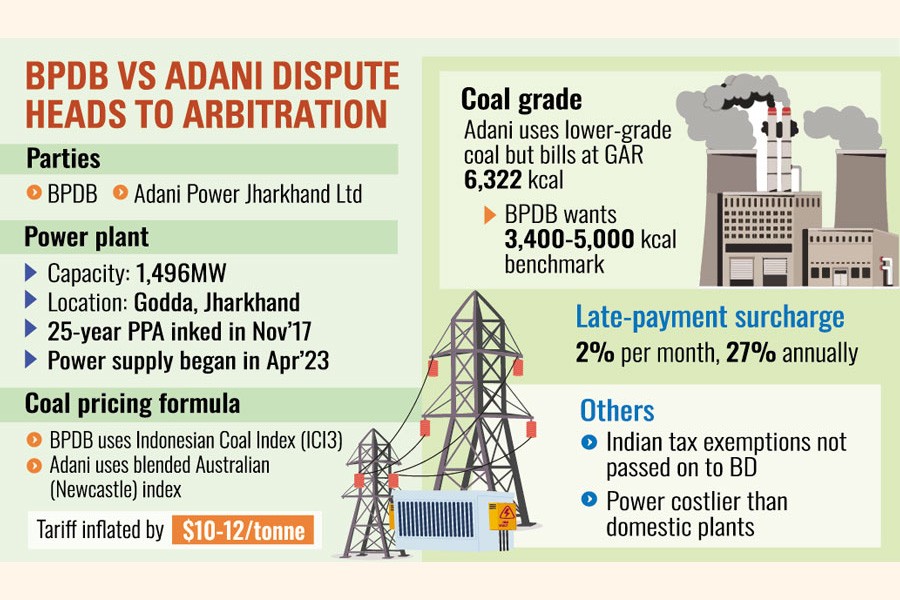
The hearing on the payment dispute between state-run Bangladesh Power Development Board (BPDB) and India's Adani Power Jharkhand Ltd (APJL) will begin in the Singapore International Arbitration Centre (SIAC) during the first week of August.
Attorney-General of Bangladesh Barrister Md Ruhul Quddus Kazal, along with BPDB officials concerned, would leave for Singapore this week to take part in the first-ever hearing on the dispute, a senior BPDB official told The Financial Express on Monday.
The hearing is going to be held after several rounds of failed talks between the two parties over the dispute concerning the power purchase agreement (PPA) and coal pricing formula.
BPDB argues that the power tariff linked to imported coal prices is significantly higher due to the disagreement over fixing the benchmark, late-payment surcharges are excessive, and tax exemptions granted in India have not been passed on to Bangladesh.
Adani's electricity is significantly costlier than that from domestic plants, such as Payra or Rampal, because of the disparity over fixing a "suitable" index to set coal prices, market insiders say.
The Indian power plant is charging tariffs by calculating the used coal price at GAR 6,322 kcal (calorific value) even though it is using lower-graded coal, they allege.
The coal price should be calculated considering the benchmark between 3,400 kcal and 5,000 kcal, they add.
Sources said BPDB uses the Indonesian Coal Index (ICI3) as the benchmark, while Adani calculates tariffs using a blended index incorporating Australian coal prices, particularly from Newcastle and the Newcastle Basin.
The latter reportedly inflates the power tariff by $10-12 per tonne, resulting in a significant billing gap.
Besides, Adani imposes a 2.0 per cent monthly surcharge on late payments, equivalent to nearly 27 per cent annually, which BPDB considers excessive and inconsistent with international norms, sector insiders say.
Adani, however, insists the PPA, inked under the now defunct Quick Enhancement of Electricity and Energy Supply (Special Provisions) (Repeal) Ordinance 2024, is in their favour.
The Indian power plant, which operates the 1,496MW Godda Ultra Supercritical Thermal Power Plant in Jharkhand, began supplying electricity to Bangladesh in April 2023.
Purchasing power from the plant has turned out to be a widely debated issue in Bangladesh since the initiation of power supply from the facility several years back under what is seen as an overrated deal signed by the deposed Awami League government.
As APJL started supplying power, BPDB sought a revision of the PPA on the import of electricity from the Jharkhand plant, but to no avail so far.
The deal was inked in November 2017 for 25 years to transmit power through a 400kV dedicated transmission line connected with Bangladesh's national power grid.
Adani shut down one of its two power units in Jharkhand on November 1, 2024, halving electricity supply over a payment backlog of around $850 million.
It also warned of closing down the remaining unit the following week unless BPDB took steps to clear the dues.
Adani, however, backtracked on its decision to stop power generation entirely after BPDB paid $170 million by opening a letter of credit at Bangladesh Krishi Bank.
The original agreement is under criticism for its coal pricing formula, which pegs costs to volatile international benchmarks and includes high freight charges.
A technical committee formed by the past interim government flagged these terms as disproportionately favourable to Adani, especially when compared to other coal-based plants like Payra.
Adani on several occasions expressed willingness to revisit the pricing formula, but there has been no final outcome, say sources.
The Adani agreement, being the single largest Indian investment in Bangladesh's energy sector, is particularly under scrutiny for its transparency and long-term cost implications.
Azizjst@yahoo.com