
Heatwave pattern shifts to a 'significant hazard' for health, crops in country
Monday, 9 May 2022
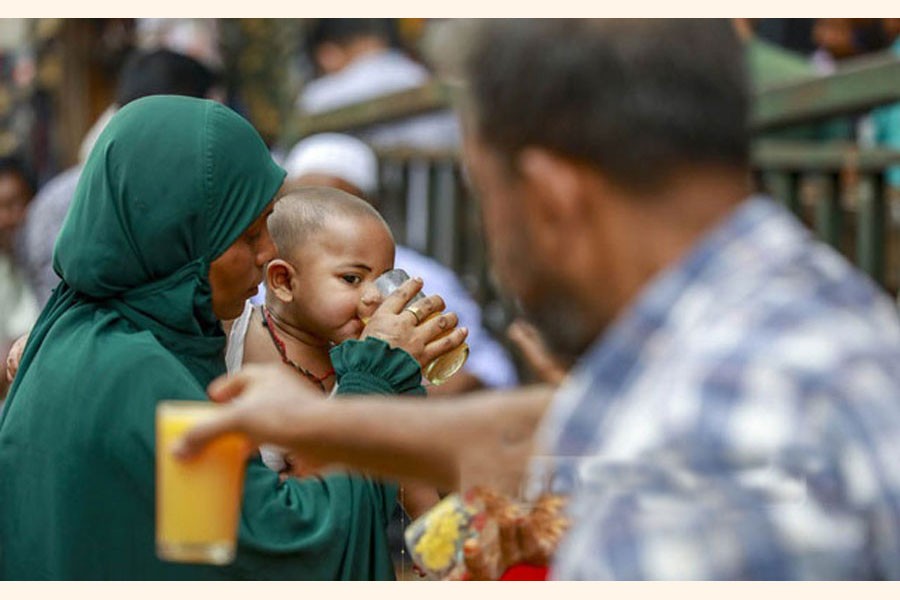
 The unprecedented heatwave sweeping over the Indian subcontinent is raising temperatures in Bangladesh as well, leading to public health problems and putting agriculture at risk, reports bdnews24.com.
An analysis of data from the past few decades indicates that climate change is causing summer heatwaves at unexpected times and is affecting a wider range of areas, according to meteorologists. Hotspots are also growing larger.
Heatwaves have become a 'significant hazard' at the start of summer, but they are not occurring in the same areas and are not following the same pattern because of climate change, said meteorologist Dr Abdul Mannan. "We notice changes every year."
For example, he said, heatwaves reached the southern district of Rangamati in the past two years. "This was not the case previously. Now there are changes to the heat maps in March and April. Temperatures are rising over time and more areas are becoming prone to heatwaves."
According to the World Health Organization, a heatwave is generally defined as a period of at least five days where temperatures in an area are five degrees Celsius above the daily average. However, the specific parameters can vary according to country and region.
The Bangladesh Meteorological Department defines temperatures of 36 to 38 degrees Celsius as a mild heatwave, 38 to 40 as a moderate heatwave and temperatures above 40 degrees Celsius as an intense heatwave.
In mid-April this year, Khulna, Rajshahi and Dhaka divisions and their surrounding areas were experiencing mild to moderate heatwaves. Rain and storms brought some relief afterwards, but a moderate to intense heatwave returned at the end of the month.
Rajshahi has twice recorded temperatures of 41.2 degrees Celsius - the highest in the country so far this year. Eleven different locations across the country recorded temperatures between 36 and 40 degrees Celsius in the 30 days of April.
The 2019 Study on Heatwaves and Associated Large-Scale Circulation in Bangladesh gives a general idea of where the highest temperatures in the country were recorded between 1981 and 2016.
However, as the climate continues to change, temperatures are rising in districts such as Sylhet, Chattogram, and Rangamati, which is likely to have a long-term impact on the environment.
"Due to its geographical location, the western part of our country is prone to heatwaves. In addition, atmospheric conditions cause some other areas to also experience heatwaves," said Mannan.
"Recently, we have seen heatwaves in the southern regions of the country in addition to the west. Even Rangamati saw heatwaves last year."
Rangpur was more prone to heatwaves, but the area has seen a gradual decline in such occurrences, Dr Mannan said. Temperatures in Rangpur did not rise too much this year.
Rajshahi, Khulna, Barishal, Chattogram and Dhaka divisions are now experiencing heatwaves. In the past, there were no heatwaves in Sylhet. But they have experienced them last year and this year."
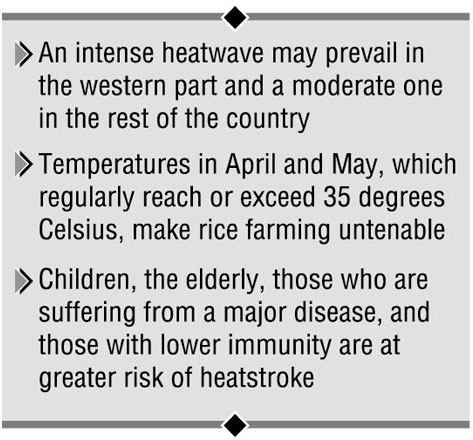
In the long-term forecast for May, the Met Office said it expects an intense heatwave in the western part of the country, and one to two mild or moderate heatwaves in the rest of the country.
Dr Samarendra Karmakar, former chairman of the National Oceanographic and Maritime Institute, said Bangladesh historically experienced more intense heat in May. The highest temperature on record - 45.1 degrees Celsius - was recorded in May 1972.
"We have seen that when average temperatures are high in April, the highest temperatures are recorded in May. May has just started. We will see what heatwaves are to come this year."
Heatwaves will slowly become a significant concern for Bangladesh as floods are, according to Mohan Kumar, a researcher of numerical weather prediction modelling and meteorology.
"Our research shows that Dhaka and other central areas of the country are now experiencing heatwaves. People, farmers and fauna are suffering the most. Private and public initiatives are necessary to supply clean water, plant more trees and provide rest areas in the shade." Rice grows best at temperatures between 25 and 35 degrees Celsius. Higher temperatures are detrimental to rice, stunting growth and reducing grain yield.
The temperatures in April and May, which regularly reach or exceed 35 degrees Celsius, make rice farming untenable.
Day labourers suffer the most from the intense heat. Experts urge the provision of clean water and shaded rest areas to help them cope with scorching heat.
Children, the elderly, those who are suffering from a major disease, and those with lower immunity are at greater risk of heatstroke, the doctor said.