
High customs duties dwarf rooftop solar ambitions
SAJIBUR RAHMAN | Tuesday, 21 July 2026
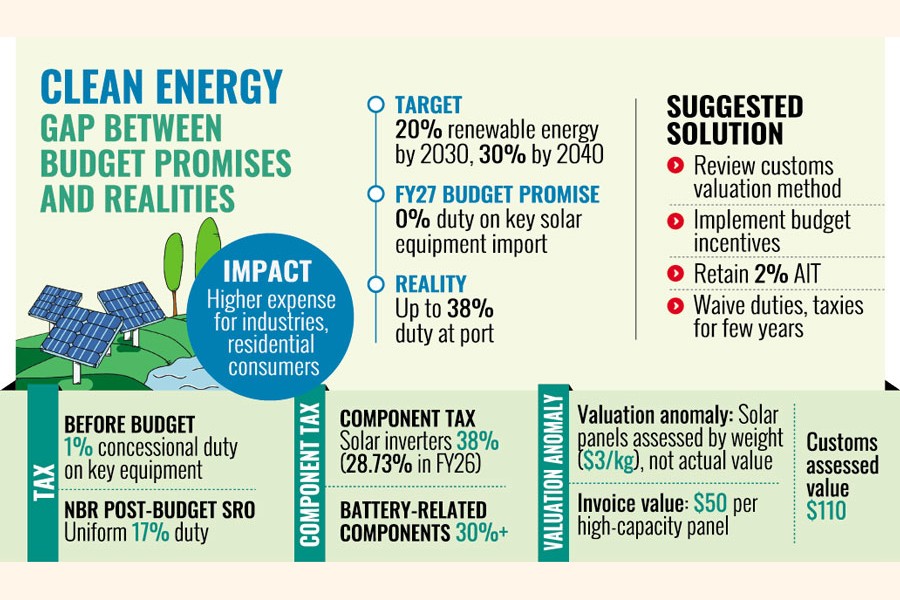
Bangladesh's push towards clean energy is facing fresh headwinds as importers of rooftop solar equipment claim they are being denied the fiscal incentives announced in the national budget, with customs officials continuing to impose higher duties through inflated assessable values.
While the FY27 budget offers duty relief to Renewable Energy Service Companies (RESCOs) and Engineering, Procurement and Construction (EPC) firms, commercial importers are facing higher import duties on key renewable energy equipment, raising concerns over the pace of private investment in rooftop solar and energy storage systems.
In Bangladesh, RESCOs and EPC firms are primarily referred to as Solar EPC Contractors, or RE Providers, or System Integrators.
An analysis by the Bangladesh Sustainable and Renewable Energy Association (BSREA) shows the concessional 1.0 per cent import duty, enjoyed by industrial enterprises on major renewable energy equipment before the budget, has been replaced by a uniform 17 per cent rate.
According to industry insiders, commercial importers paid a 28 per cent Total Tax Incidence (TTI) on solar inverters in the last fiscal year.
While the finance minister's new budget announcement initially gave the impression that the rate would be zero per cent, the subsequent Statutory Regulatory Order (SRO) released by the National Board of Revenue (NBR) set the TTI at 17 per cent.
Ultimately, the effective rate reached 38 per cent by the time shipments were cleared through the port.
According to BSREA, the customs authorities continue to assess solar panels using a weight-based valuation instead of their actual transaction value.
It says a high-capacity solar panel with an import value of around $50 is often assessed at nearly $110 because the customs apply a valuation of $3.0 per kilogram, substantially increasing the tax burden despite the government's stated incentives.
In his budget speech in parliament, Finance Minister Amir Khosru Mahmud Chowdhury said, "To promote the solar power sector, the most important and safest source of renewable and sustainable energy, I propose issuing a new notification setting the applicable import duty, regulatory duty, supplementary duty, and advance tax on the import of key equipment used in this sector at zero per cent."
Solar inverters, a critical component for converting solar-generated DC electricity into usable AC power, faced a 28.73 per cent TTI in FY26.
Photovoltaic cells assembled in modules or made up into panels also faced 28.73 per cent TTI.
Such cells not assembled in modules or made up into panels were subject to 27.5 per cent TTI, while imported lithium-ion batteries faced the highest TTI at 61.80 per cent.
The revised duty applies to key components, including solar inverters, solar photovoltaic (PV) modules, mounting structures, lithium cells, lithium-ion batteries, lithium-ion battery packs, battery energy storage systems (BESS), battery management systems, and plant monitoring systems.
Industry insiders warn that the sharp increase would raise capital expenditure for ready-made garment (RMG) factories, other industries planning rooftop solar installations, and residential consumers.
The country is charging ahead with a major green energy push.
The government has locked in aggressive targets to supply 20 per cent of electricity from renewable sources by 2030, scaling up to 30 per cent by 2040.
Minister for Power, Energy and Mineral Resources Iqbal Hassan Mahmood on July 8 announced in parliament the goals as part of a master plan to secure a clean, resilient, and dependable energy future.
"Although the government announced budgetary incentives for rooftop solar and other renewable energy equipment, importers are not receiving those benefits in practice. Customs officials at ports are charging duties based on inflated assessable values rather than actual import prices, effectively denying the incentives promised in the budget," BSREA President Mostafa Al Mahmud tells The Financial Express.
He says the higher customs charges are significantly increasing project costs for industries investing in rooftop solar and battery storage systems.
"Unless the National Board of Revenue (NBR) reviews the customs valuation methodology and ensures that the announced fiscal incentives are implemented as intended, private investment in renewable energy will slow, undermining Bangladesh's clean energy transition and industrial decarbonisation efforts," he adds.
Mahmud has also urged the government to retain the existing 2.0 per cent advance income tax (AIT) while waiving customs duties, VAT, and other import taxes on rooftop solar equipment and related renewable energy components for the next few years to accelerate private sector investments.
The BSREA analysis also shows the budget provides significant duty relief for RESCOs and EPC contractors by introducing a flat 17 per cent duty structure, replacing much higher rates previously imposed on several renewable energy components.
In contrast, commercial importers continue to face steep duties, including 38 per cent on solar inverters, while duties on several battery-related components remain above 30 per cent.
Renewable energy stakeholders have also raised concerns over the customs valuation system for imported solar panels.
"Unless this valuation anomaly is addressed and customs assessments are aligned with actual transaction values, the intended fiscal incentives will not reach investors," Mahmud adds.
Shafiqul Alam, IEEFA's lead analyst for energy in Bangladesh, says the NBR and the Ministry of Power, Energy and Mineral Resources should clearly communicate the applicable TTI on imported rooftop solar components following the issuance of the new SROs and the announcement of the FY27 budget.
He says such clarification would help remove confusion among importers and investors.
"Given the government's target to generate 20 per cent of electricity from renewable sources by 2030, with rooftop solar expected to play a key role, the best approach would be to provide a full duty and tax waiver on imported rooftop solar components," Alam adds.
sajibur@gmail.com